






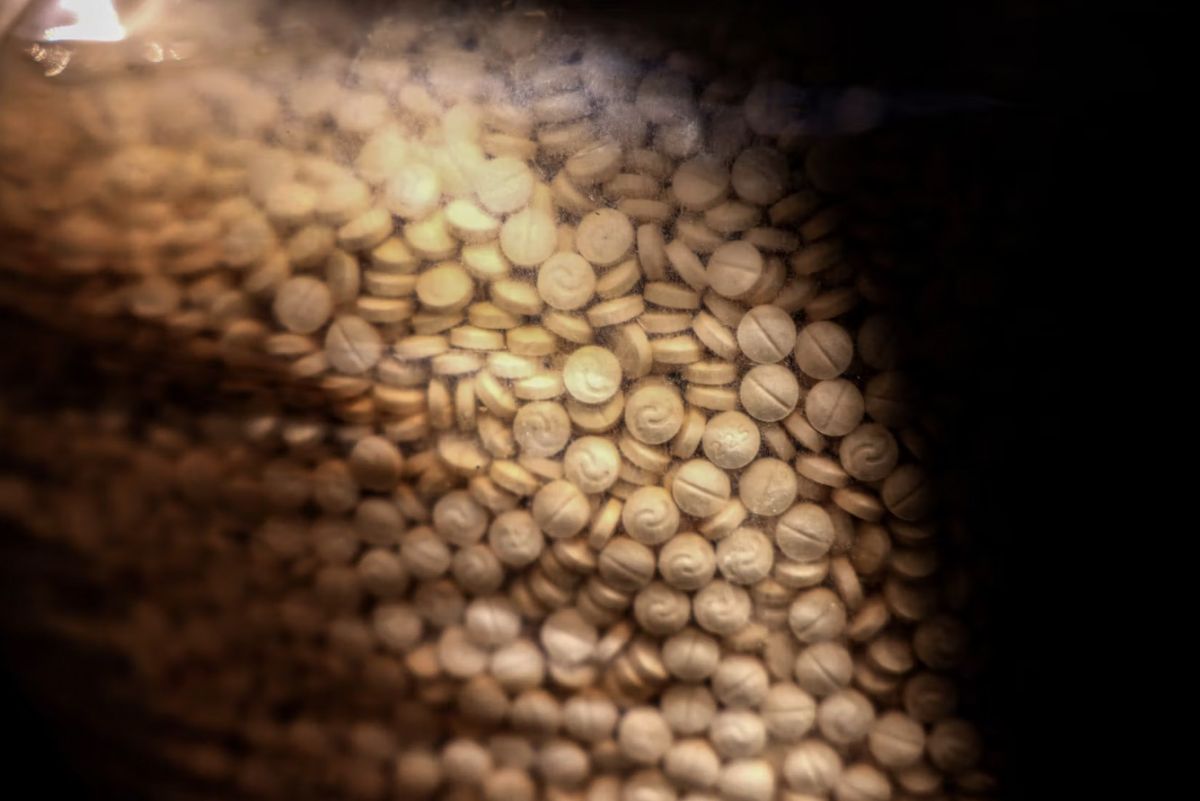
A cache of confiscated Captagon pills, presented at the headquarters of the judicial police in Zahle in the central Bekaa Valley of Lebanon, on July 21, 2022. (Credit: Joseph Eid/AFP)






The rampant production of Captagon in Syria has been severely disrupted by the regime change following the fall of Bashar al-Assad on Dec. 8, 2024, the United Nations Office on Drugs and Crime (UNODC) said Monday.
However, according to the agency, production likely "continues in Syria's neighboring countries."
Captagon, an illegal synthetic amphetamine widely consumed in West Asia, had become a major source of funding under Bashar al-Assad's regime since 2011.
However, since a coalition of rebels led by Ahmad al-Sharaa, former leader of the jihadist group Hay'at Tahrir al-Sham, took power on Dec. 8, 2024, 15 industrial laboratories and 13 smaller storage facilities have been dismantled in Syria.
Before Assad's fall, the daily production of captagon was believed to have reached several million tablets.
Probable continuation of production in the Middle East
According to this report, prepared by the UNODC and the Naif Arab University for Security Sciences (NAUSS), production "likely continues" in the Middle East, notably in Syria's neighboring countries.
Researchers were unable to verify claims that production may have been relocated to other continents, such as Africa.
The report also notes that a dynamic has developed in the region to fight Captagon production and trafficking, notably through information sharing and coordinated actions.
This has enabled very large seizures, as recently seen in Lebanon. In Lebanon, according to the UNODC, 78 million pills were seized between December 2024 and November 2025, a figure that surpasses seizures made over the previous two years.
In September, Lebanese authorities also seized 6.5 million Captagon tablets during a raid that led to the dismantling of a drug trafficking network linking Lebanon to Turkey, Australia and Jordan.
Notorious traffickers, such as Nouh Zeaiter, were also arrested recently as part of these efforts. Since December 2024, at least 177 million tablets (equivalent to 30 tons) of the drug have been intercepted across the Arab world, according to the report.
New strategies and new routes
In 2021, trade relations between Lebanon and several Gulf countries were strained or suspended following the discovery of shipments of produce in which millions of tablets had been hidden.
These seizures nevertheless show that significant stockpiles of Captagon remain in circulation in the region.
The report also highlights that while Gulf countries remain the main destination for this illicit market, traffickers have continued to diversify their strategies since December 2024.
New routes and "re-packaging" points for the pills, often transported hidden in shipments of other goods, have been reported in Western and Central Europe and North Africa, while transport more frequently takes place via land and sea routes, with several border crossings before reaching the Gulf to obscure the trail.
The report also notes "original" methods for crossing land borders, including drones and inflatable balloons.

