


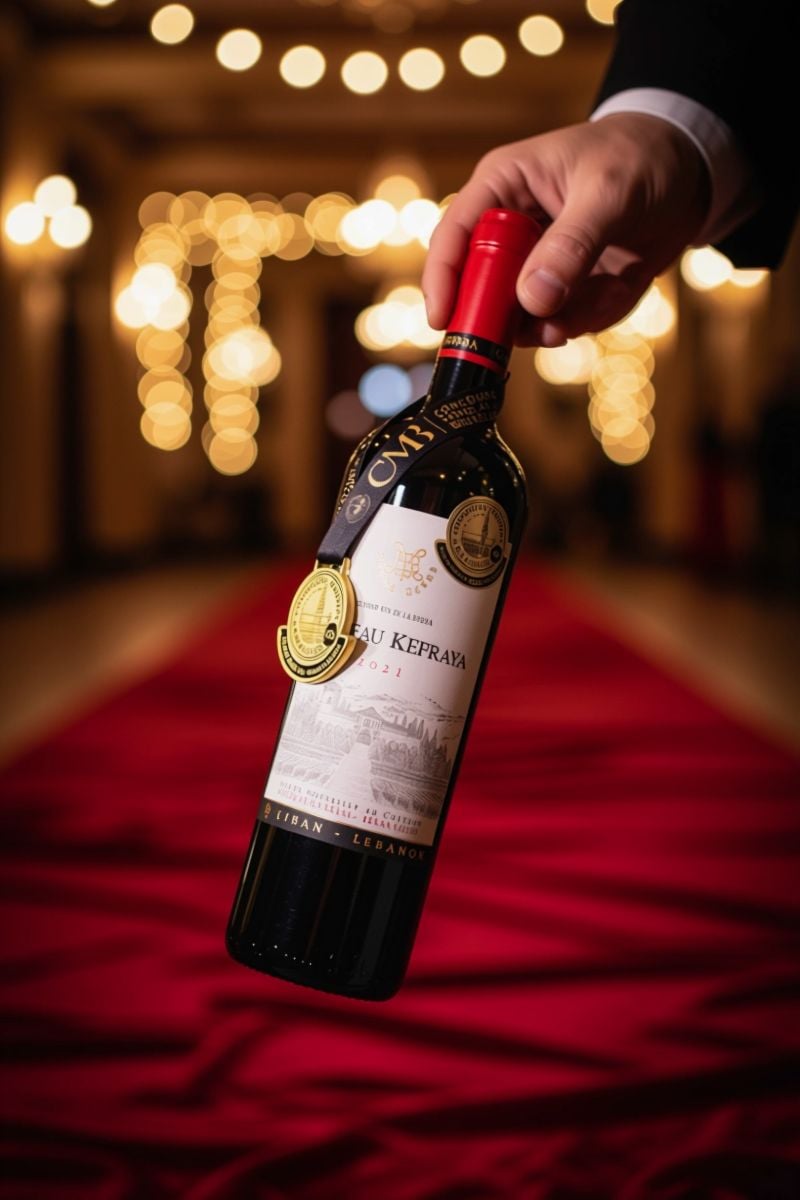
Photo provided by Château Kefraya.
Elegance and refinement are two words that sum up the philosophy of Château Kefraya. Qualities that can only be achieved through mastery, discernment and humility, all of which are essential, in the eyes of its technical director and winemaker, Fabrice Guiberteau.
Château Kefraya was born of the vision of one man, Michel de Bustros, who in the 1950s undertook a titanic project: planting vineyards on the hills of Kefraya in West Bekaa, with the ambition of creating what would become a “great wine.”
In 1979, despite the turmoil of the Civil War, the estate vinified its own grapes for the first time in its own cellar, sealing the château’s identity.
Success came quickly. In the early 1980s, the estate won its first gold medals and began exporting its wines to France. Today, Château Kefraya is distributed in more than 40 countries across five continents and has just been awarded the Grand Gold Medal at the Concours Mondial de Bruxelles, a rare distinction that attests to the quality of the wine and the estate’s expertise.
For the past 20 years, Fabrice Guiberteau has overseen the qualitative direction and refinement of Château Kefraya, now firmly established as one of the leading names in Lebanese wine.
A deep commitment to nature
The vines, trained on trellises, benefit from ideal sun exposure and are never irrigated. “We take a strictly vigneron approach, and 100 percent of our grapes come from the estate we cultivate,” Guiberteau said. The single, contiguous estate is certified organic, and the wines are certified vegan.
“We take a very environmentally conscious approach to energy use and wastewater treatment. We have our own water treatment plant at the winery, using reed-bed filtration, which allows us to return fully purified water to the environment," he added. "In addition, we have a photovoltaic panel system that enables us to reduce our reliance on electric generators. This is all part of our agro-environmental approach.”

Never irrigated for environmental reasons, the vines are naturally exposed to climatic variations, “the price to pay for quality,” Guiberteau said.
A mosaic of terroirs unique in Lebanon
Château Kefraya’s vineyard stretches across more than 300 hectares of hillsides at an altitude of 1,000 meters. Crossed on its western side by the Yammouneh (Baalbeck) tectonic fault — which originates in the Red Sea and extends to the edges of Anatolia. It offers exceptional geological diversity: clay-limestone, clay-marl, sandy and gravelly soils, some dating back to the Jurassic and Cretaceous periods.
Over millennia, the fault caused upheavals that gave rise to four distinct geological formations and 79 intra-parcel micro-terroirs. “It is a unique richness. The reason we work at the terroir level, at the level of detail, is that it is fascinating. It allows us to think, observe and continually gather more data to explain, for example, why a given plot, regardless of the year, will be more generous,” Guiberteau said.
In the heart of the cellar, the art of blending
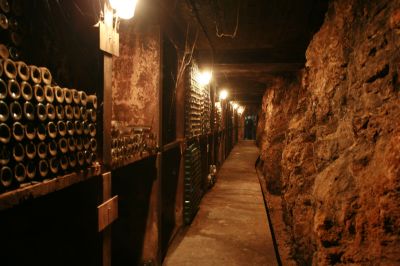
Precision lies at the core of Château Kefraya’s philosophy. Harvesting is entirely manual, berries are sorted using an optical system, and each micro-parcel is vinified separately. The winery, equipped with cutting-edge technology, combines traditional know-how with modern techniques.
Aging takes place in French oak barrels as well as in terracotta amphorae, reviving Phoenician and Roman methods.
The estate’s ampelographic diversity is remarkable. Cabernet Sauvignon, Syrah, Chardonnay and Viognier grow alongside rarer varieties such as Carménère, Marselan and Muscat à Petits Grains.
Château Kefraya also cultivates indigenous grapes like Obeideh, Merwah and Meksesseh, and has even revived ancient Lebanese red varieties, Asswad Karech and Asmi Noir, following extensive research carried out with international institutes.
A millennia-old history
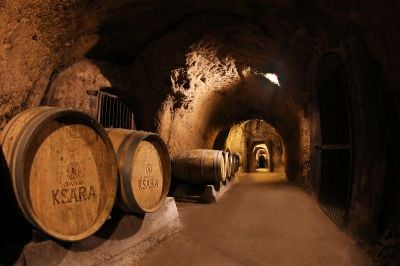
Kefraya’s history is rooted in a site once occupied by the Romans. The château was built on an artificial hill where they had established a camp. The strong presence of vineyards at the time is confirmed by the discovery of 2,000-year-old Roman wine presses. Romans were also buried on adjacent plots, explaining the hypogea still visible today.
“Making wine at Kefraya means reconnecting with 2,000 years of Roman history and nearly 5,000 years of Phoenician history,” Guiberteau said. “It is a heritage that takes on its full meaning when one seeks to present cuvées that are both elegant and refined.”