



Photo provided by Château Musar.
Musar — a name that resonates in Lebanon as strongly as it does abroad. It is a wine intertwined with collective memory, though few know its true story. It embodies both the resilience of the land and the passion of a family. In a country where the vine has endured every challenge, Château Musar has become a symbol of a unique wine identity, forged through patience, courage and loyalty to an exceptional terroir.

A high-altitude terroir shaped by seasons
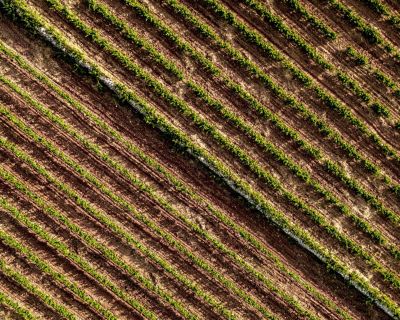
At 34° north latitude — further south than Spain or Italy — the vines of Musar rise nearly 1,000 meters above sea level. This rare combination of abundant sunshine and cool nights allows the grapes to mature slowly, producing balance and complexity. Limestone, stony and gravelly soils recall the finest Mediterranean terroirs: austere in appearance but rich in minerals, nourishing the vine without ever constraining it.
Snowy winters, dry summers and dramatic temperature swings yield concentrated, expressive grapes, marked by an almost alpine purity. In this preserved environment, few treatments are needed: the vine prospers naturally, following the rhythm of the seasons, true to ancestral know-how passed down through generations.
The Hochar signature, a rare balance
The company was founded in 1930 by Gaston Hochar’s grandfather, Gaston Sr. During the French Mandate era, his philosophy focused on high-end production. He led the company until the late 1950s, when his eldest son, Serge, Gaston’s father, took over with his brother Ronald. Serge maintained the original vision — putting quality above all else — while introducing a new standard: fully natural production.
“We let the wine ferment with the wild yeasts naturally present on the grape skin, which does all the work,” Gaston Hochar says. This method endures at Musar to this day. By the late 1970s, Serge had developed the process that would define Château Musar’s style.
“He conducted much research, studied oenology in Bordeaux and, in 1977, finally adopted the process that, to him, would give the wine a specific, unique identity, full of character,” Gaston recalls. It was then that the Musar signature emerged.
This identity rests on a rare balance: wines that follow time rather than trends. They do not seek immediate perfection but the beauty of aging. At Musar, it is often said that the wines continue evolving after bottling, revealing over the years unexpected, almost musical aromatic layers.

During the 1980s and the Civil War, Serge Hochar participated in many international fairs. At tastings and dinners, he discovered that wines produced in the late 1950s were wines for cellaring, with exceptional longevity.
“Our wines from the 1950s and 1960s can still be tasted today, and their characteristics are extraordinary, whether it’s the reds or the whites,” Gaston Hochar says. This remarkable quality gained recognition worldwide during Serge’s tours from the late 1970s until he died in 2014.
“Today, we, the third generation, continue this legacy. I personally joined the company in 1994, my cousin in 1999 and my brother in 2010. We continue to promote Lebanese wine around the world. Between 80 and 85 percent of our production is exported to more than 60 countries. What sets us apart is our unique ability to express the passage of time: the changing taste of the wine, which, when opened, different flavor layers are revealed over the hours. Few wines offer such a range of aromas, where every minute brings a new discovery. It’s all these elements that have impressed professionals the world over,” he continues.
Musar wine reflects a conversation between earth, climate and the hand of man. It captures, in a single glass, both the warmth of the Levant and the freshness of the mountains, the wisdom of the past and the energy of the present.
Château Musar does not simply make wine: it preserves a memory. A memory rooted in stone and light, in the breath of the mountains and the patience of men. A wine that speaks to everyone — deeply, sincerely — as a dialogue between the land and time.
This article was also published in French in L'Orient-Le Jour.