






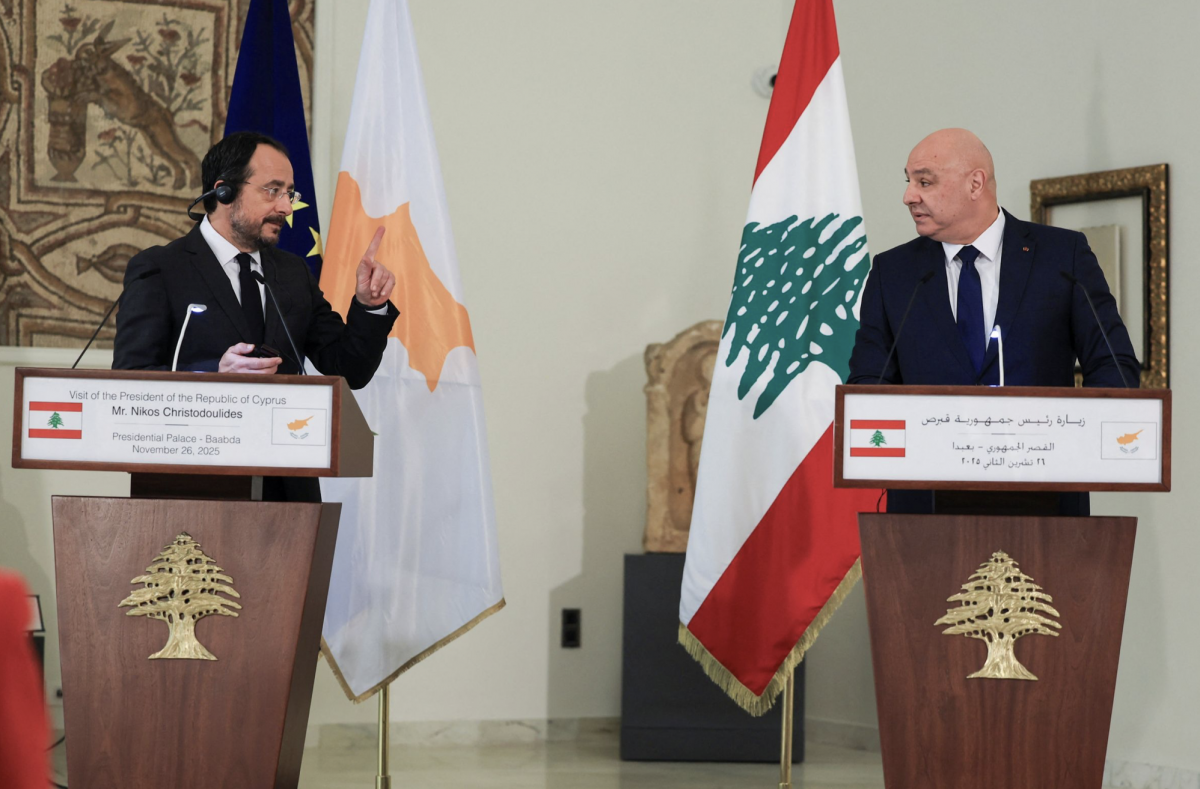
Cypriot President Nikos Christodoulides and Lebanese President Joseph Aoun attend a press conference after the signing of the maritime delimitation agreement at the Baabda presidential palace on Nov. 26, 2025. (Credit: Anwar Amro/AFP)






A ministerial source had told L'Orient-Le Jour at the end of November that before its adoption in the Council of Ministers on October 24, the agreement was indeed submitted to the Legislation and Consultations Department of the Justice Ministry for review. The latter “confirmed the legality of its adoption by the executive without necessarily going through Parliament.” This legal point was then corroborated to our editorial staff by a judicial source.
Two Lebanese Forces (LF) MPs, Pierre Bou Assi and Georges Okais, criticized the government on Saturday over the agreement signed with Cyprus at the end of November on the maritime border, which was not submitted to Parliament beforehand — an omission they say violates Article 52 of the Constitution. They are following in the footsteps of other MPs, including those from the Amal Movement, such as Ali Hassan Khalil (on Thursday), and opposition lawmaker Melhem Khalaf (on Wednesday), who raised comparable questions to the government. Khalaf’s inquiry was signed by 24 MPs.
The LF lawmakers objected to what they described as “a violation of the provisions of paragraph [h] of the preamble and Article 52 of the Constitution, by concluding the maritime delimitation agreement without prior parliamentary authorization, and contrary to the opinion of the Foreign Affairs Ministry and the Legislation and Consultations Department of the Justice Ministry.” They added that “through this act, the government infringed on Parliament’s prerogative to exercise legislative oversight over government action,” according to a statement released by the LF press office. Similar criticism had already been voiced by Georges Okais following the signing of the agreement.
In November, Lebanon and Cyprus signed a long-awaited agreement on delimiting the maritime border between their respective exclusive economic zones, ending nearly two decades of deadlock and opening the door to foreign investment in offshore energy exploration. While some hail the agreement as a diplomatic success, others argue that Lebanon could have secured a larger maritime area, as Beirut adopted the “median line theory” as the basis for delimitation. Although this approach was deemed fair by the government-appointed commission, it was criticized by several parties, including the Amal–Hezbollah alliance, which pointed to Lebanon’s limited maritime frontage compared with that of an island state such as Cyprus. According to these critics, Lebanon could have claimed between 2,600 and 5,000 additional square kilometers.
Aoun defends constitutionality of the agreement
President Joseph Aoun responded to the criticism on Friday during a meeting with a delegation of journalists. “In 2011, the Mikati government set the delimitation rules, and we merely confirmed those rules. We consulted the Legislation and Consultations Department to determine whether this treaty needed to be submitted to Parliament, and the answer was no,” the president said, according to remarks reported by the al-Markaziya news agency.
A ministerial source told L’Orient-Le Jour at the end of November that prior to its approval by the Council of Ministers on Oct. 24, the agreement was submitted to the Legislation and Consultations Department of the Justice Ministry for review. The department “confirmed the legality of its adoption by the executive without the need for parliamentary approval,” a legal assessment later corroborated by a judicial source.
In October 2022, Lebanon and Israel finalized — under U.S. mediation — an agreement delimiting their maritime border, ending a long-standing dispute over gas-rich areas in the eastern Mediterranean. That agreement was also not submitted to Parliament.
