





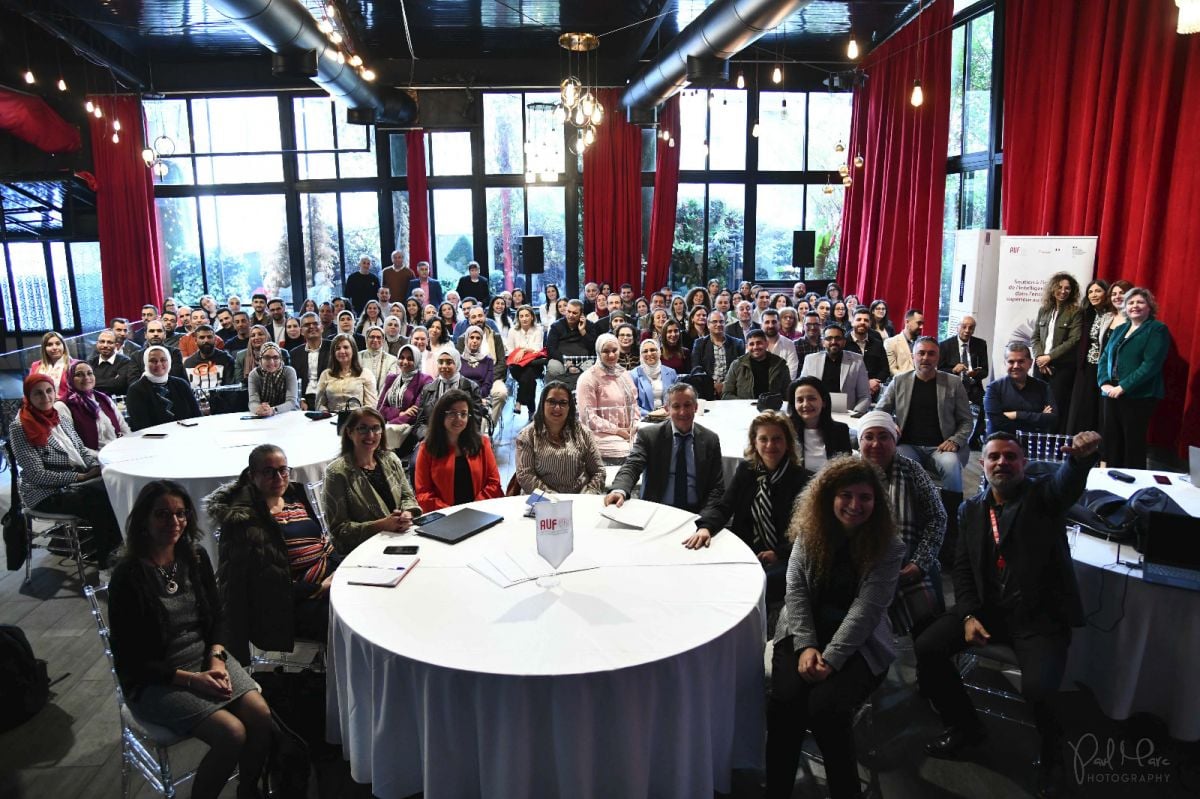
In the coming months, the participants will work to implement, within universities, a comprehensive training program on the pedagogical uses of artificial intelligence. (Credit: AUF)






One hundred forty professors from Lebanon, Egypt and Palestine gathered in Beirut from Dec. 1 to 5 for an intensive program on the pedagogical, institutional and ethical integration of artificial intelligence in non-specialized university faculties.
The sessions were organized by the Agence universitaire de la Francophonie (AUF) as part of an ambitious project funded by the French Ministry for Europe and Foreign Affairs and aimed at developing ethical, useful and learner-centered AI practices. The project, titled “Support for the Integration of Artificial Intelligence in Higher Education in the Middle East,” was officially launched Sept. 11, when AUF held the steering committee’s first online meeting.
Throughout the week, participants focused on the use of AI in teaching and research, new pedagogical approaches, the creation of Learning Labs and the development of AI projects within their institutions. Training sessions, interactive workshops and daily exchanges marked the program. It closed with certificate presentations and what organizers described as a sense of shared accomplishment.
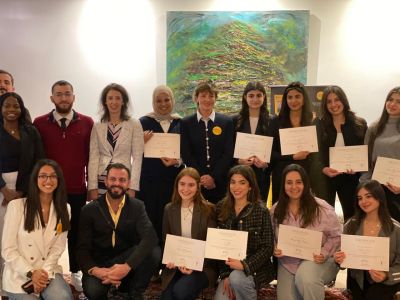
Jean-Noël Baléo, AUF’s regional director for the Middle East, said the initiative aims to strengthen the capacities of 13 beneficiary universities across Lebanon, Egypt and Palestine. “The goal is to support them in the pedagogical use of AI tools and in updating curricula for professions that will be heavily transformed in the coming years, whether that’s ChatGPT or field-specific tools,” he said.
Baléo said AUF launched the program in response to high demand from universities and faculty, while regional disparities persist. “In the Middle East, some universities, notably in Saudi Arabia and the United Arab Emirates, are very advanced, while the situation is more mixed elsewhere,” he said. “Egypt has a national AI policy; in Lebanon, it is still developing. We also see major differences among institutions: some professors lag behind their students and behind trends already widely established in the West.”
Strengthening capacity and creating a mass effect
After weeks of online training, the Beirut session helped build group cohesion. “These trainers will return to their universities to train about 3,000 professors,” Baléo said. “The goal is to produce a mass effect in the 13 universities, including six in Lebanon. The project will run through 2026 with an intensive training cycle for about 120 teachers.”
The beneficiary universities in Lebanon are the Lebanese University, the National Conservatory of Arts and Crafts (CNAM Lebanon), Antonine University, Notre-Dame University of Louaize, Al-Kafaat University and Université La Sagesse. In Egypt, they include the French University in Egypt, Alexandria University and El-Alamein University. In Palestine: An-Najah National University, Birzeit University, Hebron University and Nablus University.

Beyond technical knowledge, the project places ethics and pedagogy at the center of its training. “The challenges are many,” Baléo said. “In two of the countries involved, pedagogical continuity is weakened by school closures — in Palestine and at times in some areas of Lebanon. AI can support continuity and personalized learning, but only if it is well designed, mastered and adapted.”
He said the rise of AI also requires a rethinking of assessment. “Students are already using these technologies widely and often more quickly than their professors. We can neither ignore nor ban these tools. We must rethink teaching and assessment to provide real added value,” he said. “When a student can generate a multi-page assignment with a conversational agent, the need to rethink our approaches becomes essential.”
Training sessions throughout the week focused on new practices, emerging uses and ethical responsibility. In the coming months, participants will complete their educational projects, make Learning Labs fully operational and expand training on pedagogical uses of artificial intelligence. They will also develop shared resources to support universities through a sweeping digital transition.

 Evening recap: Netanyahu announces West Bank offensive; 7 killed in Jordan church shooting; tents burned in south Lebanon
 US strike on Iran this weekend? ‘Absolutely,’ says Barrack; ‘I have no idea,’ says Trump