



Lebanese soldiers on a base in the Sour district on July 8, 2025. (Credit: Matthieu Karam/L’Orient Today)






For the first time since the cease-fire between Hezbollah and Israel came into effect just over a year ago, the Lebanese Army on Friday released figures from its “Shield of the Nation” operation, aimed at restoring the monopoly on arms to official authorities.
As part of the truce agreement reached on Nov. 26, 2024, and implemented hours later, Hezbollah is required to be fully disarmed in Lebanon. In practice, while Hezbollah has agreed to hand over its arsenal to the Lebanese army south of the Litani — an area along the Israeli border where the army is also to be deployed — it refuses to do so nationwide.
The Lebanese authorities, for their part, have pledged to regain the sole right to arms, meaning the arsenal of all remaining armed militias.

10,000 Lebanese soldiers deployed south of the Litani
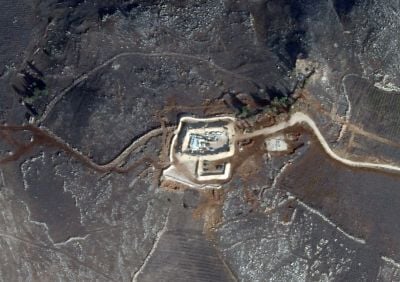
In this context, Nicolas Tabet, commander of the Lebanese Army's South Litani sector, announced Friday that since the launch of “Shield of the Nation” — a name previously undisclosed, intended to allow authorities to assert monopoly over arms — “177 tunnels have been neutralized, 11 Litani crossings closed, and 566 rocket launchers seized” in the border strip.
The army also reported having carried out “300,011 military missions south of the Litani.” "Our forces are deployed in 200 positions along the border, with 20 checkpoints installed," he added.
This information was shared during a media tour of the operations area south of the Litani River. While this is the first set of official figures released by the military, the United Nations Interim Force in Lebanon (UNIFIL), which coordinates its actions with the army, has previously given indications about the disarmament process, and political sources have cited a disarmament rate of around 80 percent in the region.
Tabet added that 10,000 soldiers are present in the area despite difficulties, and that 20 army positions have been destroyed in Israeli attacks. “The mission of the Lebanese Army is to respect international resolutions and guarantee security and stability in the south of the country,” he emphasized. He also stressed the full cooperation of the local population, who support and facilitate the army’s work.
Tabet also revealed that the operations carried out by the Lebanese Army in southern Lebanon have led to the seizure of about 230,000 pieces of arsenal, including munitions, tunnels, launching platforms, missiles and various weapons, according to the state-run National News Agency (NNA). He further said that the security plan south of the Litani River has been more than 80 percent executed, without major obstacles or objections from residents.
He noted that most of the houses targeted in the region by recent Israeli strikes were civilian homes, and said the army had asked the coordination mechanism committee to inspect these houses, but the Israeli army refused, insisting on bombing them.
The military official recalled that the army’s plan “does not include searching homes, except in cases of flagrante delicto.” He added that no extension is planned to complete the current phase of the mission.
More than 600 UN peacekeepers have already left Lebanon
The Lebanese Army also reported that “Israel has provided no proof of a Hezbollah arms smuggling mechanism.” It added that UNIFIL, whose mandate was last extended in August for a year before its gradual withdrawal from southern Lebanon, has already removed some equipment and ships from its area of operations, and that 640 peacekeepers have left Lebanon so far.
President Joseph Aoun announced on Nov. 21, on the eve of Independence Day, the army’s commitment to ensuring that only Lebanese armed forces will control the region south of the Litani and exercise authority there independently.
In a lengthy speech in which he outlined a five-point plan including “definitive” negotiations about the border with Israel, he also confirmed that “the Lebanese Army is ready to recover the occupied posts on our southern border, and that the Lebanese state is ready to immediately submit to the cease-fire supervision mechanism a precise timetable for this recovery.” President Aoun also said he was ready to engage the country “fully and effectively in the peace process” (with Israel).
The president’s remarks came as Lebanon and its authorities face increased Israeli-American pressure to disarm Hezbollah. Israeli Defense Minister Israel Katz earlier this week threatened further escalation if the militia was not fully disarmed by the end of the year, while the Lebanese Army’s plan sets the same deadline for disarmament south of the Litani.
 2 p.m. recap: Iran says, 'No military solution' to conflict; 2 Israeli soldiers wounded in south Lebanon; Houthis claim attack on Aramco