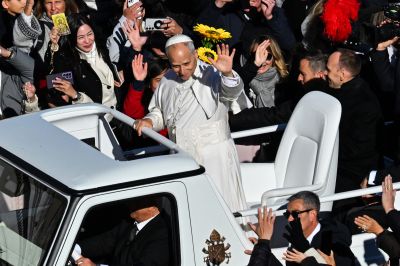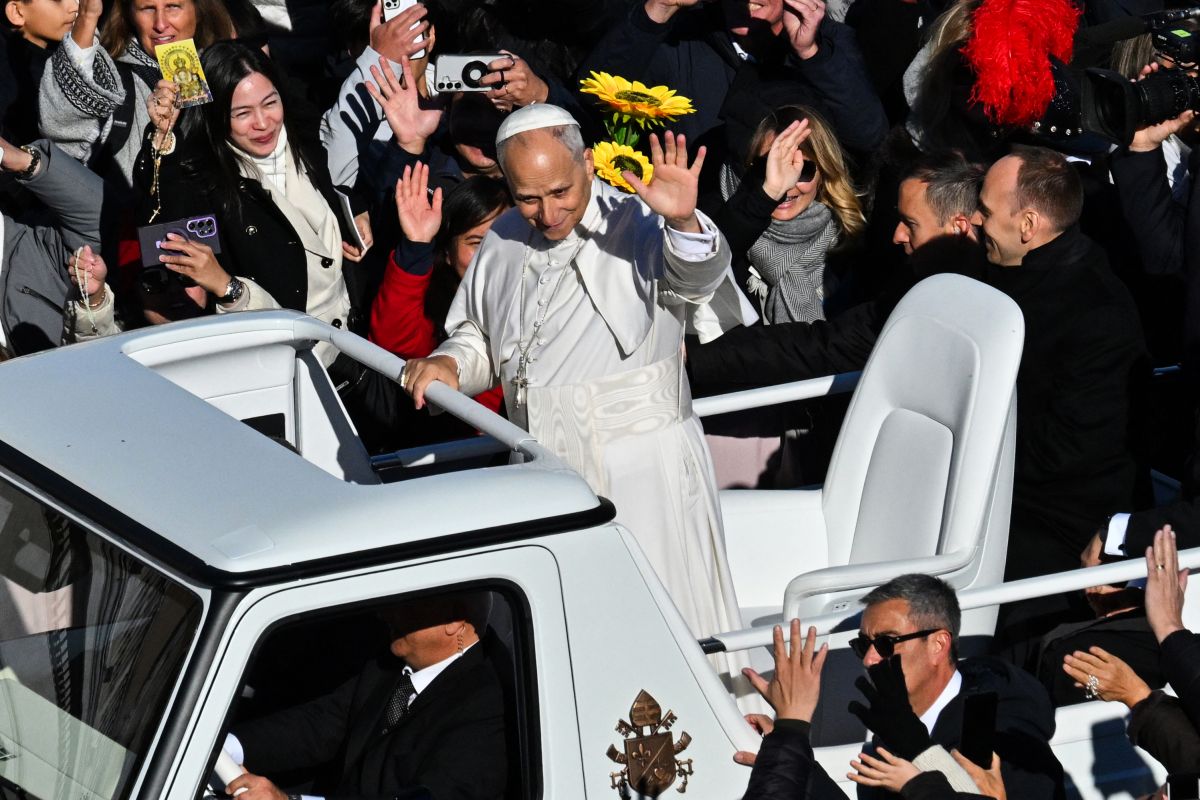
Pope Leo XIV greets the crowd from his popemobile as he leaves St. Peter's Square, at the Vatican, following the Mass for the Jubilee of Choirs and Choral Societies, on Nov. 23, 2025. (Credit: Andreas Solaro/AFP)






BEIRUT — The schedule for Pope Leo XIV's Lebanon visit has been public for several weeks now, but the details about the security measures planned for his three-day stay were just released on Tuesday.
The Vatican press office told L'Orient-Le Jour that the security measures for the pope's stay from Nov. 30 to Dec. 2, are provided by "local authorities."
In practice, the security arrangements are divided into two: the Vatican is responsible for close protection, including bodyguards and physical safety, while Lebanese security forces ensure safety along the route, at the visited sites, and around the places where the pope is residing or traveling, according to a source familiar with the preparations.
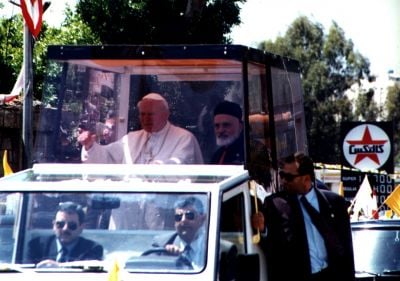
At a late October press conference by the Catholic Information Center, it was announced that Dec. 1 and Dec. 2 would be public holidays, and that the pope would travel exclusively by car throughout his journey.
"These public holidays certainly allow those who want to attend to do so, but they are also for security reasons: when the country is closed, it is easier to manage the roads," explains Ziyad Baroud, former interior minister.
Moreover, at a press conference by the organizing committee on Tuesday, the chief of staff of the Republican Guard, General Maroun Ibrahim, invited the public to arrive early for the grand mass on Dec. 2 so as to avoid the crowds. He directed attendees not to carry any flammable materials and not to display any flags other than those of Lebanon and the Vatican.
"It is also forbidden to use drones in the area," he added.
Mandatory roadblocks
As with official state visits, since the pope is the guest of President Joseph Aoun, it is the Republican Guard, affiliated with the presidential palace, that supervises the operations. Some personnel will accompany the pope along his route, while others will be tasked with controlling the program sites.
"All security departments in Lebanon will be mobilized and will work closely together," a source from the presidential palace said, without specifying the number of personnel planned for the army, Internal Security Forces (ISF), General Security (GS), State Security, and army intelligence services.
"The roads are primarily protected by the army and the ISF," Baroud notes, assuming the establishment of an "operations room made up of representatives from each of the state's security agencies" to facilitate coordination. "Roadblocks are mandatory, especially along the pope's entire route," the source at the presidential palace adds.
The Israeli risk
Such a visit requires "a robust apparatus before and after," according to Baroud, with security preparations starting two months in advance and on the ground several days before the event, but there is no such thing as zero risk. "For papal visits, the aim is nonetheless to approach a virtually zero, calculated risk," he says, thanks to a safe itinerary.
However, "even if protocol can address the risks of terrorism, attacks, or assassination attempts," one risk remains beyond the control of Lebanese law enforcement: "an external Israeli action," notes the former minister, as the country remains subject to Israeli violations of last November's truce agreement.
According to him, "the very fact that the pope decides to visit Lebanon sends a security message: 'I'm coming anyway.'"
On Monday, the day after an Israeli airstrike on the southern suburbs, the president's adviser for Holy See affairs, Naji Kozeily, told Al-Nashra that the pontiff's visit "is confirmed and that no major obstacle, even an unforeseen one regardless of its origin, can prevent it."
Emergency numbers
- Central operations room, located at the Republican Guard headquarters at the Baabda Presidential Palace (phone: 05/900713)
- Waterfront operations room (phone: 01/983053 – 01/983054)
- Transport plan operations room, at the headquarters of the Republican Guard regiment in Beirut’s Quarantine district (phone: 01/567330)
- Internal Security Forces operations room (phone: 112)
- Lebanese Red Cross (phone: 140)
- Civil Defense (phone: 125)
This article originally appeared in French on L'Orient-Le Jour.