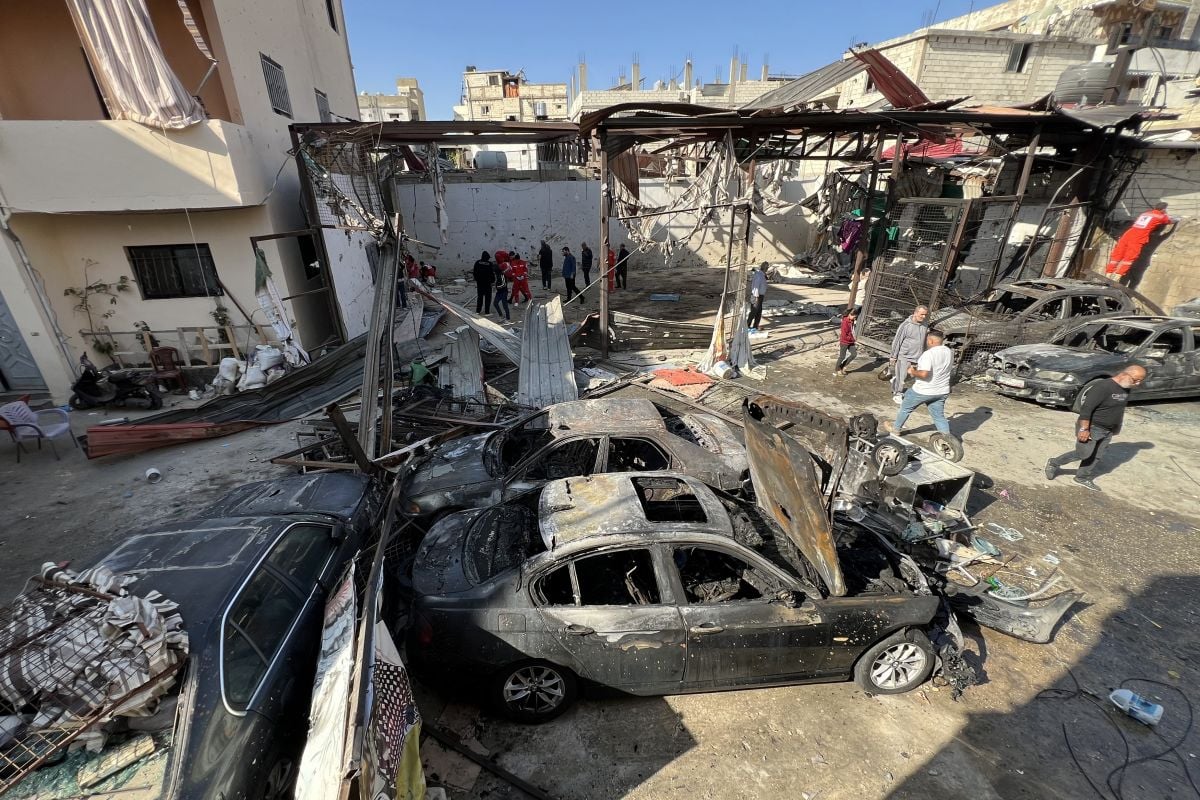
Residents inspect the damage following an Israeli strike on the Ain al-Hilweh Palestinian refugee camp, near Saida in southern Lebanon, on Nov. 19, 2025. (Credit: Mahmoud Zayyat/AFP)






SAIDA — The streets of Ain al-Hilweh camp were empty on Wednesday morning, as the largest Palestinian refugee camp in Lebanon, along with the neighboring southern city of Saida, struggled to recover from the shock of Israeli strikes that killed 13 youths playing football on a field near a mosque the previous evening.
In the camp, shopfronts were shuttered, schools were closed and streets were deserted, our field correspondent reported. Palestinian factions, from Hamas to Fatah, had called a general strike following Tuesday night’s bombing, carried out with at least three missiles, to honor the victims and condemn the Israeli attack.
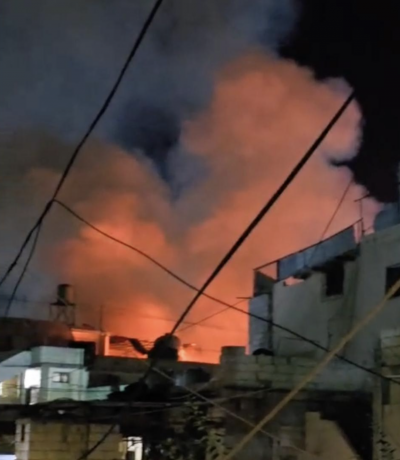
It remains unclear whether the strikes were conducted by fighter jets or drones. The powerful blasts left damaged car wrecks littering the streets around Khaled bin al-Walid Mosque, where the Israeli army accused Hamas of setting up a "training camp" and recruiting youths to carry out attacks against Israel, according to statements posted Tuesday night and Wednesday by Arabic-language spokesperson Avichay Adraee.
The Palestinian movement called these claims "pretexts," insisting on Tuesday night that it had no military installations in Palestinian camps in Lebanon.

'None of the bodies was whole'
Several people on site in Saida confirmed this account to our field reporter, including Fadi Salameh, director of Hamshari Hospital in Saida, which received the bodies of the young victims and the wounded.
"Most of the injured are youths," he said, while a rescuer living in Ain al-Hilweh and working at the hospital emphasized that the 14 victims were "young boys" who were "playing football" at the moment of the strike.
One resident, who requested anonymity, said the Israeli air force "did not hit military targets. All that is in the area are social centers linked to Hamas, the mosque, a clinic and the football field in the middle of the complex."
Another man mentioned the presence, near the targeted site, of a "Hamas center," without elaboration.

"But they killed kids, they killed children," the man lamented.
The Health Ministry's tally officially puts the death toll at 14, as the identification of the remains is still underway. "None of the bodies was whole," said Rida Kanso, head of emergency services at Labib Hospital in Saida.

Among the young victims identified was Amjad Khashan, 16. One of his relatives, Omar Hijazi, told us he saw him "an hour" before his death. "We were very close," he said. "We were laughing, playing cards. Then he told me he had a religion class at the Khaled bin al-Walid Mosque. After that, he went to play football with his friends. He never came back."
A nurse from Hamshari Hospital, speaking from home, lost his 17-year-old son, Ibrahim, whose face was “unrecognizable” and had to be identified by his clothes. The family had left the camp less than a year ago, but Ibrahim still attended one of its schools and spent time with friends there. His mother, Hiba, said of the moment of the strike: “My body trembled. I felt Ibrahim was gone. He was smart, ambitious…”
The victims' funerals will be held on Thursday, Nov. 20, families confirmed.
'There was no sign a plane was approaching'
During the bombing, Abu Mahmoud, who lives about 50 meters from the place targeted by Israeli aircraft, told our correspondent that he was "drinking tea when the house suddenly shook violently."
He said he "fell to the ground," while his 7-year-old daughter screamed in terror: "Dad, it's a bombing!"
On duty at the time, a guard at an office belonging to a Palestinian organization said that "there was no sign a plane was approaching" and "suddenly, a loud explosion thundered, then another, and a third, the most violent."
Within seconds, he "understood that Israeli aircraft were bombing the camp."
Mahmoud, a father of several children with whom he was playing at the time of the strike, "ran to protect them" as soon as the first strike hit.
"At the moment, I tried to open the door to escape, but fear paralyzed me. The third completely ripped off the door: the house was devastated, filled with smoke."
To protest this "massacre" denounced by Palestinian factions, dozens of residents of the Shatila Palestinian refugee camp in southern Beirut organized a spontaneous demonstration in the camp's streets.
A sit-in is also planned for 3 p.m. in Ain al-Hilweh to "affirm resistance and resilience against the Israeli enemy."
A meeting gathering several political, municipal and religious figures was held in Saida in the morning, at the invitation of the city's mufti, Salim Soussan, in the presence of MPs Oussama Saad (Popular Nasserist Organization) and Abdel Rahman Bizri (independent), as well as former minister Bahia Hariri, an al-Jamaa al-Islamiya official and Saida municipality president Mustafa Hijazi. They condemned the "massacre" in Ain al-Hilweh and called for unity among Lebanese and Palestinians.
Hezbollah's response
Hezbollah condemned the Israeli attack on the Ain al-Hilweh camp, noting that "this bloody crime and heinous aggression is an attack on Lebanon and its sovereignty," and a blatant violation of the November 2024 cease-fire agreement.
"The leaders of the Lebanese state must realize that showing any leniency, weakness or submission to this enemy only makes it more brutal, savage and audacious, and that merely reactive measures that do not match the scale of the aggression will only lead to further attacks and massacres," Hezbollah added.

The party affirmed that “national duty requires taking a firm and unified stance in confronting the crimes of this enemy and deterring its aggression by all possible means, and maintaining all elements of strength that Lebanon possesses as the sole guarantee for thwarting the enemy’s projects and protecting Lebanon’s sovereignty and security.”
Finally, Hezbollah extended its "deepest condolences to the families of the martyrs, to the residents of the Ain al-Hilweh camp, and to the Palestinian people, praying for mercy on the martyrs and a speedy recovery for the wounded.”
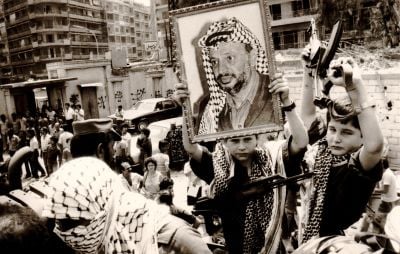
Ain al-Hilweh camp was previously hit by an Israeli bombing on Sept. 30, 2024, during an expanded Israeli offensive in Lebanon, which targeted the home of Mounir Maqdah, leader of Fatah's armed wing, killing his son Hassan and several others. Another strike had targeted the camp's entrance and killed a Hamas security official a few months earlier, on Aug. 9, 2024.
Reporting contributed by Mountasser Abdalla and Lyanna Alameddine