



The Lebanese designer Tarek Atrissi. (Credit: Photo courtesy of the artist)






On Nov. 1, Egypt inaugurated its Grand Egyptian Museum with great fanfare after nearly twenty years of construction.
"I was very proud that day, but not as much as when I learned that my studio had been commissioned to create the museum's logo and visual identity," says Tarek Atrissi from Barcelona, where he has been based for the past decade.
"I was very proud to have been selected because it was not a stroke of luck. It is the result of twenty years of experience in cultural and institutional design," he says, sporting a burgundy cap. The Atrissi Design studio worked for several months on the branding of the museum, in collaboration with architects, exhibit designers, the Egyptian government and the Japanese teams who funded the project, and proposed six entirely different identities.
A subtle and symbolic visual identity
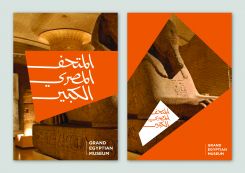
The chosen logo — unanimously — was inspired by the building’s fifth façade, the one visible from above. It intentionally avoids visual clichés of ancient Egypt: hieroglyphs, cartouches, pyramids, the Eye of Horus, Tutankhamun, scarabs, and lotus flowers.
"The museum is already filled with those elements. We had to create a contemporary, international image that reflects the architecture and vision of the place." The Arabic typography breaks free from classical calligraphy rules to create a unique graphic personality. "The exaggerated final letters of the three Arabic words open onto the future, while evoking the three pyramids visible from inside the museum."

But the logo’s public unveiling in 2017, before the official opening, provoked numerous reactions. "It became the biggest controversy of my career. Some criticized the choice of a non-Egyptian designer. Others thought the logo was too simple." But Atrissi welcomes such debates, which show that design is moving beyond professional circles: "That’s how you raise public taste and understanding," says the designer, who works to foster critical design culture in the Arab world. "I was very proud, but at the same time, it was a responsibility with a lot of pressure, since I knew such a project would receive many reactions, positive and negative, because it touches on Egypt’s national identity."
If Atrissi could not attend the museum’s inauguration in Cairo, it is because he was busy elsewhere: in the Netherlands, where his studio designed the exhibition "From Bauhaus to Mecca," opened this weekend at the Design Museum Den Bosch.
This project, which explores ties between European modernism and Islamic aesthetics, perfectly illustrates the studio’s approach: creating visual bridges between cultures, languages, and narratives. "That’s what drives us: telling visual stories that resonate in several worlds at once."
Beirut, Utrecht, New York, Barcelona
Born in Beirut in 1978, Atrissi grew up during the Lebanese civil war. After attending Carmel Saint-Joseph, he studied at the American University of Beirut (AUB). "AUB was foundational in my journey. It was the first graphic design program in the Arab world, and it taught us to value our own visual culture, to document urban typography, to create a contemporary Arab aesthetic."
Last year, he returned there to teach for a semester, amid the war between Israel and Lebanon. "It was a powerful experience. I found Beirut in an atmosphere reminiscent of my childhood, with sirens, tension. But passing on what I learned, where it all began, had immense value."
After AUB, already overwhelmed with projects for MEA and the Massaya vineyard, he continued his studies in the Netherlands, in Utrecht, then in New York. "I wanted to understand the design culture in Europe, different from that in the United States. In the Netherlands, everything is thought out, everything is well designed."
Upon arriving in 2000, he founded his studio, which became a reference in Arab design. "I always wanted to remain a niche studio, with never more than five people on the team. That allows us to maintain a high level of quality while staying agile."
Landmark projects in the Arab world
In addition to the Grand Egyptian Museum, Atrissi has worked on major projects: Qatar’s national visual identity, its Post, the Riyadh metro in Saudi Arabia, and typefaces for Apple. "These are complex projects, often on a national scale, requiring a nuanced understanding of local cultures and an ability to engage with institutions."

In Lebanon, he recently redesigned the logo for Gandour, an iconic confectionery brand. "That was very personal. The original logo was on a rooftop I used to see from my childhood home’s garden. Modernizing it without betraying its spirit was an emotional challenge."
While the designer does not plan to move back to his homeland, he still enjoys working there: "I have no plans to return, but each visit inspires me. I rediscover aspects of the country I didn’t know."
Al-Ula, a new challenge
His next big project takes him once again to Saudi Arabia. He has been tasked with creating the visual identity for the al-Ula contemporary art museum, designed by Lebanese architect Lina Ghotmeh. "It’s a very different museum, in a unique environment. The design will have to reflect that uniqueness."
Between Barcelona, the Netherlands and Colombia where he spends winters, and his regular travels throughout the Arab world, Atrissi embodies a vision of design as a bridge between cultures. "Being outside the Arab world gives me critical distance. It helps me understand better, and create better."