


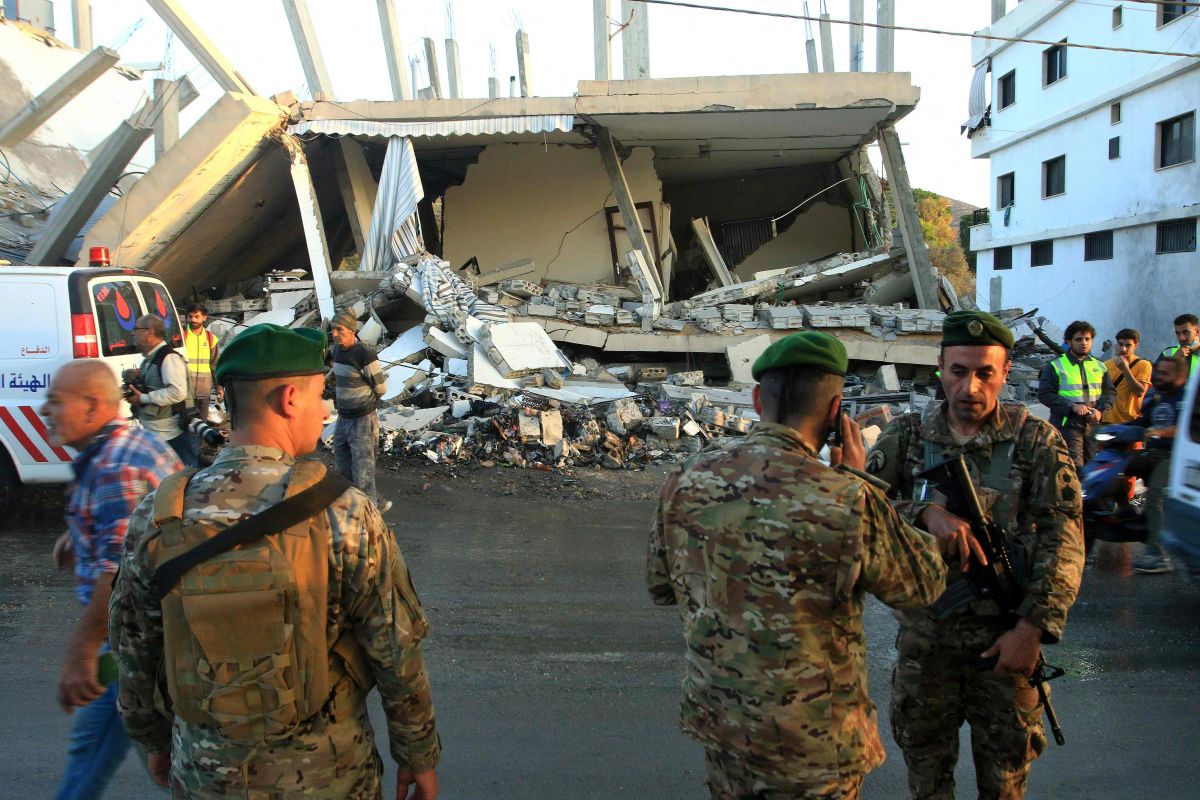
Lebanese soldiers secure the site of an Israeli airstrike that targeted a building in the village of Deir Kifa, southern Lebanon, on Nov. 19, 2025. (Credit: Mahmoud Zayyat/AFP)






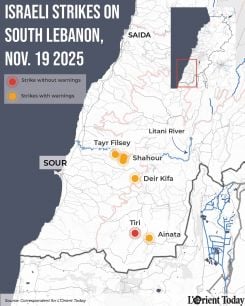
On Wednesday around 2 p.m., the Israeli army began issuing a series of warnings to residents of southern Lebanon.
The first calls targeted people in Deir Kifa and Shahour, Sour district, urging citizens to evacuate before airstrikes were carried out.
Shortly after, similar warnings were sent to residents of Tayr Filsey (neighboring Shahour, same district) and Ainata (Bint Jbeil district). In each case, the Israeli army’s Arabic-speaking spokesperson, Avichay Adraee, said the strikes targeted “Hezbollah military infrastructure.”
After the strikes, the Israeli army claimed it had “destroyed several weapons warehouses belonging to Hezbollah’s missile unit,” asserting that it “took the necessary measures to avoid harming civilians.” “These warehouses were located in the heart of civilian areas, which is another example of Hezbollah using the population as a human shield,” said the spokesperson on X, adding that “the presence of weapons warehouses violates the agreements between Israel and Lebanon.”
These strikes came a few hours after a dawn Israeli strike in Tiri, Bint Jbeil district, which killed a municipal worker, described by Israel as a Hezbollah member, while he was in his car. The attack also injured eleven people, including students on a bus, according to local correspondent and the Health Ministry.
'My hands are tied'
In Shahour, after the army’s warning, a resident told our correspondent that “the threats are generally serious.” “We have children; we need to move to a safer place, and we will return when it’s over. I pray to God that no one is harmed if the enemy carries out its threat,” he said.
Aya Zein, a student at the American University of Beirut (AUB) from Shahour, told L’Orient-Le Jour: “My hands are tied.” Her parents, younger brother, and their dog were at home when the warnings arrived. “They are a few streets from the targeted building, but you can’t imagine what I’m going through. They cannot leave, and I cannot join them.”
In Deir Kifa and Shahour, students were evacuated from schools during their last class, and families near the threatened sites had to leave their homes. The U.N. Interim Force in Lebanon (UNIFIL) sounded its alert sirens, instructing peacekeepers to remain in protected areas.
A little over an hour after the first warnings, strikes were carried out in Shahour and Deir Kifa, which the Israeli army said targeted “Hezbollah terrorist infrastructure.”
Soon after, a second warning was sent to residents of Tayr Filsey and Ainata before further strikes. According to our correspondent, in Tayr Filsey the three-story house of former municipal council president Hussein Shalhoub was completely destroyed, and several nearby homes were damaged.
Such evacuation warnings were frequent during the Hezbollah-Israel war (October 2023–November 2024) but have become rare since the cease-fire.
The last warning before this occurred on Nov. 6, 2025, when the Israeli army issued at least five warnings to residents of Kfar Dounin (Bint Jbeil), Aita al-Jabal (Bint Jbeil), Tayr Debba (Sour), Taybeh (Marjayoun), and Zaoutar al-Sharqieh (Nabatieh) before striking these locations. Since the truce, the Israeli army has continued striking southern Lebanon almost daily, often without prior warning.
Anonymous calls
In Sour, a building on Abou Dib Square and an adjacent building were evacuated as a precaution after phone calls instructed residents to leave, according to our correspondent. Security forces are checking the authenticity of the calls. The municipality of Majdel Zoun (Sour) also warned residents to be cautious after receiving anonymous calls claiming to be from the Israeli army.
“Calls from a foreign number were received by the wife of Khalil Hamid Salman [Abou Mahdi]. A man claiming to be from the Israeli army demanded immediate evacuation of the house,” the municipality said. It is monitoring the situation with authorities and urges residents to avoid the area until the threat is confirmed.
Residents of the Sabra refugee camp and the Tarik Jdideh neighborhood in Beirut also received such calls, some from the Nigerian code +234.
One killed, 11 injured in Tiri
Around 7 a.m., an Israeli army drone targeted the car of Bilal Mohammad Sheaito in Tiri, Bint Jbeil district, with two missiles, according to our correspondent. A bus carrying students passing nearby was heavily damaged, and several young people were injured.
The Tiri municipality announced that its treasurer, Sheaito, was killed in the Israeli strike on a vehicle in the town, condemning the attack as “evidence of Israel’s hostility toward public services ensuring citizens’ essential needs in our war-affected villages.”
The Israeli army, meanwhile, claimed to have killed a Hezbollah member, stating that “the targeted militant was involved in Hezbollah’s restoration efforts in the region, in violation of agreements between Israel and Lebanon.”
The Tiri municipality also called on the state, particularly the Interior Ministry, “directly concerned by the deaths of two municipal officials in less than 24 hours,” to “take national responsibility and act quickly” in response to Israeli attacks. The day before, an employee of the Bint Jbeil municipal federation was also killed in a targeted Israeli strike on his vehicle.
Berri calls for Security Council session
The Speaker of Parliament, Nabih Berri, condemned the Israeli attack on Tiri, saying: “Once again, the Israeli enemy repeats the same abuses, targeting civilians, children, and students, acting as if it is above all responsibility and justice.”
He expressed regret that Lebanon, “committed to Resolution 1701 and the November 2024 cease-fire, is now the target of criticism,” calling for continued complaints to the U.N. Security Council, which “must convene an urgent session to reaffirm Lebanon’s rights and condemn Israeli violations, whether targeting civilians or annexing land.”
The Islamic University of Lebanon in Khaldeh, where the injured students are enrolled, also condemned the attack, calling it “a blatant violation of Lebanon’s security and sovereignty.” “Endangering students and educational institutions constitutes a clear breach of basic humanitarian norms and international law,” it stated.
Alongside the Tiri strike, the Israeli army fired three artillery shells toward the wooded area of Yaroun (Bint Jbeil district). A drone dropped two sound bombs on Blida (Marjayoun), while another exploded a bomb over Adaisseh (Marjayoun). During the day, Israeli drones also flew over Saida, the Palestinian camps, and towns between Zahrani and Adloun.
The Israeli army also claimed responsibility Wednesday morning for two targeted strikes conducted the day before in southern Lebanon, in Blida and Bint Jbeil, saying it eliminated Hezbollah members. According to the army, the employee killed in Bint Jbeil was “a terrorist involved in reconstruction activities for Hezbollah.”
In Blida, a “terrorist observed gathering intelligence” on Israeli forces was killed, according to the same statement.
These attacks come after Israel bombed the Ain al-Hilweh Palestinian refugee camp on Tuesday night, killing at least 14 people, “mainly young men,” according to medical sources in Saida hospitals in southern Lebanon.
Israel accuses Hezbollah of rebuilding in Beit Lif
Alongside the strike in Tiri, the Israeli army fired three artillery shells toward the wooded area of Yaroun (Bint Jbeil district). A drone dropped two sound bombs on Blida (Marjayoun), while another detonated a bomb over Adaisseh (Marjayoun). Throughout the day, Israeli drones also flew over Saida, the Palestinian camps, and towns between Zahrani and Adloun.
The Israeli army also claimed responsibility Wednesday morning for two targeted strikes carried out the previous day in southern Lebanon, in Blida and Bint Jbeil, saying it had eliminated Hezbollah members. According to the army, the employee killed in Bint Jbeil was “a terrorist involved in reconstruction activities for Hezbollah.”
In Blida, a “terrorist who had been observed gathering intelligence” on Israeli forces was killed, according to the same statement. These attacks come as Israel bombed the Ain al-Hilweh Palestinian refugee camp on Tuesday night, killing at least 14 people, “mostly young men,” according to medical sources in Saida hospitals in southern Lebanon.
On Wednesday evening, Avichay Adraee accused Hezbollah on his X account of “working to restore its capabilities in the village of Beit Lif, in southern Lebanon, in clear violation of the agreements between Israel and Lebanon.”
According to him, the Israeli army identified “dozens of terrorist infrastructures in the village, including headquarters and weapons depots belonging to Hezbollah, placed inside civilian homes and near civilian buildings and facilities.”
He added that this is “only one example among other attempts” by Hezbollah “to rebuild its installations across Lebanon, especially in rural areas,” accusing the Shiite party of “endangering villages and their inhabitants.”
The spokesperson also said that reports on certain targets in the village had been submitted in recent months through the cease-fire mechanism, “but they were not addressed.” He concluded by stating that the Israeli army “will continue to monitor these violations and act to eliminate any threat and protect the State of Israel.”

 1 p.m. recap: Salam in Nabatieh; up to 10,000 more US troops heading to Middle East