






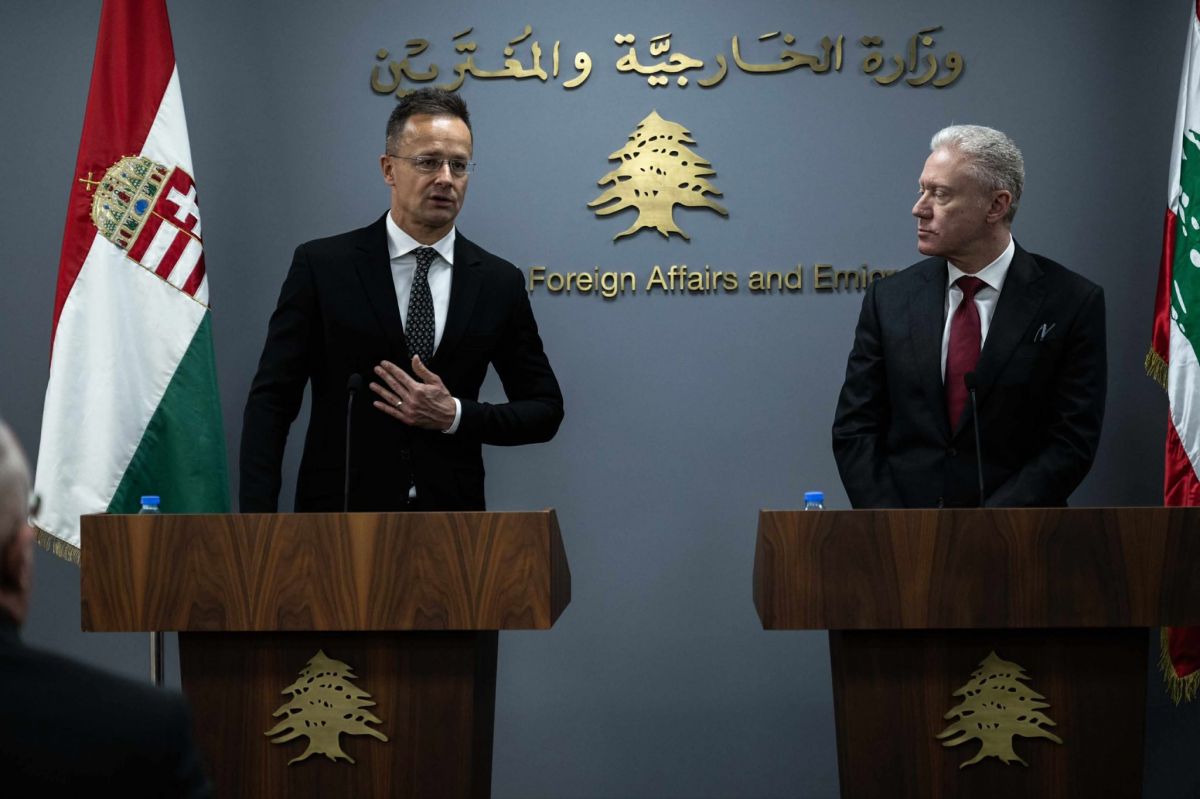
Hungarian Minister of Foreign Affairs Péter Szijjártó speaks alongside his Lebanese counterpart, Joe Rajji, on Nov. 14, 2025. (Credit: @FM_Szijjarto/X)






BEIRUT — Hungary announced on Friday that it will be granting €1.5 million (approximately $1.7 million) to the Lebanese Army via the European Union (EU), and an additional half a million euros in aid for various educational, humanitarian, and health programs in Lebanon.
The aid was pledged by Hungarian Foreign Minister Péter Szijjártó during a meeting in Beirut with his Lebanese counterpart, Joe Rajji.
During a press conference afterward, Szijjártó explained that Hungary was committed to "supporting Christian communities in Lebanon, while working for peace in the Middle East," according comments cited by the National News Agency (NNA).
"I told Joe Rajji that Hungary's national security interest is peace in the Middle East, and that Lebanon's stability is a key element," he later wrote in a statement on X. "We will not use our share of the European Peace Facility to arm Ukraine. Instead, we are reallocating 1.5 million euros to support the Lebanese Armed Forces."
Hungarian leader Viktor Orban is known for his pro-Putin stance in the Russia-Ukraine war, which began in February 2022.
During the press conference, according to NNA, Szijjártó also announced that it would be extending efforts that started in 2019 as part of a project to help restore Lebanese churches.
"After having financed the rehabilitation of 63 Christian churches in Lebanon, Hungary will dedicate this year 200 million forints — half a million euros — to modernizing education in Catholic schools, providing financial support for care and services for Christian families in Beirut who need help, and funding humanitarian programs in the Bekaa," he stated.
Aid for Syrians
Szijjártó also pledged to "help resolve the issue of Syrian displaced persons," claiming — despite warnings from the U.N. and several humanitarian organizations that conditions in Syria are not conducive to a safe return for many of the hundreds of thousands of Syrians who fled to Lebanon — that "the reasons for their displacement from their country are no longer present under the new Syrian administration."
Orban's Hungary is also known within the EU for its aggressive crackdowns on immigration. "The financial aid provided to them in Lebanon should be redirected toward Syria's reconstruction to ensure their swift return," Szijjártó argued, calling on the EU and U.N. not to "encourage" Syrians to stay in Lebanon, but to "push them to return to Syria."
For his part, Rajji emphasized "the importance of Budapest's role, through its position within the European Union, in helping to resolve the issue of Syrian displaced persons and convincing member states to provide the necessary aid for their return to their country."
He asked the European nation "to help, in cooperation with the international community, to exert pressure on Israel to stop its daily aggressions against Lebanon, withdraw from the occupied territories, and release prisoners."
The minister, who is close to the Lebanese Forces (LF), also thanked Hungary for "its ongoing support to Lebanon in the cultural and educational fields," stressing that "there is no danger to any community in Lebanon, and the ambition of the Lebanese people with all its components is to live together in a normal country where there are only legal arms."
The head of the Free Patriotic Movement (FPM), Gebran Bassil, also met with Szijjártó. In 2019, when Bassil was foreign minister, the two politicians had reached a first agreement on the restoration of Catholic churches in Lebanon.
