





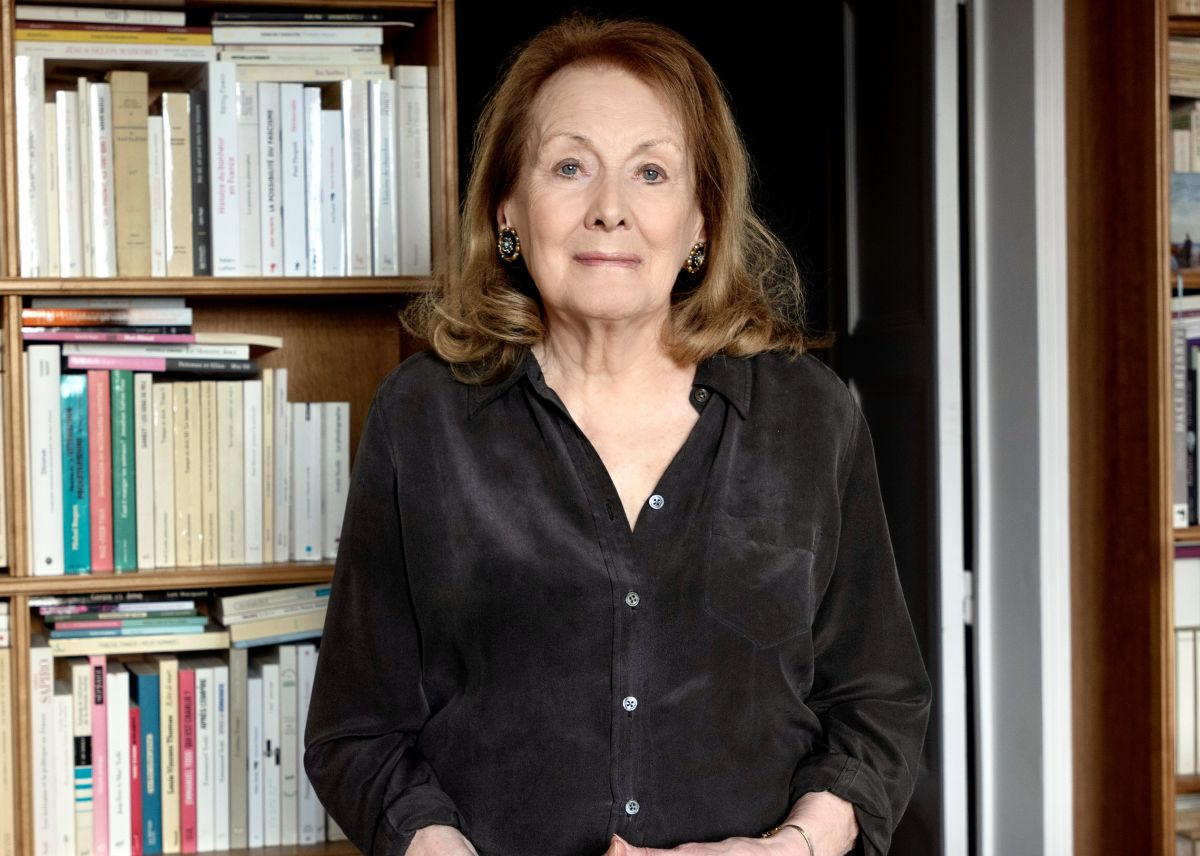
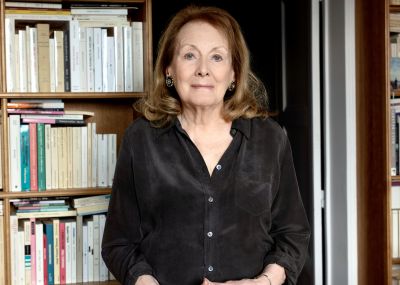
The writer Annie Ernaux, at home. Photo provided by Gallimard.






Her publicist warns from the start that nothing can be promised — not even a refusal. Since receiving the 2022 Nobel Prize in Literature for a body of work carved out of nighttime pain, Annie Ernaux has become elusive.
An unflinching chronicler of France’s social changes with a stark, unsentimental style, the writer has spent half a century holding up a mirror to a country undergoing profound transformation.
Her autobiographical but non-narcissistic works recount a France of supermarkets and gilded salons, of May 1968 and the post-COVID era, and of noisy and quiet struggles, furious and pacifist battles.
A central feminist figure, attentive to class struggle and the guardian of a collective memory that haunts her, Ernaux has long said she never separated her life from her times.

By recounting without adornment her clandestine abortion, forbidden loves, illness, aging, and solitary crusades, she captures a humanity of cutting lucidity. Every humiliation, every fleeting joy, every ordinary gesture becomes essential — intense, political.
Though her voice has grown more fleeting, the octogenarian — particularly active since 2023 in signing statements and appeals against Israeli military actions in Gaza — agreed to reflect, exclusively for L’Orient-Le Jour, on her literary work and social battles.
L'Orient-Le Jour: Your works draw as much from collective memory as from your own, tracing eras, society and France’s wounds through personal experience. How do you link the intimate with collective history?
Annie Ernaux: It’s true that my personal memory touched, without my fully realizing it, on collective memory, because my life resembles that of many who could not or did not express the feelings of their times.
"Les armoires vides" [Published in English under the title "Cleaned Out"], my first book, follows a young woman — me under another name — moving from a working-class world to a bourgeois one, from my parents’ small shop to the university.
In the end, I describe nothing but the culture gained through study and the transformation of social backgrounds. These phenomena are well documented now, but 50 years ago, they were not. If I managed to write it, I’m not aware enough of how to give you a more concrete answer.
OLJ: Your work shows a desire to fix the passing of time. What are you afraid of forgetting?
AE: At my age, I see that what has been lived disappears extremely fast — dangerously fast. The internet and the hypermodernity of the past 15 years have sped this up, leaving no time for silence or for experiences to unfold.
Take the Israeli Palestinian conflict: it’s as if Oct. 7, 2023, revealed for the first time what has existed for more than 70 years. I remember 1967, the Oslo accords, the conferences, the speeches… Even among witnesses, I sense a kind of amnesia. I mean this collectively…
OLJ: And personally?
AE: It’s delicate. I’m afraid of forgetting everything. I care deeply about the past — not to repeat it, but so as not to be devoured by an overwhelming present. I often think of people who have disappeared, not only around me but in public life — artists the world forgets too quickly. That feeling of general loss is what strikes me most, and what I fear most.
OLJ: Your writing relies heavily on the intimate — the body, desire, shame, family. Are there still parts of your life you consider untransmittable?
AE: Naturally. Some matters are harder to explain than others, and certain internal questions — painful or joyful — become more insistent with age. Alongside these emotions comes the need to write, to understand them, to get closer to buried feelings, to help others or rebuild oneself. I won’t write about what I can’t face, especially matters specific to women that have fed my work until recently — you’ll understand, even if that isn’t what you asked.
OLJ: What did it cost you to expose your life on the page?
AE: I never felt I was exposing my life. I see it as material too vast to be contained in a few books. Every life is shaped by evolving memory. And memory also exists in others. So recounting my experiences costs me nothing personally. It can weigh more on others, on their judgments.
OLJ: Speaking of judgment, is the accusation of immodesty — often thrown at you — a way to delegitimize women’s voices?
AE: Of course. This reminds me of Passion simple (Gallimard, 1992; adapted by Lebanese director Danielle Arbid in 2021), which examines the dependence created by a brief, obsessive affair with a married man. It was deemed shameless. Men have spoken of love and sex for millennia. But when a woman speaks of it from her own point of view, using words outside romantic vocabulary — sometimes crude, as I used — it triggers contempt and anger.
OLJ: Your signature has shaped and sometimes anticipated feminist and social struggles. Are you aware of being seen as a reference?
AE: I don’t know what it means to be a reference or an icon. I simply wrote what I needed to at each moment — about motherhood, the tasks of my generation, or my clandestine abortion, which I described when many believed the debate had ended after legalization. Yet current events show the issue is eternal. I worry only about my sense of urgency.
OLJ: You welcomed the #MeToo movement. What did it evoke for you?
AE: My first reaction was joy — an unstoppable wave. I once thought I would die without seeing a true women’s liberation movement like that of the 1970s. I thought everything was lost. My mistake was not paying enough attention to the generation who were 20 in 2010. They are the ones who revolted and exposed the grip of male desire. Of course, I support them. It’s vital to listen to and believe them. Finally.
OLJ: You belonged to a generation of women who won major freedoms. Why do some women in the arts seem out of step with this liberation of speech?
AE: I don’t really know. Tradition and upbringing still weigh heavily. Some women don’t fully feel they are equal to men, and some continue to benefit from domination — beauty, youth, certain advantages.
You might think freedom came from the May 1968 generation, but can one live only on what one once was? I don’t think so. Women who refuse feminism choose submission — and strange as it seems to me, they have the right to.
OLJ: Your activism for Palestine dates back years. What responsibility do intellectuals have regarding Gaza’s situation more than two years on?
AE: Writers spoke out after Oct. 7 and Israel’s response, but it was difficult. The French government immediately labeled as anti-Semitic anyone who defended Gaza. Intellectuals who spoke differently were discredited. We weren’t brave enough, and it took too long to unite and speak forcefully.
There’s also media domination — not only in France — which makes people feel powerless. At one point, it seemed actors or athletes would replace authors in speaking out, but that didn’t happen.
OLJ: So, there is a moral imperative for public figures to take a stand on Palestine?
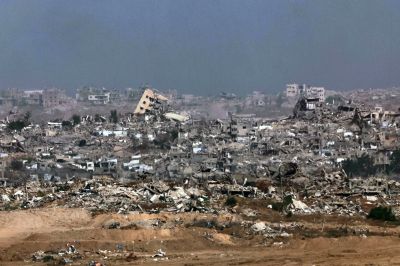
AE: Absolutely. From the start of this war, everything has been visible; images reach us continuously. It’s the first time in history that one can so clearly see what one country inflicts on a population. A country that was itself a victim of the Holocaust, yet, in a shocking reversal, put Netanyahu and a far-right government in power, and believes itself superior to the people with whom it shares the land.
OLJ: After France recognized the State of Palestine last September, what should the government do now?
AE: End all trade with Israel — that’s the first step. Trade, arms… stop. This should involve all of Europe, not just France. Israel’s expansionist will has no limits — you can see it in south Lebanon.
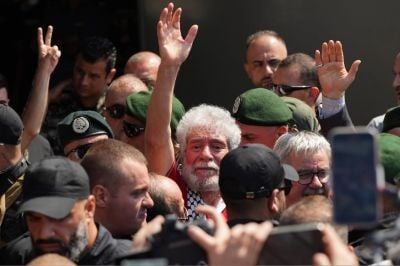
OLJ: You have signed many petitions for the release of activist George Abdallah, who was freed in July 2025. Why was this cause important to you?
AE: Honestly, until I was asked to sign a final text months ago, I had forgotten who he was. I learned he had been imprisoned for nearly 40 years and read about his case. I was struck by the injustice and by the lack of respect for human rights. Under American and Israeli pressure, France repeatedly refused his release when the time had come. That pushed me to advocate.
OLJ: What does this say about France’s political memory and its relationship with the Arab world?
AE: It’s complex and strained. Again, a question of memory. We had colonies in North Africa, and the Algerian war — though not called that — is an example. The way it was suppressed says much. Nothing was resolved. France has not come to terms with its attitude toward Arab nations, as if it struggles to see them as equal states and peoples.
OLJ: You often say, “writing is a chance, not a show of courage.” What separates the chance from the courage?
AE: I meant it, although now I no longer oppose the two. I was lucky to read, to learn, to be in a position many aren’t. My first novel found two publishers. I never needed courage; writing was necessary.
OLJ: Do literary prizes create an artificial hierarchy?
AE: What’s unfortunate is that French literary life is structured around them twice a year, especially in the fall. It’s depressing. It sidelines cultural life that should exist beyond awards. Publishers decide what to push, journalists review the same books, and everything is driven by profit. Yes, I regret that.
OLJ: The Nobel Prize gave you global visibility. Has it changed your sense of responsibility or your voice?
AE: It’s delicate because it’s harder not to seem to weigh in on everything. I’m constantly solicited. But I refuse to go beyond what I would have done without the Nobel. I don’t want to become a voice used for everything.
OLJ: Are you working on something now?
AE: Yes, I’m writing — of course. I won’t talk about it, because writing is discovery. It won’t surprise you that it’s autobiographical — that’s broad enough for you to imagine (laughs).
OLJ: Would you want France to honor you after your death?
AE: I don’t see how. I hope only that my books keep being read. Are you thinking of the Panthéon?
OLJ: Among other things…
AE: Certainly not! (laughs) I have no such wish, though people will do what they want. National tributes… I don’t think they mean much. They are rituals through which a country celebrates itself. A writer’s legacy is not decided in official palaces. What matters are the voices that continue to circulate, the humanity that recognizes itself in them. Knowing young people read my books and want to meet me — that is the only true recognition.

 7 p.m. recap: Iran warns Egypt, Israeli soldiers vote in south Lebanon, Haret Hreik responds to Kataeb