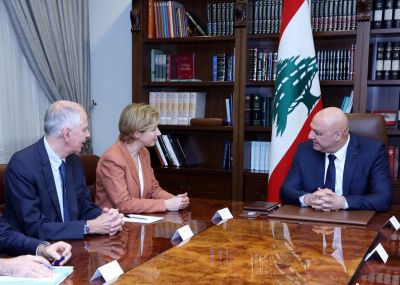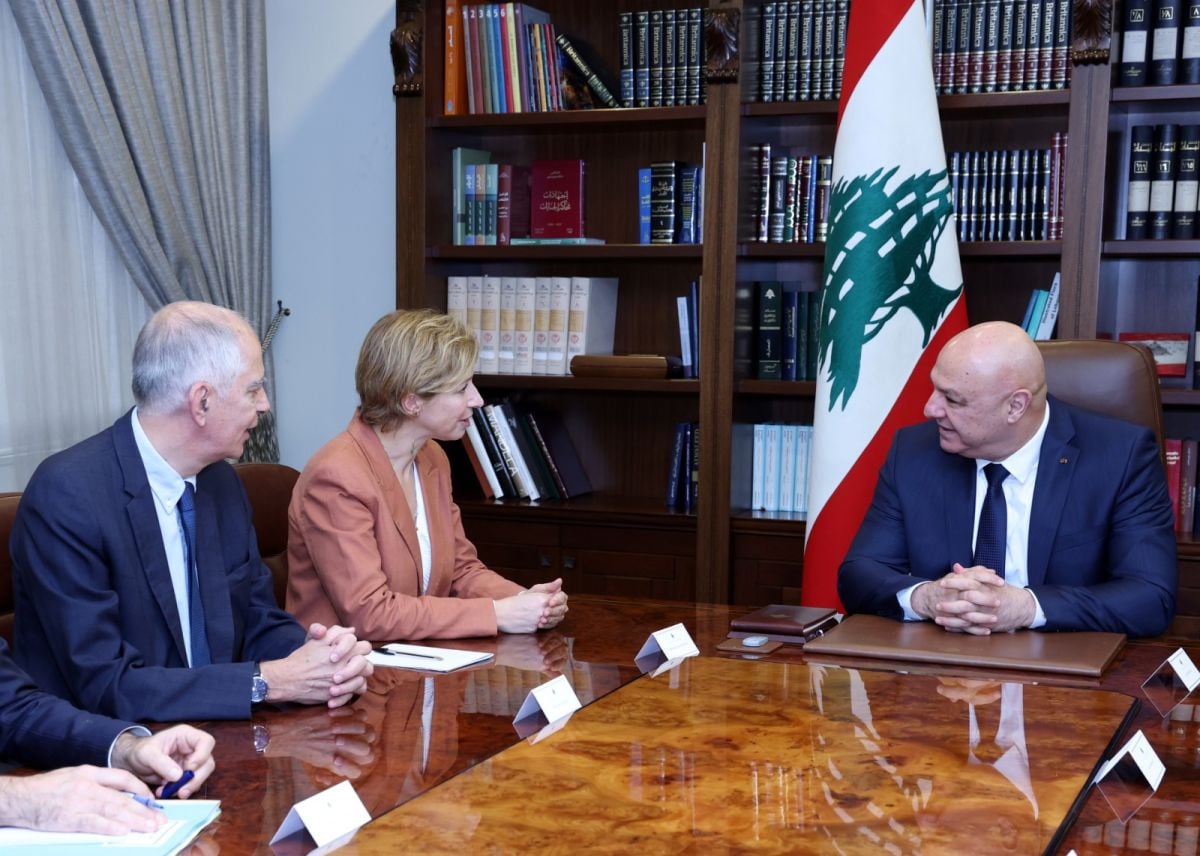
President Joseph Aoun meets with the adviser to President Emmanuel Macron, Anne-Claire Legendre, and the French ambassador to Lebanon, Hervé Magro, on Nov. 13, 2025. (Credit: Lebanese presidency)






BEIRUT — President Joseph Aoun told French President Emmanuel Macron’s adviser Anne-Claire Legendre on Thursday that the “moral support” shown by Lebanon’s partners “is not enough” for the Lebanese Army to carry out its missions.
During their meeting at Baabda Presidential Palace, Aoun also said the military “needs resources and equipment,” which should be provided through the support conference for the Lebanese Army that Macron has pledged to organize in coordination with the United States and Saudi Arabia.
According to a statement from the presidency, Aoun also discussed preparations for a reconstruction conference “to allow residents of the South whose homes have been destroyed to return.” He said reconstruction cannot take place “amid daily Israeli attacks, which now target civilians and infrastructure, such as recently in Blida.”
Need the context?
Paris reaffirms its presence as president's advisor for MENA dispatched to Lebanon
Legendre arrived in Beirut on Wednesday night for talks with Lebanese officials. After visiting Baabda, she met with Parliament Speaker Nabih Berri at Ain al-Tineh, Prime Minister Nawaf Salam at the Grand Serail and Foreign Minister Joe Rajji.
Her visit comes just days after a major U.S. Treasury delegation was dispatched to Beirut, as Washington’s diplomatic push intensifies and the cease-fire — guaranteed by France and the United States — grows increasingly fragile.
Aoun told Legendre that Israeli “occupation and hostile acts” are preventing the Lebanese Army from fully deploying across south Lebanon.
“Despite Israeli violations, the Lebanese Army continues operations south of the Litani River, notably to confiscate weapons and munitions, inspect tunnels and depots, and assert state authority in line with U.N. Security Council Resolution 1701 and the security plan approved by the Lebanese government,” he said.
Aoun added that “the army carries out its instructions with precision,” accusing Israel of seeking to “undermine the army’s capacity and role, which is supported by all Lebanese.” He recalled that “12 soldiers have died in the line of duty” and dismissed Israeli accusations of negligence as “fabrications.”
Despite the cease-fire concluded in late November 2024 with Hezbollah, Israel has continued daily strikes in south Lebanon, the Bekaa Valley and the southern suburbs of Beirut. The Israeli army still occupies at least five sites in the South. Hezbollah, for its part, refuses to hand over its weapons to the Lebanese Army — as requested by Salam’s government last summer — until Israel halts its cease-fire violations.
Aoun also criticized some countries for echoing Israeli claims about Lebanon’s non-compliance with the November 2024 agreement while ignoring Israeli attacks.
He said he welcomes any European participation after the withdrawal of the U.N. Interim Force in Lebanon (UNIFIL), whose mandate expires at the end of 2026, provided coordination continues with the Lebanese Army.
He stressed that the army’s missions extend from border protection to combating terrorism and smuggling, underscoring the importance of both national and international support.
The president reaffirmed that negotiation remains “the only path” to restoring stability in south Lebanon, with France, the United States and the cease-fire monitoring “Mechanism” providing support. He also reiterated Lebanon’s commitment to implementing the reforms needed to revive its economy.
Legendre “conveyed President Macron’s greetings and reaffirmed France’s commitment to supporting reconstruction, the army, and the stability of the South,” according to the presidency.
No substantive statement followed her meeting with Berri.
Legendre, accompanied by French Ambassador Herve Magro and a delegation, was also received by Lebanese Foreign Minister Joe Rajji. During the meeting, Legendre once again affirmed “France’s support for the Lebanese Army” and reiterated President Macron’s commitment to organize a conference in Riyadh in support of the army.
She added that “communication continues with the Saudi side to highlight the progress made in asserting the State’s sovereignty across its territory and in ensuring the monopoly of arms within the set timeframe.”
For his part, Rajji thanked France for its efforts to support the Lebanese Army and maintain stability in the South, reaffirming “the government’s commitment to implement the decision on the monopoly of arms.”
He also stressed “the need to end Israeli aggressions, ensure the immediate and unconditional withdrawal from the five occupied points, and secure the release of Lebanese prisoners.”
Legendre, who is expected to travel next to Damascus, also emphasized her country’s support for establishing the best possible relations between Lebanon and Syria, based on mutual respect for sovereignty. She recalled that France is ready to provide all necessary documents to facilitate the border demarcation process.
Minister Rajji assured that Lebanon is fully prepared to engage on this issue.