


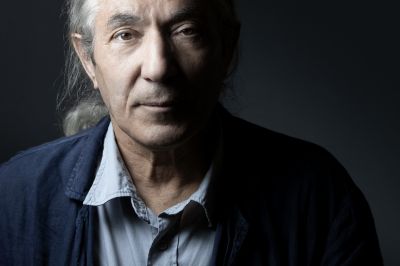
Algerian author and member of the jury Boualem Sansal attends a news conference at the 62nd Berlinale International Film Festival in Berlin Feb. 9, 2012. (Credit: Morris Mac Matzen/Reuters)






French-Algerian writer Boualem Sansal is a prize-winning novelist whose stance against Islamism won acclaim from the French right, and he became embroiled in a political row between Algeria and its former colonial master.
Sansal, 81, known for his strong stances against both authoritarianism and radical Islam, was once a high-ranking Algerian official but became deeply unpopular with authorities there.
Algeria handed him a five-year jail term in March on charges of undermining its territorial integrity over comments related to a dispute with Morocco.
His ordeal came against a backdrop of tensions between France and Algeria, which accuses Paris of siding with Morocco.
Sansal, granted French nationality in 2024, was arrested at Algiers airport in November after travelling there from France.
The Elysee has described him as "a great writer and intellectual," and French President Emmanuel Macron had vowed "unstinting efforts" to secure his release.
Algeria pardoned him on Wednesday following a request from German President Frank-Walter Steinmeier, and the writer is now being transferred to Germany for medical treatment after a year in detention.
Born in Algiers under French colonial rule, Sansal was 18 years old when Algeria gained independence in 1962.
After completing a doctorate in economics, he taught at a university, worked in the private sector, before becoming a senior civil servant at the ministry of industry.
'Courageous opponent of Islamism'
A relative latecomer to writing, Sansal turned to novels in the late 1990s and has tackled subjects including the horrific Algerian 1992-2002 civil war between authorities and Islamists.
His first novel, published in 1999, "Le Serment des barbares" ("The Oath of the Barbarians"), recounted growing Islamist influence in an Algerian society where violence, fear and corruption reign.
His books are not banned in Algeria, but he is a contentious figure, particularly since visiting Israel in 2014 and falling from official favor for his stances against the government and against the "Arabization" of education.
Sansal's hatred of Islamism has not been confined to Algeria. He has also warned of creeping Islamisation in France, a stance that has made him a favoured author of prominent figures from the right and far right.
Politicians from this side of the political spectrum have rushed to draw attention to his plight. He is a member of the strategic committee of French media outlet Frontieres, which backs the far right.
Centre-right former premier Edouard Philippe, who is a candidate in the 2027 presidential elections, said after his arrest that Sansal "embodies everything we cherish: the call for reason, freedom and humanism against censorship, corruption and Islamism."
Far-right figurehead Marine Le Pen, another possible 2027 contender, called him "a freedom fighter and courageous opponent of Islamism."
'Exposed obscurantisms'
In 2015, Sansal won the Grand Prix du Roman of the French Academy, the guardians of the French language, for his book "2084: The End of the World," a dystopian novel inspired by George Orwell's "1984" and set in an Islamist totalitarian world in the aftermath of a nuclear holocaust.
His publisher said that Sansal's novels and essays "exposed obscurantisms of all kinds that are tragically affecting the way of the world."
His jailing coincided with one of the worst lows in French-Algerian relations since Algerian independence, after Macron renewed French support for Moroccan sovereignty over the disputed territory of Western Sahara during a landmark visit to the kingdom last year.
Western Sahara, a former Spanish colony, is de facto majority-controlled by Morocco.
But it is claimed by the Sahrawi separatists of the Polisario Front, who are demanding a self-determination referendum and are supported by Algiers.
The case against Sansal in Algeria related to comments he made to the Frontieres outlet in October last year, when he said that France had unjustly transferred Moroccan territory to Algeria during the 1830-1962 colonial period.
Algeria views those claims, which align with longstanding Moroccan territorial assertions, as a challenge to its sovereignty.
Sansal, whose father came from Morocco, told Frontieres: "France did not colonise Morocco... Why? Because it is a great state. It is easy to colonise small things that have no history."
 Israeli army carries out demolition at Jabal Amel School in Houla as strikes continue