






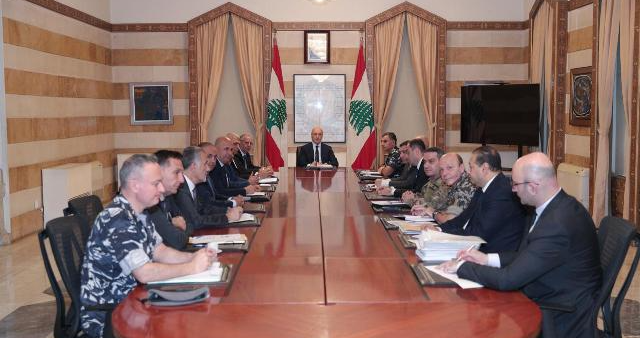
Interior Minister al-Hajjar chairing a meeting on 11 Nov. to discuss the security situation in Lebanon. (Credit: NNA)






Interior Minister Ahmad al-Hajjar chaired a meeting of the Central Internal Security Council to review the overall security situation in Lebanon, discuss measures to strengthen law enforcement and border control, and address preparations for the Pope’s upcoming visit to the country, the state-run National News Agency (NNA) reported Tuesday.
The meeting was attended by the Public Prosecutor at the Court of Cassation, the Governors of Beirut and Mount Lebanon, the Directors General of the Internal Security Forces (ISF), General Security, State Security, and Civil Defense, along with representatives from the Lebanese Army Command and a number of concerned officers.
Hajjar stressed "the need to intensify the efforts of security agencies to maintain security and public order and combat crime, emphasizing the importance of continuing fieldwork, increasing patrols, and strengthening the security presence across various Lebanese regions." He also highlighted the need to "reinforce measures to combat drug trafficking and smuggling and to tighten border control."

Security situation inside the refugee camps, fires discussed
The participants also discussed the security situation inside the refugee camps, particularly Shatila, and the recent incidents there involving murders and drug trafficking, affirming that strict measures will be taken to restore order.
In late October, two violent incidents occurred in Beirut’s Shatila camp. On a Saturday night, Elio Abou Hanna, 24, was shot and killed by an armed Palestinian patrol in the eastern part of the camp after he inadvertently entered the area while driving home from Beirut’s Badaro neighborhood. Just a few days later a young woman was killed in another incident inside the camp, in a "drug den."
The Council also listened to a detailed briefing from the Director General of Civil Defense about the measures taken to extinguish the fires that broke out over the past two days. Hajjar instructed the ISF to conduct immediate and serious investigations into the fires suspected to have been deliberately set, to arrest the perpetrators and refer them to the competent judiciary.

For the third consecutive day, fires have been raging through forests in several regions in northern and southern Lebanon, despite the mobilization of firefighting teams, Civil Defense and the Lebanese Army.
The blazes have sparked anger among many environmentalists and activists, who denounce the lack of responsiveness from authorities.
Security measures accompanying the Pope’s upcoming visit to Lebanon
The meeting also discussed the security measures accompanying the Pope’s upcoming visit to Lebanon at the end of this month, with Hajjar instructing governors and concerned agencies to mobilize all resources to ensure the success of this historic visit.
The pope will arrive in Lebanon on Nov. 30 at 3 p.m. and will remain until Dec.3. He will meet with President Joseph Aoun, Parliament Speaker Nabih Berri, and Prime Minister Nawaf Salam, as well as with representatives of civil society and diplomats, as well as partaking in religious and interfaith ceremonies.
In case you missed this one
Interfaith meeting with the pope in Beirut seen as 'declaration of hope'
In the context of strengthening the security presence and supporting the Lebanese Army’s redeployment plan, the Council addressed the issue of withdrawing additional escort and protection personnel belonging to the Internal Security Forces and State Security who are assigned to certain personalities and officials beyond what is stipulated in the official decree regulating personal protection.
The withdrawal is to take place within two months from Tuesday. During this period, the State Security Directorate will conduct a security assessment and prepare a study identifying the personalities and officials who may still require protection, to be presented to the Council for an appropriate decision.

