












The mayor of New York does not set foreign policy. Nor is he particularly representative of the dynamics that shape U.S. society, and he rarely manages to assert himself at the national level.
While Zohran Mamdani was born in Uganda to Indian parents, is a Shiite Muslim, and was raised in a family of intellectuals close to Edward Said — thus raised on the post-colonial thought — he focused his entire campaign on rent freezes, free bus service and child care, issues that affect everyday life.
These factors largely determined the votes in his favor, yet they are far, very far, from the American “culture wars” or the Palestinian question. Across the world, however, his victory was almost exclusively interpreted through these lenses.
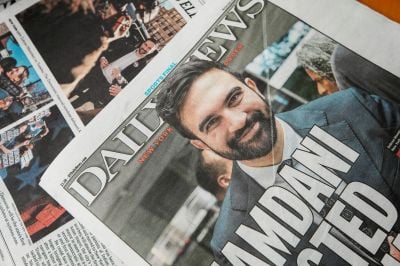
How could it be otherwise in an era so deeply marked by identity-based polarization? How could it be otherwise when a 34-year-old Muslim is elected mayor of the city that witnessed the collapse of the WTC on Sept. 11, 2001? And above all, how could it be otherwise after Gaza?
It cannot be said enough: There is still a widespread underestimation of the extent to which the genocidal war in Gaza is one of the major turning points of our time, far beyond the borders of our region.
Would Mamdani even have been elected without Gaza? Nearly 62 percent of his voters during the primary elections stated that “his support for Palestinian rights” was a motivating factor in their vote, and 83 percent of new voters said his pro-Palestinian stance had encouraged them to vote for him, according to a survey conducted by the Institute for Middle East Understanding.
Of course, neither the world nor New York revolves around Gaza. But Gaza, and more broadly Palestine, now divide the world in two. The reactions to the triumph of Mamdani — who holds positions far from radical on this issue — illustrate how much this divide is widening both between and within our societies.
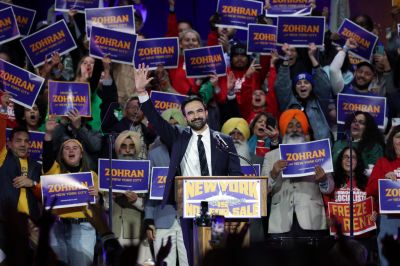
On one side, there are those for whom Palestine is not just another conflict, but a true compass — a magnifying mirror of Western hypocrisy and all the injustices that stem from it. It is the cause through which a whole segment of Western youth engages with politics and shapes their worldview. It is also a cause that confirms, in the eyes of societies in the Global South, that the international system was created by and for Westerners, and that Palestine has long been, well before Donald Trump, one of its main blind spots.
Mamdani, along with many others, can in this sense be seen as an heir of Said. They rightly denounce Israeli exceptionalism, which stems not only from a Western-centric view of history but also from a cultural, and sometimes even civilizational, reading of the conflict. Palestine is often their starting point, but it is a whole world that they deconstruct and reinvent from there.
The rise of this movement brings hope for the Palestinian cause. It can shake Western societies out of their blindness and leaders in the Global South out of their torpor. This is only possible, however, if Said’s thought is not distorted and if this current quickly addresses its two main pitfalls.
First is the denial of the threat of antisemitism — or sometimes a shameful sympathy with certain figures or ideas — under the pretext that Israel constantly uses the notion of antisemitism to criminalize any form of criticism directed at it.
Second is the tendency to see imperialism only when promoted by Western powers, while ignoring or downplaying the atrocities committed by the self-proclaimed “Axis of Resistance” simply because it claims to defend Palestine.
But in light of the annihilation of Gaza, the blinders of the other camp are even more visible and unbearable. First, there is a conservative, identity-driven international movement — on the rise across societies — that believes that the conflict has a civilizational dimension and sees Israel as the armed wing of the West in the Middle East. Whatever its crimes, it justifies them by the existential nature of its fight against a perceived Muslim threat, associated with terrorism, that must be annihilated before it destroys them.
Then there is a more moderate current, which does not share this far-right vision and sometimes even opposes it in practice, while nevertheless playing into its hands without realizing it.
Because of the weight of the Holocaust in collective memory, its unresolved colonial legacies, and its sometimes legitimate fear of an aggressive, at times terrifying Islamism, this current day by day reinforces Israeli exceptionalism. It is unable to see Palestine as anything other than a mere conflict, nor Israel as anything other than a democratic state with illiberal tendencies; it is unable to acknowledge Israel as an occupier that attacks and attempts to erase another people. Understanding the perspective of the opposing camp would disorient its world. Once again, the stakes far exceed Palestine.
Of all the countries fixated on Palestine, France is perhaps the most worrying case. The controversy surrounding a concert by an Israeli orchestra, repeatedly interrupted at the Philharmonie de Paris, and even more so the cancellation of a conference on Palestine at the Collège de France, shows just how much this issue is exposing all the obsessions and unspoken tensions simmering within French society.
Between these two worldviews, there is no longer any space for dialogue. No nuance is acceptable. Palestine has become a global and civil war in which every word, every action, every analysis or opinion turns into a battlefield. The other is, by nature, an enemy — to be ignored or destroyed.
Any attempt to build bridges between these worlds is immediately denounced and rejected outright by both sides. It will take years, probably even decades, to process all of this.
In the meantime, we can take some comfort in the fact that a third of New York Jews voted for an openly pro-Palestine candidate. This is a small glimmer of light in the darkness.
This piece originally appeared in French on L'Orient-Le Jour. Translated into English by Joelle El Khoury.
