





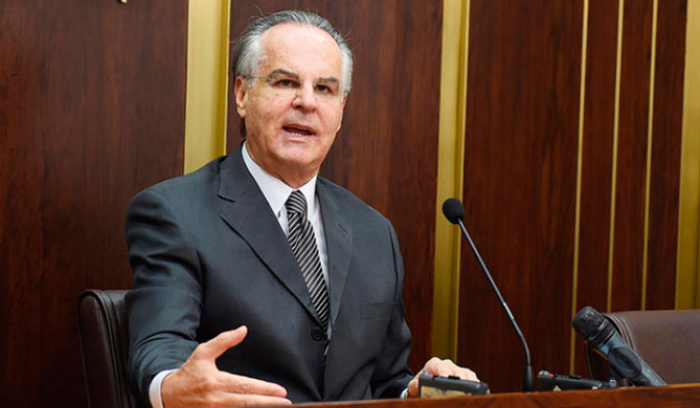
Lebanese Forces MP and chairman of the Parliamentary Administration and Justice Committee, Georges Adwan. (Credit: NNA)






Lebanese Forces (LF) MP and chairman of the Parliamentary Administration and Justice Committee, Georges Adwan, said that the government has made a “big step forward” by approving and sending to Parliament this week a draft bill amending the electoral law. However, he noted, there is still a way to go before the text, which would expand the impact of expatriate voting in the next legislative elections, is adopted.
“If we lived in a country that applies the Constitution and the law, we could congratulate expatriates. But we are in a country where two approaches clash: one that gives no value to the Constitution and the law, and the one we are trying to establish, which advocates their implementation,” the MP said in an interview with Radio Liban Libre, reported by the National News Agency (NNA).
“We can say that we have made a big step thanks to the government, and I therefore commend Presidents Joseph Aoun and Nawaf Salam. But we have not yet reached our goal,” he added.
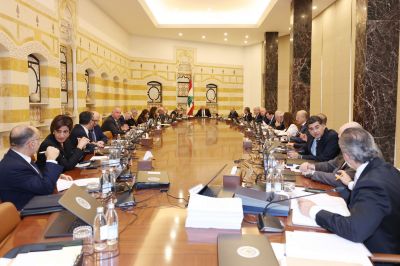
On Thursday in Baabda, the Cabinet decided to send to the Parliament a draft law with double urgency, providing for the suspension of Article 112 of the 2017 electoral law (which limits voting by Lebanese abroad to six seats only) for the 2026 legislative elections, thus endorsing amendments that Hezbollah, its ally the Amal movement, and the Free Patriotic Movement (FPM, Aounist) categorically reject. The draft will be sent to parliamentary committees before reaching the chamber.
The LF’s position has evolved since 2017: the Christian party, traditionally one of Hezbollah’s fiercest opponents, now supports the amendments proposed by the government.
What Nabih Berri will do
The Cabinet’s move should, in principle, require the Speaker of Parliament and head of the Amal Movement, Nabih Berri, to put the bill on the agenda once parliamentary committees have reviewed it, unless he finds a way to bypass this obligation.
“If the government had not submitted the bill correcting the impossibility of implementing the law, it would have failed in its duty and contributed to creating confusion over the election date … it is now up to Parliament to assume its share,” Georges Adwan said. “When a government sends a bill under accelerated procedure, it signals a danger, and Parliament must respond quickly to adopt the necessary amendments,” he added.
“Will President Berri impose his position over constitutional logic? I don’t know. In every country in the world, disagreements arise and are resolved through democratic means, notably by voting. We voted within the government, and it turned out that the majority of Lebanese want expatriates to vote for all 128 deputies. The issue now needs to be brought to a plenary session: if the bill obtains a majority, that will be excellent,” he continued.
Adwan also said that “framing this issue as a defeat for the [Shiite] duo is unacceptable, because complying with the Constitution represents a step toward a change in direction and the building of the future.” He added: “Today’s battle therefore pits the old mode of governance against the one we want to establish; without this change, it is impossible to build a state.”
On a broader level, Georges Adwan noted that “the current internal and external situation requires a reassessment. I know President Berri well: he fully understands the dynamics of any change in internal and regional power balances.”
He also made a renewed appeal to Hezbollah to comply with the government’s decision this summer to restore the state’s monopoly on weapons, while Israel continues its almost daily deadly strikes in Lebanon. “For national reasons, and to exit the crisis Hezbollah has dragged us into this ‘support war’ in Gaza, and after its latest statement, I hope a new evaluation will take place and that denial will end, so that new positions can emerge. Dialogue should not be interrupted on any issue, but it must also not block decision-making,” he said.

 Evening recap: Netanyahu announces West Bank offensive; 7 killed in Jordan church shooting; tents burned in south Lebanon
 US strike on Iran this weekend? ‘Absolutely,’ says Barrack; ‘I have no idea,’ says Trump