





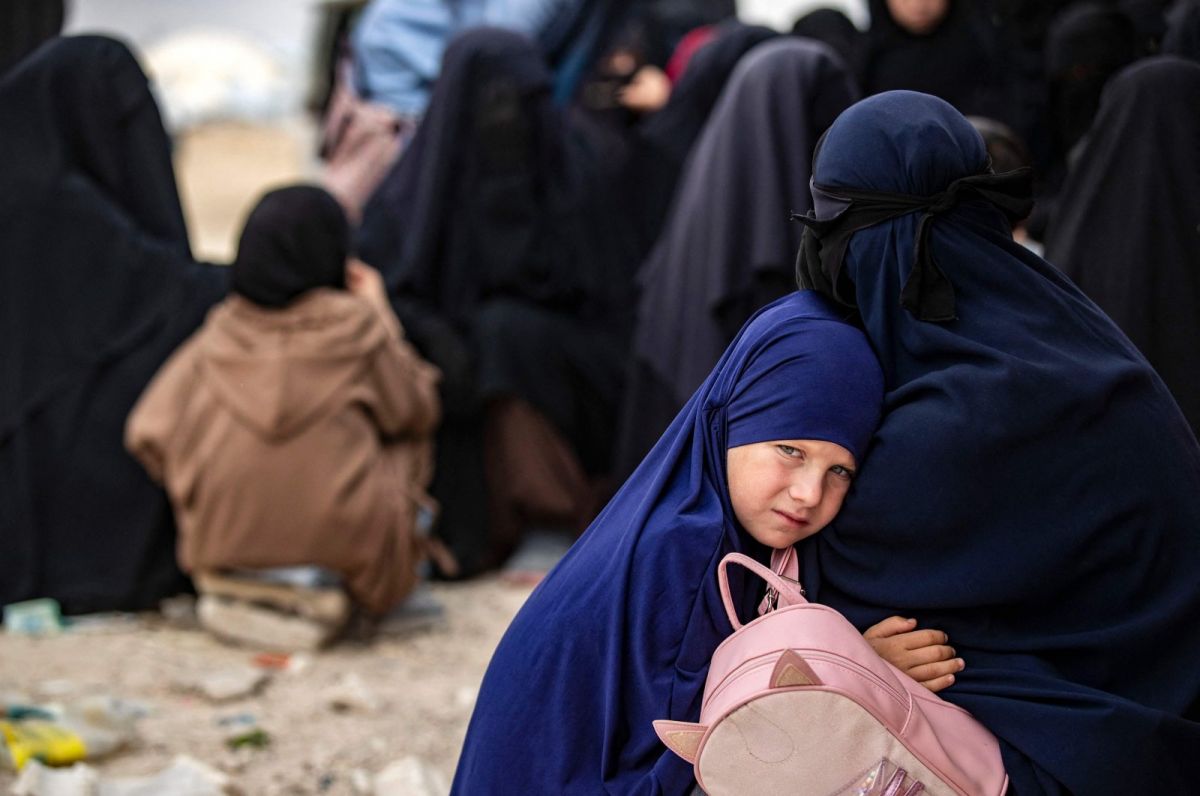
A little girl hugs her mother in the al-Hol camp, in northeastern Syria, on Oct. 11, 2023. (Credit: AFP archives)






The issue of repatriating Lebanese women of the Islamic State group (ISIS) detained in Syria appears to be making progress.
Lebanese security services met on Thursday with representatives of the Syrian Kurdish authorities about these women, who are the wives of Lebanese jihadists from the terrorist group, detained with their children in Kurdish-run camps in northeast Syria.
This information was confirmed to L'Orient-Le Jour on Friday by the families' lawyer, Mohammad Sablouh, and Abdel Salam Ahmad, the Lebanese representative of the Kurdish Autonomous Administration in Syria.
"Our discussions with Lebanese security services focused on a number of common issues. At the top of the priorities was the case of the Lebanese women detained in the al-Hol and Roj camps. The mechanisms of their handover to the government were discussed," Ahmad said.
He assured that these women and their children are expected to return to Lebanon "soon."
"We are waiting to obtain documents proving that these people are Lebanese, as most do not have identification documents," he continued.
He also said there were discussions about "common security issues, particularly in light of intensified activity by terrorist groups in the region. Ways to strengthen cooperation and coordination to address these issues were also studied."
Sablouh, for his part, emphasized that "the atmosphere is positive" and said that about ten women and children could return to Lebanon soon.
The Lebanese channel LBCI reported on Friday that eleven women could be repatriated.
According to information obtained by L'Orient-Le Jour, a total of 19 Lebanese women and children are still held in northeastern Syria.
Most are in al-Hol, others in the Roj camp.
Long ignored, this case recently resurfaced under pressure from the families.
When asked, a Lebanese General Security source said they had no information about a potential repatriation.
The 2011 Syrian revolution and the ensuing war attracted many Lebanese Sunnis, some of whom became radicalized and joined ISIS.
Most are originally from Tripoli, Minyeh, and Dinnieh in northern Lebanon, or from Saida in southern Lebanon, according to several testimonies collected by L'Orient-Le Jour.
No official estimate exists for the number of Lebanese who joined the caliphate in Raqqa.
Hezbollah, for its part, fought alongside the regime of Bashar al-Assad, who was toppled in December 2024.
These discussions come as, in parallel, new Syrian authorities under Islamist president Ahmad al-Sharaa are negotiating with their Lebanese counterparts for the release of Syrians held in Lebanese prisons, whom they deem to be unjustly detained.

 7 p.m. recap: Iran warns Egypt, Israeli soldiers vote in south Lebanon, Haret Hreik responds to Kataeb