






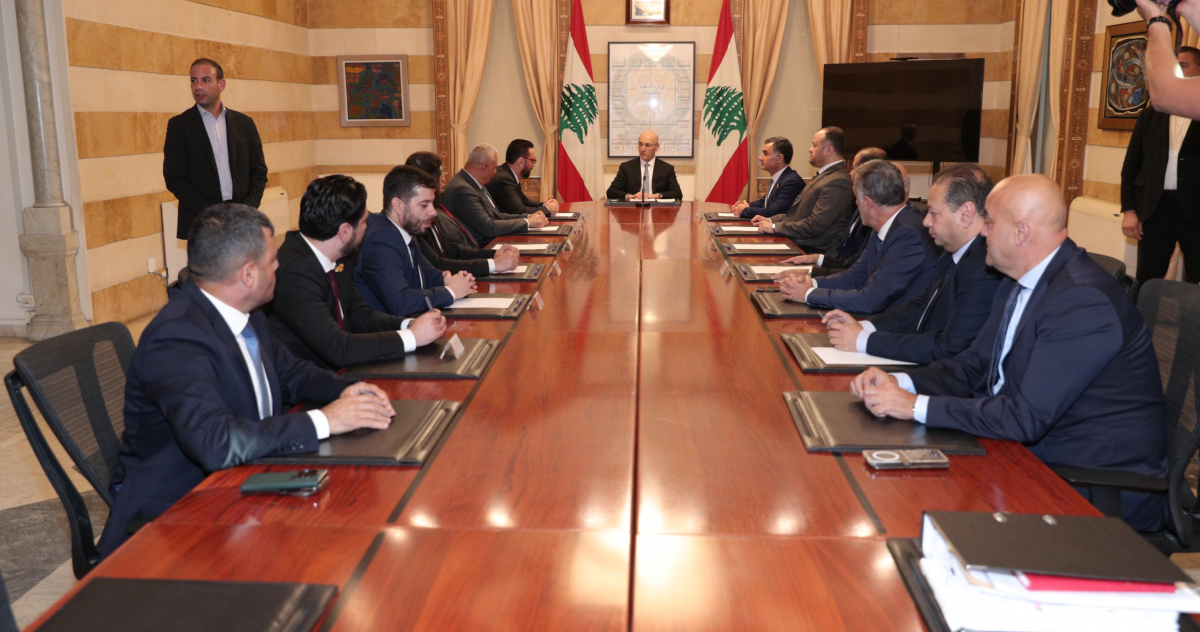
Minister of Interior Ahmad Hajjar chairs a meeting with a Syrian delegation in Beirut, on Oct. 29, 2025. (Credit: NNA)






BEIRUT — A Syrian delegation visited Beirut on Wednesday to discuss Lebanon and Syria's joint projects to combat illegal drug trade and terrorism as well as how to manage border and passport control between the two countries.
The delegation, led by Syrian deputy Interior Minister General Abdel Kader Tahan, met with Interior Minister Ahmad Hajjar, the director-general of the Internal Security Forces (ISF), General Raed Abdallah, and the director-general of General Security, General Hassan Choucair.
In comments cited by the state-run National News Agency, Hajjar said the meeting was held at the request of the Syrian delegation in order to "reaffirm the depth of Lebanese-Syrian relations," in line with recent bilateral visits, notably the meetings between President Joseph Aoun and his Syrian counterpart Ahmad al-Sharaa, Prime Minister Nawaf Salam’s visit to Damascus, and that of Syrian Foreign Minister Assaad al-Shaibani to Beirut.

"Following these talks, and after the reorganization of the Syrian security services, it was decided to intensify cooperation and reciprocal visits between the two ministries of Justice, particularly to examine the issue of Syrian detainees in Lebanon," Hajjar added.
Lebanon is "working on the issue of Lebanese detainees to accelerate trials and process their cases," he added, noting that the Syrian delegation had put forward "direct coordination mechanisms aimed at strengthening the protection of both societies against all kinds of crimes."
On the issue of drug trafficking, Hajjar said "the foundations for direct coordination have been laid," and expressed hope that this latest visit would mark "the beginning of a new phase of cooperation and direct coordination."
"The security and stability of Lebanon is reflected in Syria, and vice versa," he said.
Before the meeting at the ministry, a security coordination meeting was held at the Hilton Habtoor Hotel in Sin al-Fil, attended on the Lebanese side by Choucair, Abdallah, and Colonel Tony Mansour, security affairs advisor to Aoun.
"The Lebanese and Syrian peoples are bound by historical and family ties," Choucair said at the start of the meeting, which he said focused — by Aoun's request — on synchronizing efforts to combat the drug trade and "terrorism," as well as to coordinate on immigration and "information management."
"At the end of these talks, we'll have a roadmap for institutional cooperation between our two countries to preserve everyone's security," Choucair added.
Tahan explained that "this cooperation aims to deepen technical and operational expertise, as any security problem in one country can affect the other."
"We came with a specialized delegation to strengthen coordination in the interests of both brotherly countries," he stated.
These latest meetings are part of a process of reconciliation between the two countries after several decades of hostility marked by the Syrian occupation of Lebanon and the Syrian Civil War. With the toppling of the Assad regime in December, relations have seen a renewal. In August, Sharaa called for "state-to-state relations with Lebanon," insisting that there could be no "geographic curse" between the two countries.
In September, Aoun met his Syrian counterpart in Doha, on the sidelines of the Arab-Islamic summit. At the beginning of October, the Syrian Foreign Minister’s visit to Lebanon marked a new stage with the suspension of the work of the Lebanese-Syrian Higher Council and the decision to limit bilateral exchanges to official diplomatic channels.
Describing his visit as "historic," Shaibani reaffirmed Damascus's commitment to respecting Lebanon’s sovereignty and the principle of "non-interference" in its affairs.
