


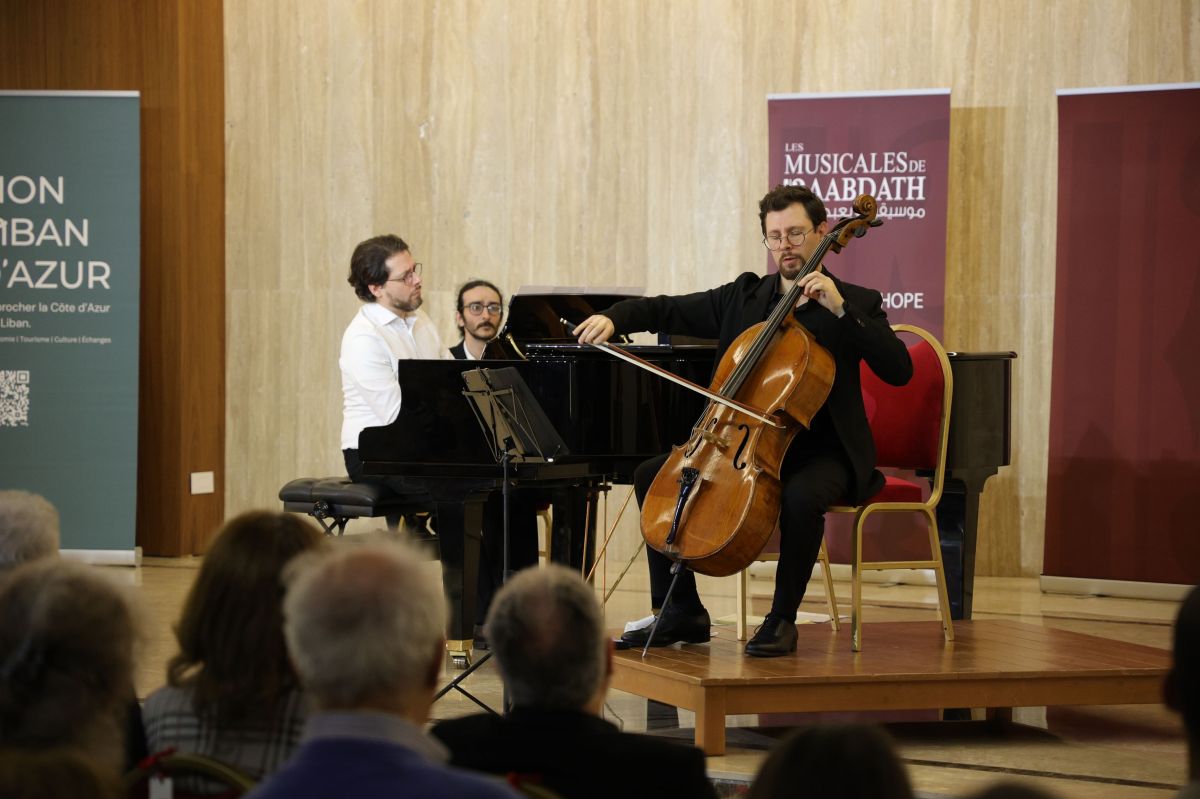
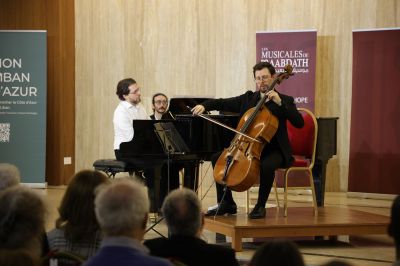
Sari and Ayad Khalifeh in concert as part of the Musicales de Baabdate. (Credit: Leon Markarian)






The Khalifeh brothers (Ayad and Sari) are undoubtedly great musicians and performers. They demonstrated this during their cello-piano recital on Saturday, Oct. 25, 2025, as part of the "Musicales de Baabdate" — in collaboration with "Mon Liban d'Azur" — featuring composers such as Boghos Gelalian, Camille Saint-Saëns, Gabriel Faure, Edvard Grieg, as well as Sari and Ayad Khalifeh.
Gelalian’s "Sonate brève pour violoncelle et piano" ('brief sonata for violen and piano') is a short, dense, and highly expressive work, especially in its andante. Its language is emblematic, fusing Western modernity (Debussy and Ravel) with Eastern roots.
It demands an intellectual and inward interpretation, fueled by deep mutual listening between the cellist and pianist. Gelalian was a profoundly humanistic and meditative composer. A student of Bertrand Robillard, who played the great organ at Saint Joseph University, he was influenced by Bartok, Prokofiev, Honegger, and Khachaturian, but also by Near Eastern modes. Their performance was tense, incisive, and architecturally structured.
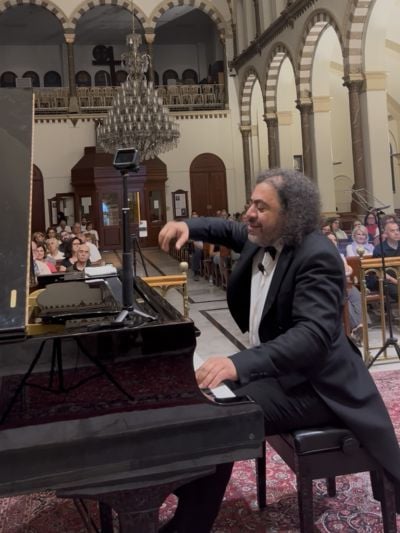
Ayad was at the piano and Sari on the cello. The piano was percussive without overshadowing the cello. Silence is crucial in Gelalian’s writing: allowing the music to resonate in the space like in an Armenian church.
The performers let Gelalian’s music breathe in the room. In the excerpt from Saëns’s "Carnival of the animals, the swan," a work for cello and two pianos or chamber orchestra, Sari sang languorously and poignantly over his brother’s ethereal chords. A "noble absurdity," as the musician puts it, made famous by the ballet "The Dying Swan," choreographed by Michel Fokine and first performed in 1905 by Anna Pavlova.
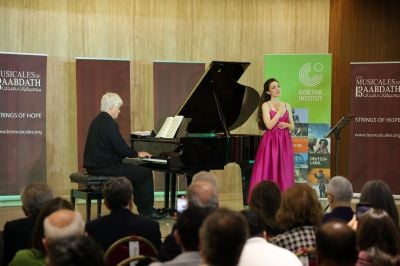
Faure’s "Sicilienne," taken from his incidental music for "Pelléas et Melisande," has become one of his most popular pieces. In the arrangement for cello and piano, the two brothers captured its melodic freshness.
The key piece was Edvard Grieg’s "Sonata for cello and piano in A minor," which best achieves the fusion of folklorism with great classical forms. It is a splendid work, whose power and gravity are heightened by an almost monumental construction.
The work is marked by a virile and passionate accent, so striking that it’s surprising such a direct and sonorous piece is neglected by performers and has remained almost unknown. The two brothers are exemplary in their ease, color, and expressiveness.
But why did they omit its slow movement, the "Andante molto"? A mystery. "Andante molto tranquillo," (moderately slow, walking pace) what a pity, mystery.
The Khalifeh brothers concluded their recital with two original works, specially commissioned for the "Musicales du Liban" festival: "Prayer and Levantine Dance." Two pieces at the crossroads of classical, jazz, and contemporary Arabic music, also blending Bach, Debussy, and the "maqam."
It was a beautiful dialogue between East and West, between cello and piano. Their performance at times evoked the improvised melody of the Levant.

 7 p.m. recap: 1 person killed near border with Lebanon; 200 kilos of explosives carried by mules; Riyadh shuts its airspace