


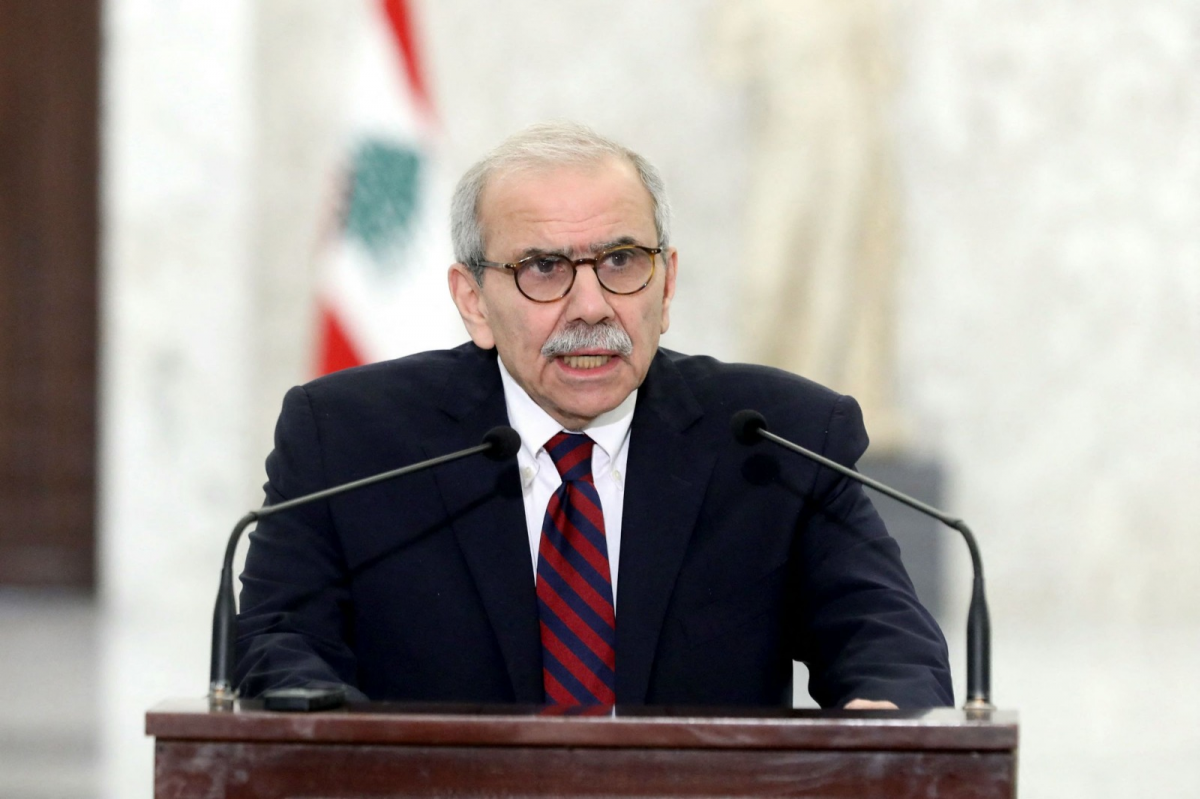
Prime Minister Nawaf Salam. (Credit: NNA)






BEIRUT — In a Thursday interview with pro-Iranian channel al-Mayadeen, Prime Minister Nawaf Salam admitted that efforts to open diplomatic channels with Israel “have not been fruitful,” though he said they had “helped avoid the worst” amid daily Israeli violations of the November 2024 cease-fire.
Salam nevertheless insisted that Lebanon has not yet "exhausted all diplomatic and political avenues," and that these remain the fundamental choice after the Lebanese authorities have repeatedly called on the international community to pressure Israel, as he recalled in his interview.
This stance appears to be a response to recent pressure from the U.S. administration calling for direct negotiations with Israel to discuss halting strikes, withdrawing from positions still occupied on Lebanese territory, and the demarcation of the land border, with Lebanon being "still at war, a war of attrition," according to Salam.
While in mid-October President Joseph Aoun had called for negotiations with Israel, not ruling out that they could be direct, Salam said this option was "not part of [his] government’s plan."

The head of government also said the country is "decades behind" in implementing the Taif Agreement, especially regarding the disarmament of militias, chiefly Hezbollah. The 1989 Taif Agreement, concluded to put an end to the 15-year civil war, called for the dissolution of "all militias, Lebanese or otherwise," and their disarmament — a point that, like many others in the text, remains partially unfulfilled.
Basing himself on Taif, the prime minister insisted that disarmament is "above all a Lebanese requirement" and is "neither an American nor an Israeli demand," even as Israel conditions any withdrawal from Lebanese territory on Hezbollah’s disarmament, a demand for which Washington also presses Beirut.
Hezbollah, by contrast, refuses to disarm citing various pretexts. In this context, Salam warned that "any deviation" from the Taif Agreement could "threaten" Lebanon’s civil peace, noting that "it is impossible to have two armies in the same country."
According to the Lebanese Army’s plan presented to Parliament last Sept. 5, Hezbollah's infrastructure south of the Litani River should be disarmed by the end of the year.
This plan followed the government’s Aug. 5 decision to restore the state monopoly on weapons. The army has already begun dismantling Hezbollah’s arsenal along the border, the first step in a process that will later extend to other regions.
'Without the Lebanese resistance, Israel would never have withdrawn from Lebanon in 2000'
Salam, a former judge at the International Court of Justice (ICJ), also recognized that "without the Lebanese resistance, Israel would never have withdrawn in 2000."
According to him, this "resistance," which Hezbollah became the leading force of over the years, initially "had a pluralist character" since it brought together the Lebanese Communist Party, the Syrian Social Nationalist Party, and the Organization of Communist Action, among others.
"Their role should not be minimized," he stressed. "Over time, Hezbollah took the upper hand and played the central role in the liberation of the South," he added, while recalling these events date back almost twenty-five years. "Today, the situation is no longer the same," he said.
Regarding a possible peace with Israel, Salam stated that Lebanon remains committed to the Arab Peace Initiative, adopted at the Beirut summit in 2002, "which is our reference, as well as that of all Arab countries."
He added there are regular contacts and open channels of communication with Hezbollah, specifying that the door remains "open," despite high tensions between the pro-Iranian party and the Grand Serail.
Addressing the accusations by Hezbollah partisans who called him "Zionist," Salam said he did not know "whether to laugh or be shocked," calling such statements "utterly absurd." He recalled that during his time at the United Nations and the ICJ, he was, on the contrary, accused of being "one of the fiercest opponents of Israel," even described as "the devil incarnate" by the Israeli state.
Regarding the legislative elections scheduled for May 2026, Salam assured they would take place "on the scheduled date and at the appointed hour," without wading into the controversy over expatriate voting, which has been the subject of much debate in recent months.
Asked about his possible personal participation, he recalled that his cabinet is made up of technocrats, none of whom are candidates in the elections. According to him, one of the fundamental principles of transparency in the electoral process is "the neutrality of the government in charge of overseeing it."
 Israeli army carries out demolition at Jabal Amel School in Houla as strikes continue