


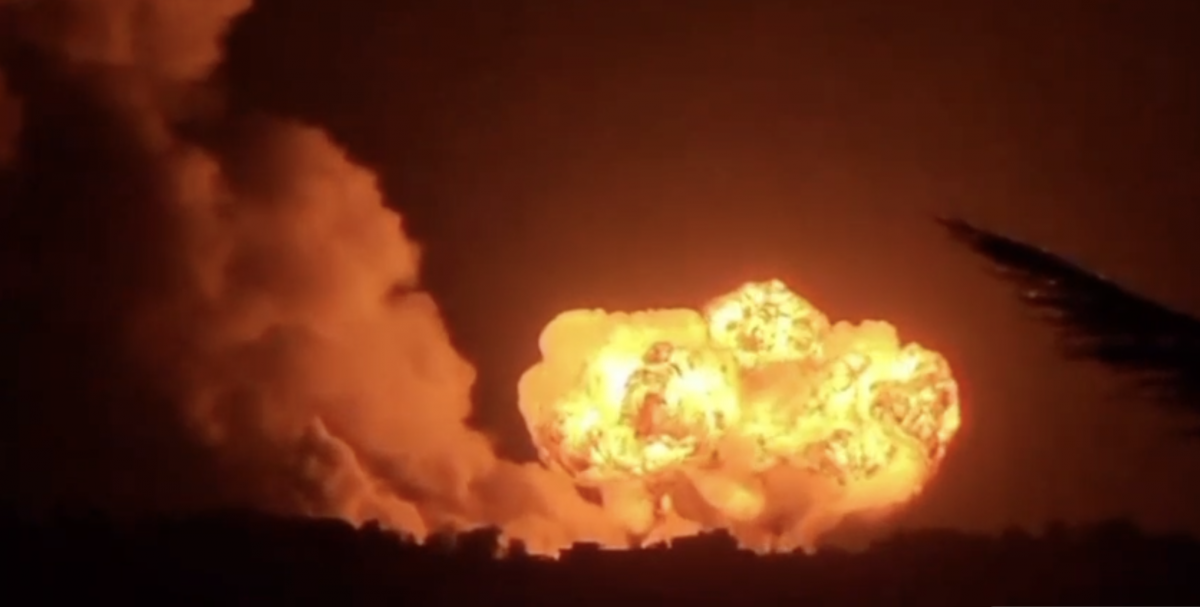
Israeli strike in Ansar, in the Nabatiyeh district, on Oct. 16, 2025. Screenshot from a video received by our correspondent.






SOUTH LEBANON — A series of powerful Israeli strikes across southern Lebanon and the Bekaa Valley on Thursday killed a customs officer and injured at least seven people, escalating tensions despite a long-standing cease-fire.
The Israeli army claimed to have targeted "infrastructure linked to Hezbollah" as well as the association "Green Without Borders," an environmental NGO.
In the evening, eight Israeli strikes targeted the area between Sinai and Ansar, in the Nabatieh district, with explosions being heard as far as Saida, our regional correspondent reported.
According to an initial report by the Health Ministry, the strikes wounded five people in Ansar (Nabatieh district).
"The explosions lit up the sky and came one after another. They were very powerful and very close. The house shook with us, and the fighter jets were flying so low it felt like they were touching the houses," a resident of Adloun (Saida district) told our correspondent. According to preliminary information, the strikes targeted a quarry, a concrete crusher, a stone factory and building equipment.
The strikes also resulted in material damage to homes and a nearby school, our correspondent added.
The Israeli army's Arabic spokesperson, Avichay Adraee, wrote on X: "The Israeli army struck infrastructure linked to Hezbollah and the organization Green Without Borders." He noted that the NGO is sanctioned by the U.S., adding that the army "targeted Hezbollah infrastructure … used in reconstruction attempts."
He specified that a "quarry, used by Hezbollah to produce cement for the reconstruction of terrorist facilities and infrastructure," was destroyed. "These infrastructures have enabled Hezbollah to continue its reconstruction efforts under a civilian guise," he claimed.
Adraee added: "A target linked to the Green Without Borders association was also targeted, as Hezbollah used it to conceal terrorist activity." He claimed that in "2018, it was already revealed that this association was operating under civilian cover to mask the presence of Hezbollah in the border area with Israel."
Lebanese President Joseph Aoun condemned the strikes, saying that "this repeated Israeli aggression is part of a systematic policy aiming to hinder economic recovery and attack national stability under false security pretenses."
"This aggressive behavior constitutes a grave violation of Resolution 1701 and the cease-fire agreement and confirms that Israel continues to violate its international obligations and use force outside of any legal framework, which requires an international response to put an end to these condemnable violations," Aoun added.
Notably, this is the latest in a series of Israeli strikes that have targeted equipment used in reconstruction.

Earlier attacks across southern Lebanon
Earlier in the afternoon, an Israeli fighter jet and drone bombed the village of Bnaafoul, southeast of Saida, twice.
A resident reported that the strike hit an area close to homes: "Everything in my house was destroyed. I am leaving the region with my family for a safer place."
The strikes targeted an area between Bnaafoul and Houmin Tahta (Nabatieh), about 10 kilometers from Bnaafoul public school, injuring one person, according to the Health Ministry. Soon after, an Israeli drone struck Kawthariyet al-Siyyad in the Saida district.
Israeli drone strikes also targeted the Ali Taher region, facing Nabatieh Fawqa, and the Dabbash hill, near Kfar Roummane
Meanwhile, reconnaissance drones overflew Adloun and Zahrani in the Saida district.
Earlier in the day, the Israeli army fired automatic machine guns, conducting sweeping operations, from the newly occupied Tallet Hamames hill towards Wadi al-Assafir valley. Israeli machine gun fire also targeted the outskirts of Aitaroun (Bint Jbeil) from the Jabal Blat position.
An Israeli incendiary bomb was also dropped on Deir Antar in the Bint Jbeil district.
In the Marjayoun district, an Israeli drone dropped a bomb on a farmer in the Ghassouna area, east of Blida. Yet, no injuries were reported, according to our correspondent.
Israeli strike in the Bekaa
In the Bekaa Valley, two houses that had been previously attacked were once again struck in Shmustar, west of Baalbeck, our regional correspondent reported. The Israeli attack killed one and wounded another.
The customs officer killed in the attack had initially been reported missing. He was near the strike site while out for exercise and is survived by his wife and three children.
The Israeli army claimed to have targeted "underground Hezbollah infrastructure where weapons were stored," claiming that the group is "continuing efforts to reestablish terrorist infrastructure throughout Lebanon, cynically using the population as human shields."
EDL repairs outages caused by Israeli bombings
Meanwhile, Electricité du Liban (EDL), the state electricity provider, announced in a statement that it had repaired the outages caused by last Saturday's massive Israeli bombings of Msayleh in the Saida district of southern Lebanon.
"The power supply has returned to its pre-attack levels," EDL reported. "The main 220-kilovolt transmission line linking Zahrani to Sour" has been repaired.
But the 66 kV Zahrani–Msayleh transmission line remains out of service due to a fallen pylon. Repairs will take longer, but the temporary outage does not affect the overall supply due to the existing "three backup lines replacing it," EDL added in its statement.
Lebanese Army removed 10,000 rockets and 400 missiles
Senior military officials from the U.N., the U.S., France and the Lebanese Army met on Oct. 15 in Naqoura, where they "aligned priorities for maintaining the cessation of hostilities in southern Lebanon and the disarmament of Lebanese Hezbollah," announced the U.S. Central Command (CENTCOM).
The participants "discussed the Lebanese Army's continued disarmament operations," the statement added, noting that "the Lebanese Army has successfully removed nearly 10,000 rockets, almost 400 missiles and over 205,000 unexploded ordnance fragments during the past year."
“Our Lebanese partners continue to lead the way in ensuring the disarmament of Lebanese Hezbollah is successful,” said Adm. Brad Cooper, commander of CENTCOM, the statement added. “We remain committed to supporting the LAF’s efforts as they work tirelessly to strengthen regional security.”
Centcom also reported that last week, Lt. Gen. Joseph Clearfield was appointed the senior U.S. military representative in Lebanon and named chairman of the Mechanism during a ceremony in Beirut. Created under the November 2024 cease-fire agreement, the Mechanism is tasked with “monitoring, verifying and assisting the enforcement of commitments made by Israel and Lebanon, including disarming Lebanese Hezbollah.”
“We are working with the Lebanese Army, UNIFIL and our French and international partners to ensure the success of the cessation framework,” said Clearfield. “We have a shared interest in preserving peace and stability in Lebanon.”
 Israeli army carries out demolition at Jabal Amel School in Houla as strikes continue