


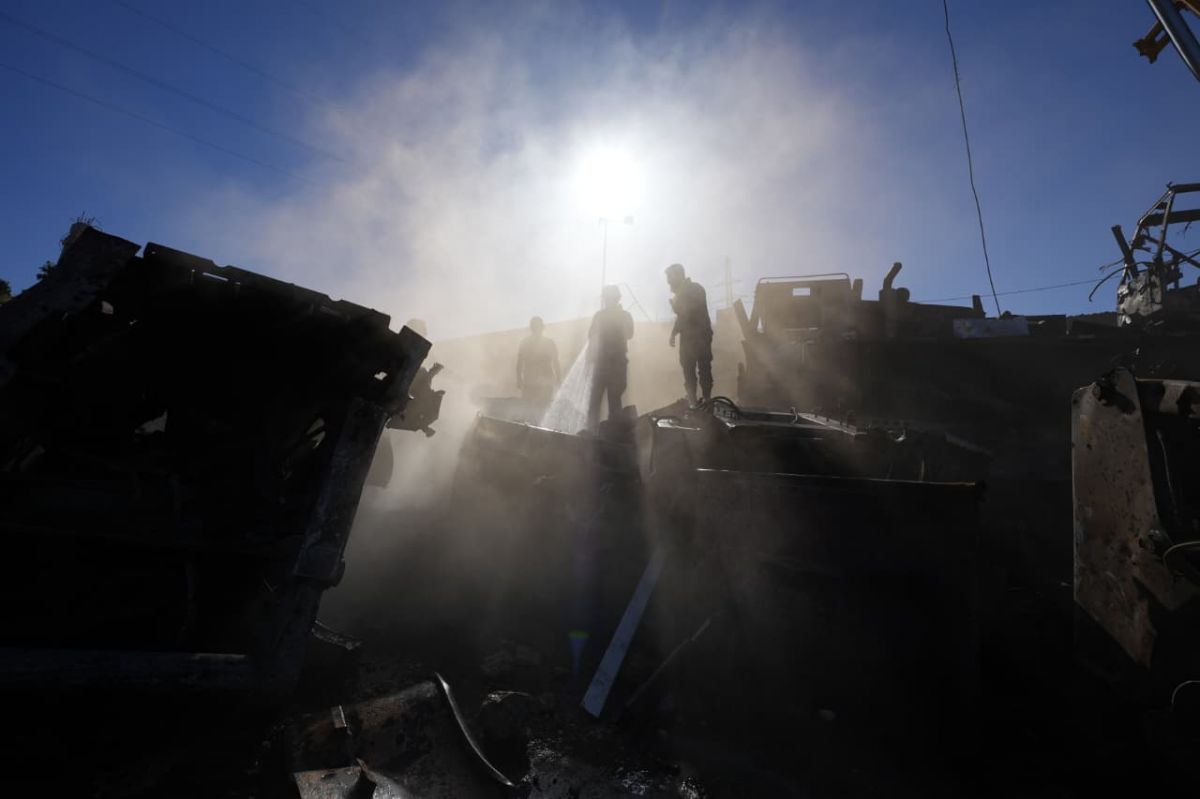
Firefighters at the site bombed by Israel in Msayleh, on Oct. 11, 2025. Photo Mohammad Yassin/L'Orient Today)






Just hours after ten missiles struck construction equipment in Msayleh, southern Lebanon, “the scene is terrifying,” reports our correspondent on the ground. On site, the owners of the targeted equipment — who now face “millions of dollars” in losses — denounce an economic war aimed at keeping the country down and suffocating Hezbollah. They affirm that their “lives and equipment are offered in sacrifice for Lebanon,” as stated by one of them, Ossama Fakhoury.
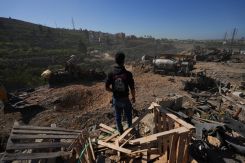
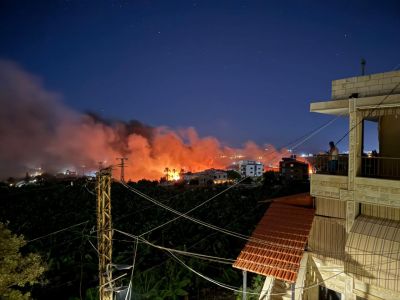
Upon arrival, along a road littered with stones, debris from electricity pylons, tangled wires and scattered fragments stretching hundreds of meters, a smell of rubber lingers in the air, and smoke still rises from burning machinery. Dozens of scorched and twisted vehicles are visible, along with burnt trees, gutted vehicles and an entire building consumed by flames, “reduced to nothing but a black block.”
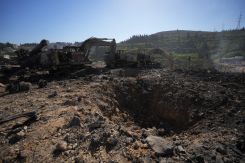
Huge craters were also gouged out by the powerful missiles used by the Israeli air force. Most are about three meters deep and up to 25 meters in diameter, and one reached a depth of eight meters, according to the National News Agency (NNA).
'It felt like hell'
From the early hours, locals came to inspect the site. A resident of Najarieh, a nearby town, said he was awakened “terrified by the sound of huge explosions.” “It felt like an earthquake, then I heard warplanes and successive explosions. I stepped onto the balcony and saw the whole area on fire; flames erupted in several spots along the road and tongues of fire shot into the sky,” he said. “The sounds of planes, missile impacts and my children's screams ... it felt like hell. It's a night I will never forget.”
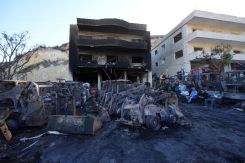
The despair is even more acute among the owners of the construction equipment targeted by the Israeli strikes on the lot that housed vehicles belonging to several operators. According to the official agency, the strikes destroyed more than 300 vehicles, including bulldozers and excavators, as well as over 100 smaller “Bobcat”-type machines. The initial estimate puts the losses at several hundred million dollars.

Israel's 'revenge' against the South and all Lebanon
Ahmed Tabaja, one of the owners, told L’Orient-Le Jour he denounces an “economic war” waged by Israel. “We belong to no party, we are civilians. Our targeting by the enemy is revenge against the South and the people of the South, and vengeance against all of Lebanon,” he said. For him, the Israeli state's goal is simple: “To strike Lebanon’s economy and prevent the reconstruction of towns and villages in the South.
Targeting civilians is a war crime,” declared the industrialist, noting that the strikes killed a Syrian who was traveling from Saida to Hasbaya in a van with a Lebanese colleague, and injured several people, notably due to exploding window glass from the blasts over several hundred meters.
The Israeli army claimed it targeted infrastructure used by Hezbollah to rebuild its capacities in the South.
“Now I’m wondering how I will be able to move forward with my life,” added Tabaja, whose hundred or so construction machines and a building were destroyed, stating that nothing will prevent Lebanese from “living their lives and remaining attached to their homeland.”
Ali Diab, another owner who suffered losses at the site, told our publication he was unaware the site had been bombed until dawn. “This is not a military complex; these are machines stored on an empty lot,” he insisted, interspersing his comments with “Allahu Akbar” (God is great). Stating he is “with the resistance,” he condemned Israel “which does not distinguish between stone and humans,” while also criticizing the current government, which “follows an American agenda instead of protecting us,” echoing criticisms from the Amal-Hezbollah duo since the cease-fire.
Lebanese President Joseph Aoun strongly condemned the strikes in a statement Saturday morning, but noted that condemnation is not enough and stressed these attacks raise several “challenges” for the country: Fears of escalation in Lebanon amid the Gaza cease-fire, and a call for all sides — including Hezbollah — to respect the terms of the truce.
Similar strikes had already targeted, on the night of September 3 to 4, a large depot of construction material in Ansarieh, southern Lebanon, killing a Syrian worker who was present on site.

 1 p.m. recap: Salam in Nabatieh; up to 10,000 more US troops heading to Middle East