


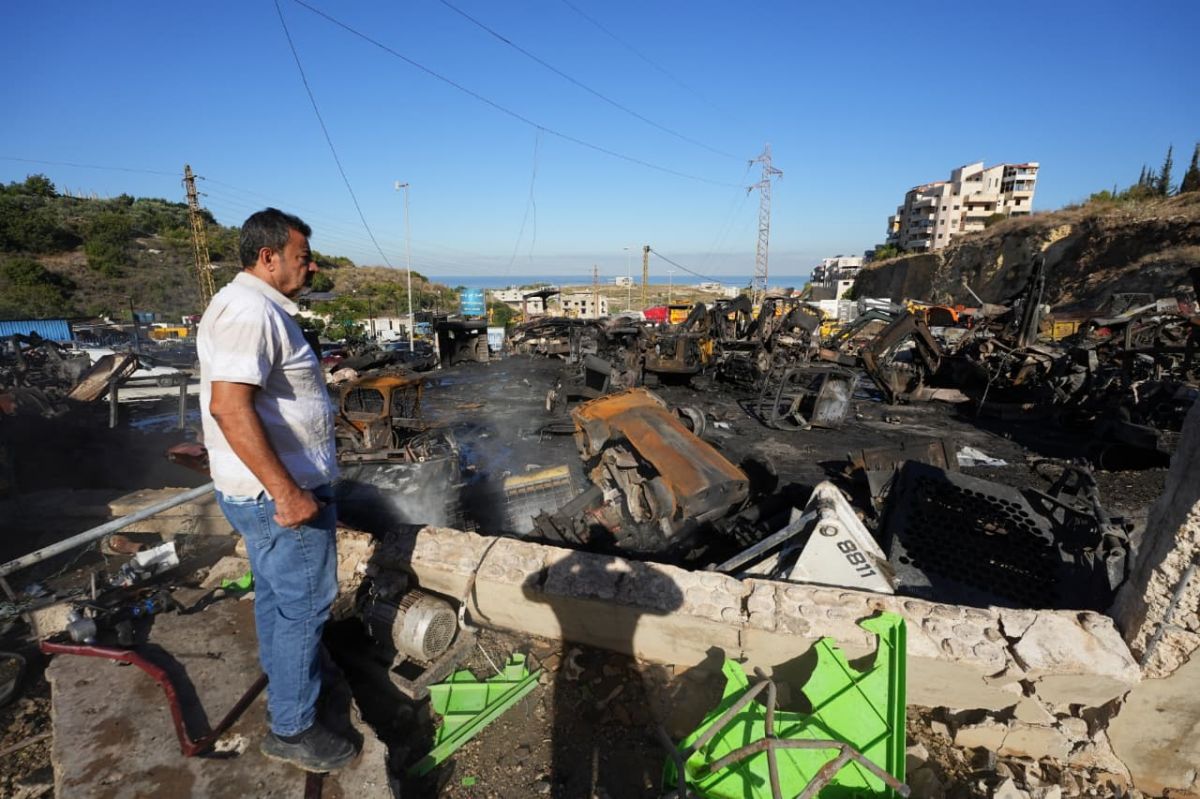
A man at the site was struck by ten Israeli missiles in Msayleh on Oct. 11, 2025. (Photo: Mohammad Yassin/L'Orient Today)






A Syrian national was killed overnight from Friday to Saturday in massive airstrikes carried out by the Israeli military in Msayleh, on the road between Zahrani and Nabatieh, south of Saida, according to information from our correspondent in southern Lebanon.
Lebanese President Joseph Aoun condemned the strikes, which took place shortly after the Gaza cease-fire went into effect. The strikes, which are in direct violation of the truce between Israel and Hezbollah that supposedly went into effect in Nov. 2024, present a series of "challenges" for the country, said Aoun.
Sources told our correspondent that around 4 a.m., about ten missiles were fired by fighter jets at a site housing construction equipment. The explosions were heard in Saida, Nabatieh, and several villages in the Zahrani area, while flames arising from the targeted site. The strikes took place just a few hundred meters from the residence of Parliament Speaker Nabih Berri in Msayleh. Roads connecting Zahrani to Nabatieh were cut off due to debris scattered by the blasts.
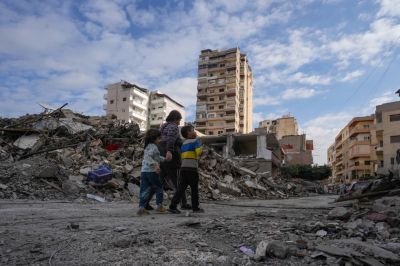
Eight-meter-deep crater
The person killed in the strikes was identified as a Syrian resident of Hasbaya who happened to be passing the site in a pickup truck. The strikes also injured seven people: One Syrian and six Lebanese, including two women, according to the official tally from the Lebanese Health Ministry.
According to the National News Agency (NNA), which described the strikes as "the largest air strike targeting a purely industrial area since the end of the 66-day war," 300 bulldozers and other construction vehicles were destroyed, with damages that could run into hundreds of millions of dollars. At the site, deep craters were gouged out by the Israeli missiles, one of which was nearly eight meters deep.
Damage was also reported to the power grid, while dozens of homes and businesses in the area had their windows blown out by the force of the explosions, over several hundred meters around the site.
In the morning, an unexploded missile was also found at the scene. The army engineering unit said it would wait 72 hours before removing the projectile from the attack site to detonate it.
Aoun calls for 'supporting Lebanon'
According to a message on X by its Arabic-language spokesperson Avichay Adraee, the Israeli army stated that its strikes targeted Hezbollah "infrastructure."
For his part, Lebanese President Joseph Aoun on Saturday morning denounced the massive strikes, saying they present several "challenges" for Lebanon and the international community.
"Once again, south Lebanon is the target of a blatant Israeli aggression against civilian facilities, without motive or even pretext," the head of state said in a message posted on the presidency's X account. He noted that the strikes are especially grave because they come "after the cease-fire agreement in Gaza and the approval by Palestinians of the mechanism stipulated in that agreement to limit and disable weapons."
According to him, this situation presents the Lebanese and the international community with "fundamental challenges," particularly the question of whether "some are seeking to compensate" for the war in Gaza by turning to Lebanon, pursuing a political strategy based on "fire and death."
In what also appeared to be an appeal to Hezbollah, he called for "supporting Lebanon" by respecting the terms of the truce, "which has been accepted by all parties," saying this is a matter of "common sense and the most basic justice since Lebanon was drawn into the Gaza war under the slogan of supporting" Hamas.
In a statement, Lebanese Parliament Speaker Nabih Berri, who has a residence a few hundred meters from the targeted site, stressed that Israel's overnight bombing of Msayleh "will not change our convictions and principles, nor those of our people, who, once again, are paying with their lives, their homes, and their livelihoods for their attachment to their land and their legitimate right to a dignified life."
"As always, this is not an attack against Msayleh, its inhabitants, and the owners of the industries located there, but an attack against Lebanon and all its inhabitants," he added, calling for unity among the Lebanese in the face of these attacks.

On Oct. 8, 2023, Hezbollah opened what it called a "support front" the day after the Oct. 7 Hamas incursions into Israel. "Our responsibility to all the Lebanese people and throughout its entire territory requires us to face these challenges — and not simply to settle for condemnation, as legitimate as it may be, of an obvious aggression."
Despite a cease-fire that has been in effect since Nov. 27, 2024, Israel continues its near-daily strikes on the country, preventing people from returning home and rebuilding. The U.N. said in early October that 103 civilians have been killed in Lebanon since the cease-fire.
Meanwhile, in the morning, an Israeli quadcopter drone dropped several bombs on a house in the center of Aita al-Shaab (Bint Jbeil), completely destroying it.

