


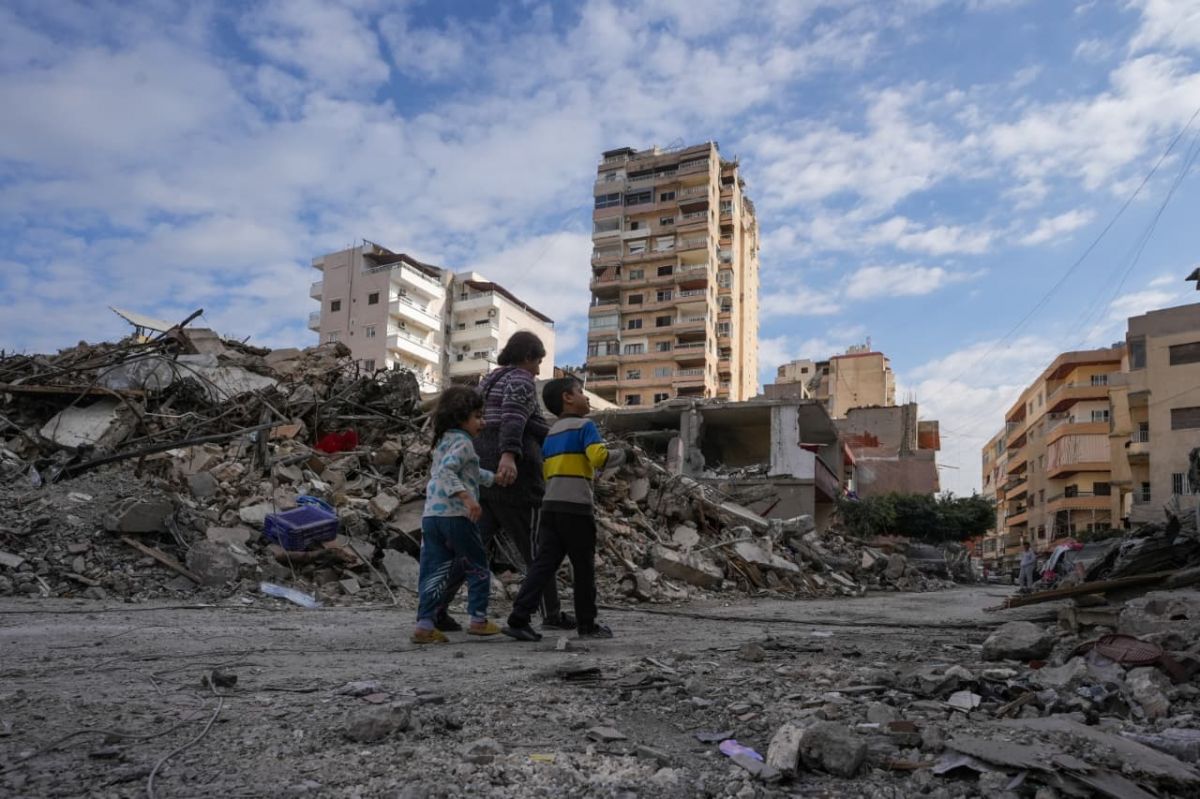
A family walks through the rubble in the streets of Sour, Nov. 28, 2024 (Credit: Mohammed Yassine/L'orient le Jour)






A fragile status quo while waiting for regional developments. This is, in short, the best way to describe the situation in Lebanon after the agreement on the first phase of Trump's plan for Gaza.
While many talk about a new Israeli war against Hezbollah after calm returns to Gaza, the latter does not believe in such a scenario, for many reasons. But it is not the only one to think so, Lebanese official circles are also convinced. Sources close to both sides advance five arguments, some linked to the broader context and others to the local realities.
Concerning the overall context, the aforementioned sources are convinced that the decision in the region, and particularly regarding Lebanon, is currently in the hands of the United States, which clearly has enormous influence over the situation.
In the current climate, with the Americans believing they have helped bring to power in Lebanon parties close to them, why would they want to risk having those parties weakened or even swept aside by another major Israeli attack, especially when a replacement is not assured and chaos could prevail in the country?
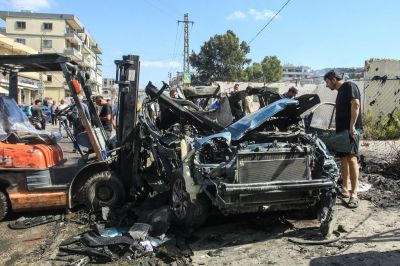
The second argument is as follows: By presenting Lebanese officials with the document from envoy Tom Barrack, and later after it was criticized by former U.S. ambassador to Lebanon Liza Johnson, the Americans have, in a way, managed to place Hezbollah’s weapons at the forefront of Lebanese priorities.
Debates on this issue abound between Hezbollah’s opponents and supporters, to the point that the demand for Israeli withdrawal from five (actually seven) positions occupied in the aftermath of last autumn’s war has become secondary. Therefore, if Israel were to launch a new war today, that could bring the withdrawal issue back to center stage, while one of the current objectives is to foment internal conflict in Lebanon, or even confrontation between Hezbollah and the army.
The third argument, according to the same sources, is a continuation of this idea. Another large-scale Israeli attack could put the army on the spot in terms of having to defend Lebanese territory, and at the same time, could give Hezbollah renewed legitimacy by allowing it once again, as it had done for years, to present itself as the sole defender of this territory.
Similarly, the fourth argument is that the current situation is entirely in Israel’s favor: they carry out attacks when they wish and under their preferred terms, without fear and without risking retaliation from either the state forces or Hezbollah.
The latter is even criticized by its opponents on this score, as some openly ask why it does not respond to Israeli attacks targeting mainly its personnel and military facilities, while it repeatedly refuses to hand over its weapons.
The prevailing question in Lebanon today is about the usefulness of Hezbollah’s weapons, which it refuses to cede to the state but does not use to counter Israeli aggression. In this context, the Israelis prefer to let this new controversy grow, rather than give Hezbollah a pretext to alter the current state of affairs.
Finally, the last argument concerns the Israeli domestic front. Why would the Israelis risk starting a new war against Lebanon, when residents of the northern regions, who had been forced to flee for months after Hezbollah opened the front in support of Gaza on Oct. 8, 2023, have now returned home? The issue of displacement was a real problem for Netanyahu’s government — and had become a priority because of the public criticism it caused.
For all these reasons, the prevailing tendency in Lebanon is not to believe in the outbreak of another Israeli war in the near future. However, this conviction does not apply to the rest of the region.
An Iranian official (Ali Akbar Velayati) recently declared that a cease-fire in Gaza could mean an escalation elsewhere. He mentioned, in this context, Iraq, Yemen... and Lebanon. Since Lebanon seems ruled out for the reasons already discussed, this leaves the other two — and a third, which the aforementioned official avoided mentioning: Iran itself.
According to sources close to the Islamic Republic, Iran is convinced Israeli strikes are coming. The only question is when. These same sources revealed that two days ago, Iran was placed on maximum alert because information had been received about the imminence of an Israeli attack.
But nothing happened. This does not mean that the risk of a new attack has been eliminated. On the contrary, Israelis believe that the threat posed by Iran must be definitively neutralized, especially since the country now has a network of allies throughout the region — what has been called the "axis of resistance."

For Israelis, half-measures are no longer enough. As Tom Barrack said in one of his interviews, "the head of the snake must be cut off," otherwise the "axis" could always re-form and represent a risk to Israel.
Sources close to Hezbollah believe the risk is real, but that the time for a new Israeli attack against Iran may not have come yet. Quite simply because nothing has changed in the balance of power since the last attack in June 2025, which required American assistance to achieve even part of its objectives.
Finally, such a decision requires a green light from the U.S., which does not seem to be forthcoming for now. But this does not mean it could not be granted one day. If that happens, Hezbollah refuses to say what its reaction might be.
