





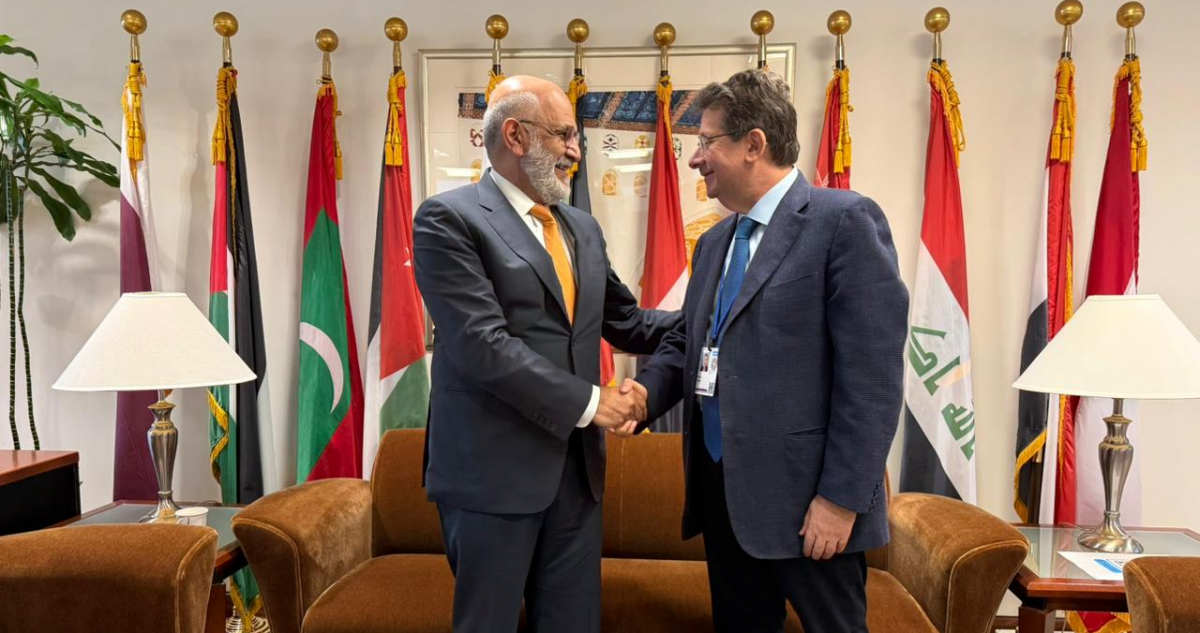
The chairman of the Parliamentary Finance Committee, MP Ibrahim Kanaan, and the executive director of the World Bank, Abdelaziz el-Mulla, in Washington this week. (Photo released by NNA on Oct. 16, 2025.)






BEIRUT — The president of the parliamentary Finance Committee, MP Ibrahim Kanaan (formerly of the Free Patriotic Movement), affirmed that the plan for the distribution of losses being prepared by the government of Nawaf Salam had received an “agreement in principle” from the International Monetary Fund (IMF).
The IMF views this draft law as one of the main prerequisites for a preliminary agreement that could enable Lebanon to enter into a short- or medium-term financial assistance program.
He made these comments from Washington, where he took part in the annual meetings of the IMF and the World Bank, alongside the Lebanese delegation led by Finance Minister Yassine Jaber, who was also present.
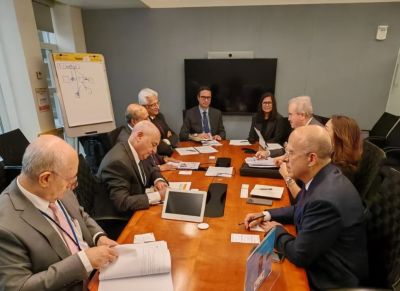
“The financial gap law and the restitution of deposits, the result of several years of work, are now on the IMF’s table, which has agreed to them in principle, which will make it easier in the future to establish concrete mechanisms for the restitution of bank deposits frozen by the sector since the start of the crisis that began in 2019,” he stated more specifically.
The details of this draft law have not yet been made public. However, regarding the distribution of the country’s financial losses, the IMF has repeatedly made clear that it will make no concessions on the principle of the hierarchy of responsibilities, and insists that bank shareholders must be called upon before depositors are affected.
The IMF, which does not rule out that the state could also be required to contribute, considers that the priority of such a plan must be to protect small depositors, while also judging it difficult not to use part of large deposits, given the scale of the country’s financial losses compared to the revenues it is able to generate for its recovery.
But many MPs, including Kanaan, refuse to consider any "haircut,” while Banque du Liban (BDL, central bank) Governor Karim Souhaid, who is accompanying Jaber in Washington, for his part advocates reducing BDL’s deficit by about $30 billion by eliminating irregular claims — that is, deposits that would have been constituted illegitimately according to certain criteria — but not illegally. This is another solution the IMF considers contrary to international standards.
For now, no official word has come from Washington, where the Lebanese delegation traveled without much hope of advancing the pace of reforms, which have slowed since last April.
Earlier this week
First 'positive' and 'frank' day for Lebanon at IMF and World Bank annual meetings
According to a statement released by the National News Agency (NNA), Kanaan met with World Bank Executive Director Abdelaziz al-Mulla for a discussion focused on the organization’s various ongoing projects aimed at financing the rehabilitation of the country’s infrastructure, weakened by years of crisis and mismanagement and, in some cases, destroyed by Israel's aggression on Lebanon.
The MP also met with the IMF mission chief for Lebanon, Ernesto Ramirez Rigo, for a meeting he described as “positive and constructive.” He also visited the U.S. Treasury Department, where he met with the Deputy Assistant Secretary of the Treasury, Maida Fornia.
Among other statements reported by NNA, Kanaan said, “U.S. interest in Lebanon is evident, and we all know how influential this role is, at a time marked by an unprecedented U.S. presence in the region and worldwide.”
He also said that “on the political level, it is necessary to restore confidence in Lebanon through support for the state-building project,” adding that he had “sensed American appreciation for the role played by President Joseph Aoun and the government.”

 7 p.m. recap: Iran warns Egypt, Israeli soldiers vote in south Lebanon, Haret Hreik responds to Kataeb