


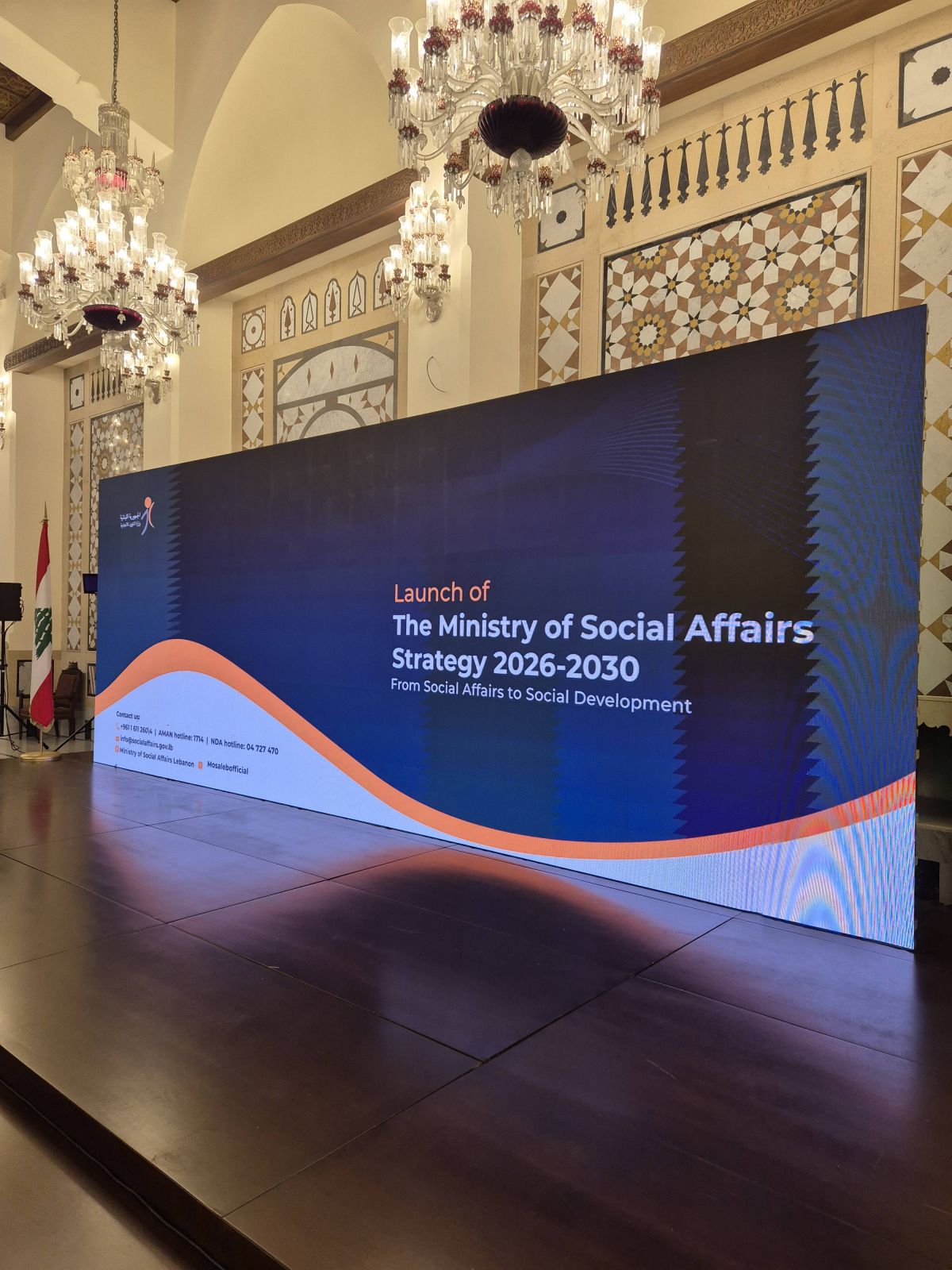
Launch of the Grand Serail strategy. (Credit: Ghassan Nehmeh/L’Orient-Le Jour)






More than just a name change, it is a true "transformation of concept, vision, and role."
By unveiling her ministry's new strategy — now renamed the "=Social Development Ministry "— on Friday at the Grand Serail, in the presence of Prime Minister Nawaf Salam and a large number of ministers, MPs, senior officials, and representatives of international organizations, Minister Hanine al-Sayyed was keen to emphasize the shift in the government's social policy.
'A ministry of the people'
"Our ministry is no longer simply a distributor of aid," she said. "It is becoming an institution that thinks, plans, and acts to make a real difference in citizens' lives. It is the ministry of the people, the human face of the state."
She explained that the new framework integrates social protection, public services, and economic empowerment within a unified system, reflecting a holistic approach to well-being.
"A person's social needs cannot be separated from their health, economic stability or sense of security and justice," she emphasized. The minister stressed the central role of economic inclusion, developed in close partnership with the private sector. "True dignity cannot be achieved without the ability to work and produce," she said, before concluding: "Poverty cannot be reduced through assistance, but through empowerment and opportunity."

The minister also recalled the three pillars of the ministry: Social assistance, which includes in particular the AMAN program and the national allowance for persons with disabilities, in a country where the unemployment rate reaches up to 45 percent in some regions and 86 percent among people with disabilities, the second pillar is social services, built around 165 social development centers and more than 200 partners, and finally, economic inclusion and local development, considered as essential levers for sustainable recovery.
She also announced the complete digitization of databases and the interconnection of regional centers to improve transparency and equitable access to public services. "From Akkar to Sour, from Baalbek to Chouf, these centers are the human face of the state," she said. "Our ministry makes no distinction by region, community, or confession. It belongs to all Lebanese."
Recognizing the crucial role of the ministry's staff, the minister confirmed the reintegration into Social Security of social workers and administrative employees, the launch of training programs, and the preparation of a legal framework to formalize the profession of social worker.

Sayyed also reaffirmed the central role of the ministry in the matter of the return of Syrian refugees, advocating for a coordinated approach that guarantees a safe and dignified return, while easing pressure on host communities.
'National priority'
Recalling that social spending in the 2026 budget increased by more than 40 percent compared to the previous year, delivering "a clear message: Social protection is a national priority."
Salam in turn praised the work of the Social Development Ministry, whose strategy "fits within efforts to build a state of law and not of assistance, of development and not of emergency."
The prime minister mentioned "the challenge of transforming the administration into a public service and the programs into policies whose results are measurable." And to conclude: "This strategy does not belong to this ministry, but is an inclusive national framework, in which state institutions complement one another."

 7 p.m. recap: Houthis threaten Riyadh, Netanyahu talks of prolonged war against Hezbollah'; Israel arrests 2 men in Syria