





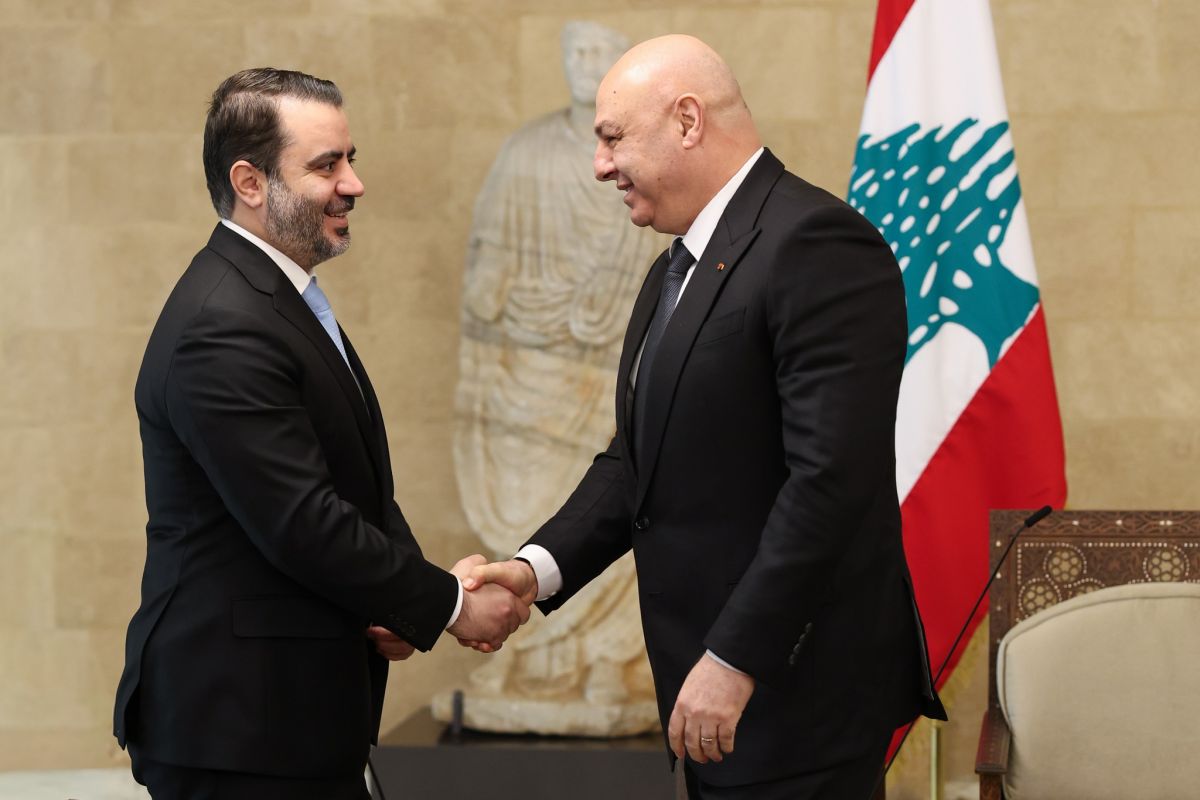
President Joseph Aoun welcoming the Syrian Minister of Foreign Affairs, Assaad al-Shaibani, before a meeting at the presidential palace in Baabda, on Oct. 10, 2025. (Credit: The presidency)






BEIRUT — From Beirut on Friday, Syrian Foreign Minister Assaad al-Shaibani — the first high-level official to make such a visit since the fall of the Assad regime — expressed the new Syria’s willingness to 'open a new page' with Lebanon.
Promise kept: Even before the minister’s arrival, Bustros Palace was notified, through the Syrian Embassy in Lebanon, of the decision to suspend the activities of the Lebanese-Syrian Higher Council and to restrict all types of correspondence between the two countries to official diplomatic channels. Lebanese Foreign Minister Joe Rajji announced that this body "is now a thing of the past."
'Today, we have opened a new page in relations between Syria and Lebanon," declared the Syrian minister after a meeting with Prime Minister Nawaf Salam. He described his visit as "historic," adding that Damascus is committed to "respecting Lebanon’s sovereignty" and the principle of "non-interference" in its affairs.
In addition to the head of government, Shaibani met at the Grand Serail with Deputy Prime Minister Tarek Mitri, Rajji, and Justice Minister Adel Nassar.
At the same time, security meetings were held between General Security Director General Hassan Choucair and Syrian Deputy Interior Minister for Security Affairs, General Abdel Kader Tahan, as well as between Lebanese Army Intelligence Director General Tony Kahwagi and Syrian Intelligence Chief Hussein al-Salameh.
In Baabda, Shaibani assured President Joseph Aoun that Syria was "ready to discuss any outstanding file, whether economic or security-related," and stressed the need to "correct past mistakes and build the future," while reaffirming "the sovereignty of Lebanon and the desire to establish strong relations based on respect and cooperation."
President Aoun, called for "strengthening relations between the two countries on the basis of mutual respect and non-interference," "enhancing political, economic, and security cooperation," and reviewing past agreements.
He highlighted the importance of creating joint committees to examine pending files and asked Syria to appoint a new ambassador to Lebanon to facilitate follow-up through the embassies in Beirut and Damascus.
The president also noted that suspending the Lebanese-Syrian Higher Council requires a law passed by Parliament in order to allow the resumption of diplomatic relations between the two countries on a state-to-state basis.
Shaibani renewed Syrian President Ahmad al-Sharaa’s invitation to Aoun to visit Syria, arguing that the ongoing reconstruction in the country would have positive repercussions on Lebanon and ties between the two peoples.
Aoun said he was ready to make this visit after the two countries had raised the level of diplomatic representation, in turn inviting President Sharaa to Beirut.
Notably, the Syrian minister did not meet with Parliament Speaker Nabih Berri, an ally of Hezbollah.
Syrian detainees
His talks mainly focused on resolving the issue of Syrian detainees in Lebanon, on ways to encourage the return of refugees, and on control of the shared border to prevent smuggling.
He said discussions had "advanced considerably" on the detainees issue, which Damascus is demanding be resolved through their release. "We discussed the need to accelerate resolution of the issue," Shaibani said after his meeting with Prime Minister Salam. "In the coming days, there will be tangible results."
According to information obtained by L’Orient-Le Jour, Syria has requested the release of all its nationals detained in Lebanon. Lebanese authorities responded that this was not immediately possible for judicial reasons and that the procedure had to follow legal channels.
The Lebanese justice minister insisted on the need for a joint judicial agreement requiring a law passed by Parliament, while the prime minister proposed a quick mechanism not requiring parliamentary approval.
Shaibani again stressed the urgency of releasing the detainees in the coming days, or if not, at least 500 of them.
Lebanon specified, however, that it could not release such a number at once and that the process should go forward in phases, in smaller groups, following the mandatory judicial process. Next Tuesday, a Syrian delegation led by Justice Minister Mazhar al-Louais will travel to Lebanon to continue discussions on this matter and to expedite the release of some detainees.
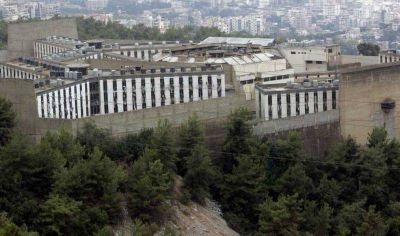
A Lebanese judicial official who requested anonymity told AFP that around 2,250 Syrians are detained in Lebanon’s overcrowded prisons. Lebanon, meanwhile, has asked the new Syrian authorities for information on the many political assassinations attributed to Damascus during its tutelage over Lebanon and after the withdrawal of its troops in 2005, said Nassar to AFP.
"We have requested all the information in the Syrian party’s possession about the assassinations that took place in Lebanon," he said, listing the many figures killed, including former Prime Minister Rafic Hariri. He said the Syrian side had "shown cooperation" on the matter.
Borders and security
The talks also addressed the return of Syrian migrants and refugees, with Lebanon hosting around 1.3 million who fled Syria after the civil war sparked by the crackdown on a popular uprising against the Assad regime in 2011. According to the U.N., about 294,000 of these refugees have returned home since Assad’s fall.
Shaibani stated that his country is currently "studying plans with international support for a dignified return." The porous border between the two countries and measures to strengthen security and intelligence cooperation were also on the agenda.
According to our information, the Syrian delegation requested the withdrawal of the Lebanese Army from four positions in the heights of the Bekaa, where it has been since the 2014 Battle of Ersal.
The Lebanese Army insists these areas are Lebanese land. It was agreed that these disputed points would be addressed as part of the border demarcation process. On the military front, the Syrians requested the return of tanks brought into Lebanon after the fall of the Assad regime. An agreement was reached to return these tanks and weapons, although the army claims the equipment belongs to the Popular Front for the Liberation of Palestine – General Command (PFLP-GC).
The Syrian delegation also requested, according to our sources, the removal of entry fees for citizens of both countries. It was decided to work toward lifting the $50 entry fee required for Syrians entering Lebanon and for Lebanese entering Syria. Economic cooperation and reopening trade routes were also discussed, with an agreement to restart talks.
The Qataris expressed willingness to support joint projects and to encourage the conclusion of agreements between the two countries. Salam mentioned reviving oil and gas transport lines to Tripoli in order to deliver Qatari gas to the refinery.

 Evening recap: Netanyahu announces West Bank offensive; 7 killed in Jordan church shooting; tents burned in south Lebanon
 US strike on Iran this weekend? ‘Absolutely,’ says Barrack; ‘I have no idea,’ says Trump