





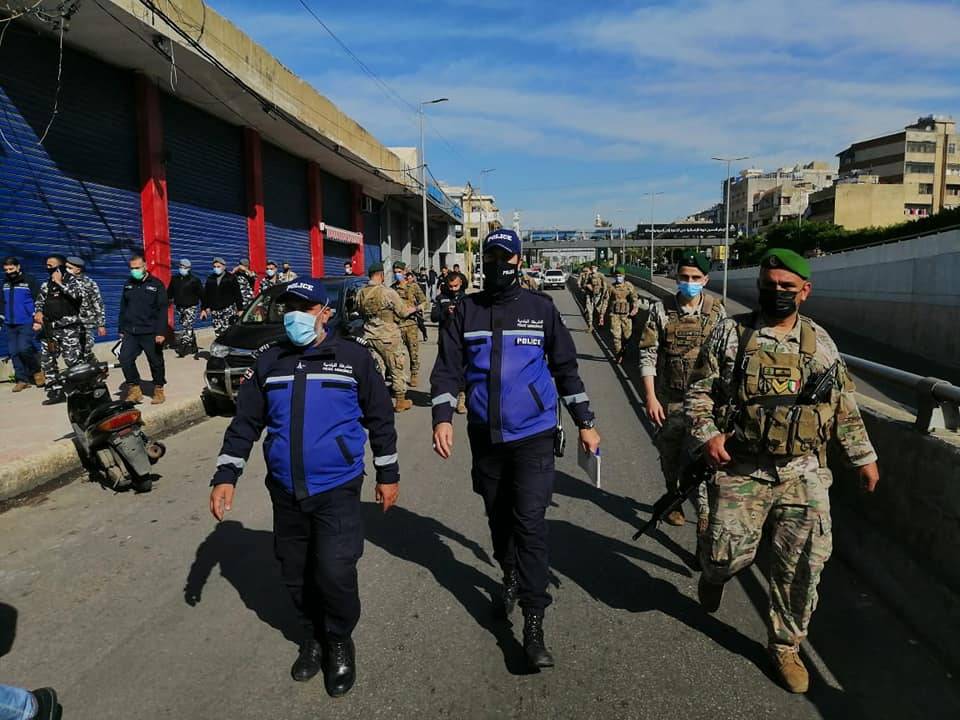
Police officers from the municipality of Ghobeiri with soldiers from the Lebanese Army, Jan. 24, 2021. (Credit: GhobeiryLB/Facebook account)






BEIRUT — Lebanon’s General Security (GS) said on Friday it had dismantled a network “operating on behalf of Israel and preparing terrorist acts on Lebanese soil, including targeted attacks and assassinations.”
In a statement, the authority said it had arrested several members of the network, at least four of them, as part of the operation.
According to the GS, one of the detainees admitted that the group was responsible for “previous assassinations targeting officials from Jamaa Islamiya,” a Lebanese Sunni party affiliated with the Muslim Brotherhood and closely linked to Hamas.
The authority said it carried out a “meticulous operational, security and technical monitoring operation,” leading to multiple raids across the country. In one of the searches, a joint force from the Lebanese Army and the army’s intelligence directorate took part, seizing vehicles and equipment used by the network and arresting several suspects.
Those detained include a Lebanese-Brazilian, a Palestinian and two Lebanese nationals. The GS said further details would be released once the ongoing investigation is complete.
Earlier in the day, a security source told L’Orient Today that two people had been arrested in connection with a separate investigation into a suspected plot involving “rigged scooter batteries.”
The suspects were found in possession of the modified batteries, the source said. Several local media outlets reported that the General Security (GS) carried out the arrests, though the authority declined to comment when contacted.
Investigators are examining how the batteries were modified and what targets may have been intended. Reported theories questioned whether the explosives could have been detonated at random — similar to the attack on Hezbollah's pager devices in September 2024 — or aimed at a specific site, such as the mausoleum of assassinated Hezbollah leader Hassan Nasrallah in Beirut’s southern suburbs.
The security source reported that the probe remains ongoing to identify the details.
On Thursday, a judicial official told AFP that the authorities have arrested 32 people in the past few months, found guilty or suspected of passing information to Israel aimed at targeting Hezbollah leaders.
In July, GS confirmed to L’Orient Today that an internal memo had warned of “terrorist groups’ intentions” to smuggle explosive-laden car batteries into Lebanon. However, a GS source at the time said no such devices had entered the country.
The terrorist threat in Lebanon resurfaced at the start of the summer after the suicide bombing at St. Elias Church in Damascus on June 22 that killed at least 25 people. This attack, the deadliest targeting Christians in Syria since the 2011-2024 war began, was claimed by an obscure jihadist group called Saraya Ansar al-Sunna.

Following the Damascus bombing, Lebanese security forces reported a series of arrests linked to suspected terrorist cells operating within Lebanon, though no direct connection to the church attack was established.
Fears of renewed attacks, particularly from groups based in Syria, have also grown following the rise to power in Syria of Ahmad al-Sharaa, the former leader of Hay’at Tahrir al-Sham, an al-Qaeda affiliate. Some of Hezbollah’s critics and regional analysts argue that the group invokes the threat of terrorism to justify retaining its arsenal, as pressure mounts domestically and internationally for it to disarm after the deadly war with Israel.
Beirut’s southern suburbs — a Hezbollah stronghold — have previously been hit by attacks claimed by Islamic State and the al-Nusra Front. In November 2015, twin suicide bombings in Burj al-Barajneh killed 44 people and wounded 240.
