






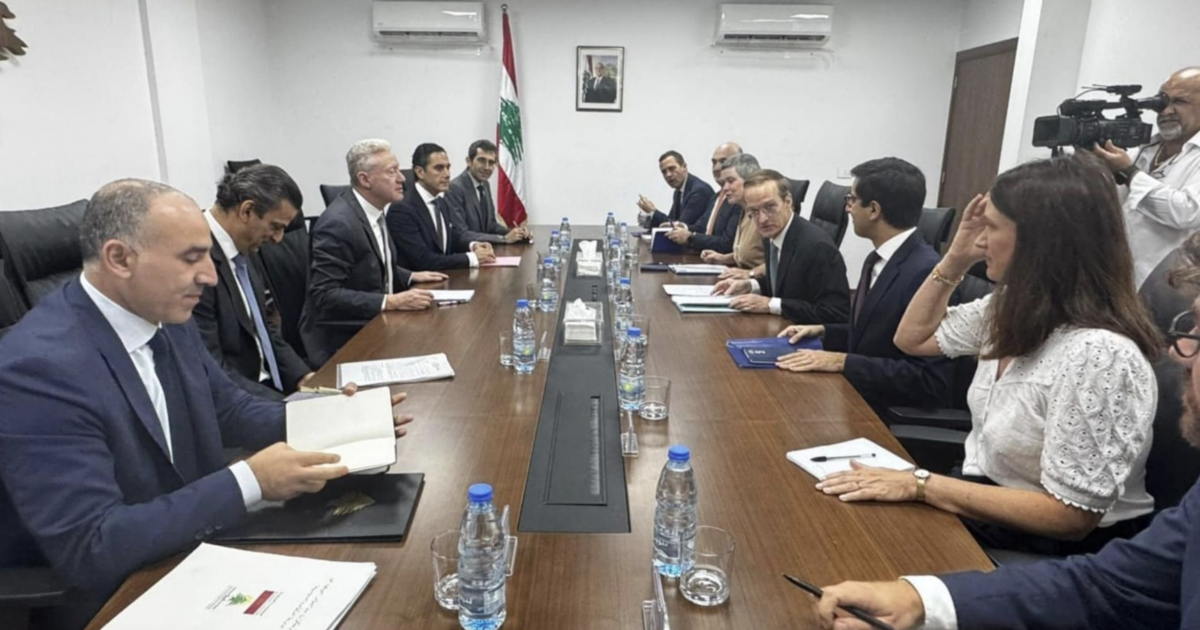
The Minister of Foreign Affairs, Joe Raggi, set to receive delegation from the European Union on Thursday, Oct. 9, 2025. (Illustrative photo from the National News Agency - NNA)






Meeting with a European delegation on Thursday, Foreign Minister Joe Rajji stressed the "importance of continuing support" for the Lebanese Army, particularly in view of the end of the United Nations Interim Force in Lebanon (UNIFIL) mandate in southern Lebanon, scheduled for the end of 2026.
He also called on the European Union (EU) to "put pressure on Israel" to withdraw from Lebanese territory in line with the cease-fire agreed to in November 2024. President Joseph Aoun had met with the same delegation the previous day.
The delegation also discussed support for the Internal Security Forces (ISF) in a meeting ater on Thursday with Prime Minister Nawaf Salam, according to a message from the Grand Serail on X.
Rajji emphasized "the importance of continuing support to the Lebanese armed forces, on which heavy responsibilities will fall, especially in the phase following the end of UNIFIL's mission at the end of 2026," according to the National News Agency (NNA). UNIFIL spokesperson Kandice Ardiel warned Wednesday that there is still "no security or stability along the Blue Line" in southern Lebanon.
He called on the EU to "put pressure on Israel to stop its daily aggressions against Lebanon, withdraw unconditionally from all territories it occupies, and release prisoners." These are conditions also set by Hezbollah for discussing its disarmament, as part of a 'national security strategy'. The minister also said that "the Lebanese government is continuing the path of reforms initiated since its formation, which respond to a Lebanese popular demand before being an international requirement."
Under the cease-fire agreement between Israel and Lebanon signed on Nov. 27, 2024, inspired by U.N. Resolution 1701 of 2006, the Lebanese Army must deploy in southern Lebanon, where it is to be the only armed force, dismantling, with the help of UNIFIL, Hezbollah's military infrastructure. The Lebanese Army informed the Cabinet this week that 9,200 soldiers are currently deployed in southern Lebanon, 2,000 more than in May, L'Orient-Le Jour learned from a government source. By the end of the year, the number is set to reach 10,000.
Charles Fries, deputy secretary general for peace, security and defense at the European External Action Service (EEAS), who is leading the European delegation, said that "the European Union will continue to support Lebanon and its armed forces," presenting several ideas through which the Union could help the country after the end of UNIFIL's mission, NNA reported.
He praised "the essential reforms undertaken by the Lebanese government," stressing that they "will help strengthen the Lebanese-European relationship, especially regarding the financial support the European Union can provide to Lebanon, and raise this relationship to a comprehensive strategic partnership." He also assured his "support for Lebanon's position" regarding the return of Syrian refugees to their country, "provided that this return complies with international humanitarian law."
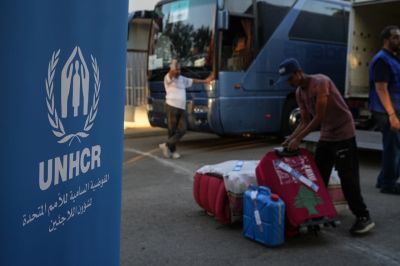
On Thursday morning, a fourth convoy for the "voluntary return" of Syrian refugees and migrants, as part of a plan set up by the UN High Commissioner for Refugees (UNHCR), left Thursday morning, involving 168 families, our correspondent in the north Lebanon reported.
'Need to strengthen support for the FSI'
The delegation then met with Aoun. "The meeting focused on EU support for the Lebanese Army and the importance of continuing this support, as well as the need to strengthen support for the ISF," reported the Grand Serail on X. Nawaf Salam met with the director of the ISF, General Raed Abdallah, ten days ago.
"The measures taken by the government to strengthen the authority of the state were also discussed, as well as the security and military priorities that the EU could help to support," the Grand Serail said.
Before the Prime Minister, the delegation again stressed "the importance of continuing the reform process initiated by the government," also mentioning "the need to reach an agreement with the International Monetary Fund" (IMF).
While Salam and the Ministry of Finance wish to move towards an agreement with the IMF, they are increasingly encountering latent resistance — even outright opposition — from other actors, foremost among them the Banque du Liban (BDL, central bank), the banking sector, and employers' organizations.

