





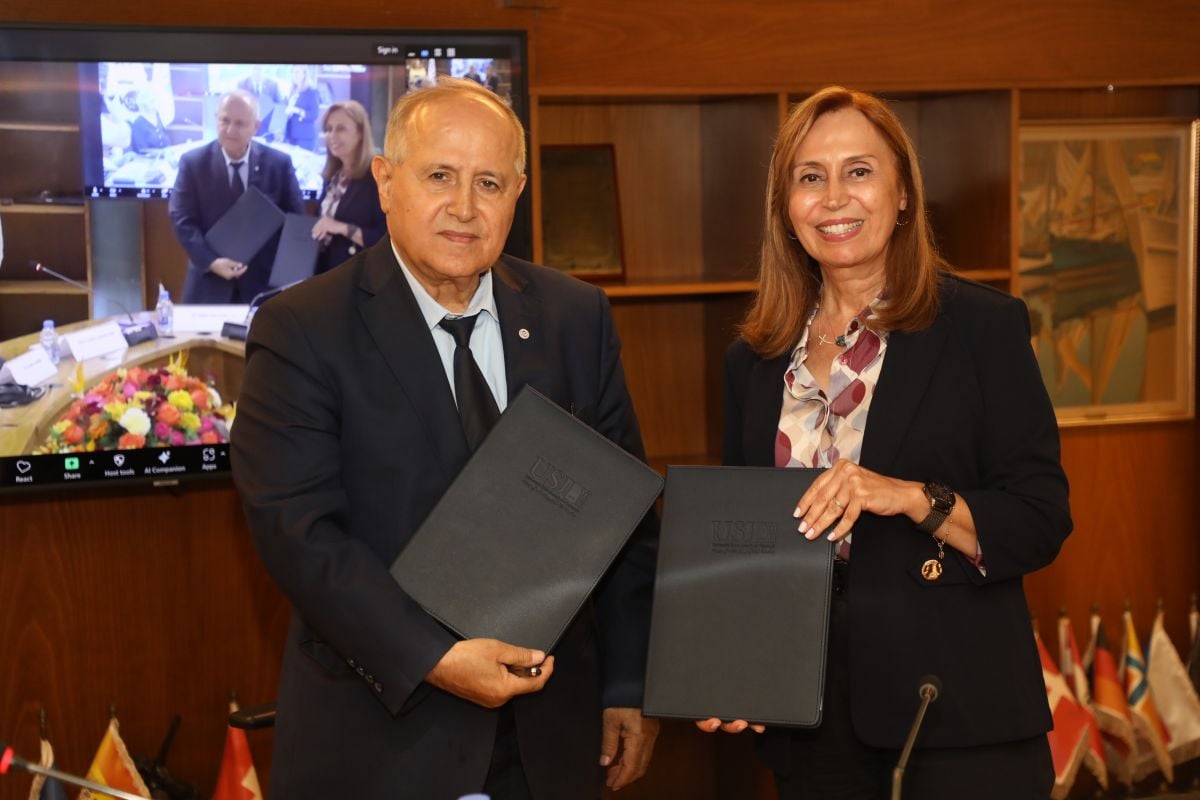
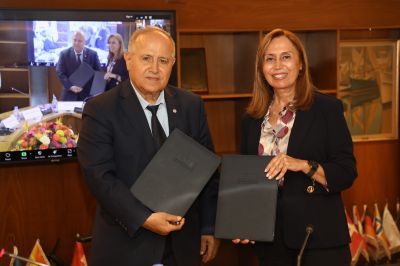
A memorandum of understanding was signed between the rector of USJ, Father Salim Daccache, and the dean of the FdLT, Professor Gina Abou Fadel Saad, in order to establish a scholarship fund intended to support ETIB students. (Credit: ETIB)






On Sept. 30, to mark World Translation Day, the École de traducteurs et d’interprètes de Beyrouth (ETIB) (School of translations and interpretations of Beirut), a cornerstone of the Faculty of Languages and Translation at USJ (FdLT), inaugurated two new rooms equipped with cutting-edge technology, thanks to a generous donation from the Swiss association ALAM (A Better Future for Lebanon) and the USJ Foundation.
The Joseph Zaarour Room is now suited for videoconferences, seminars, roundtables, and remote thesis defenses, meeting the needs of an increasingly connected academic world. The Saint Jerome Room, meanwhile, is intended for students and serves as a dedicated space for interpretation training and academic gatherings.
To mark the 45th anniversary of ETIB's founding, a memorandum of understanding was signed between USJ rector Fr. Salim Daccache and FdLT Dean Prof. Gina Abou Fadel Saad to establish a scholarship fund "designed to support ETIB students, so their future can live up to their dreams," as specified by Cynthia Ghobril Andrea, director of the USJ Foundation, with the possibility for friends and partners of the school to contribute.
During the inauguration ceremony, FdLT Dean Prof. Gina Abou Fadel Saad discussed contemporary issues in translation and presented the evolution of the discipline toward a genuine science: Translatology.
While technology is now omnipresent in the translator's profession, it does not replace humans. On the contrary, it requires constant adaptation, technological awareness, and advanced training to make the most of AI tools.
Professor Saad also highlighted the importance of cross-disciplinary skills in the digital age: Critical thinking, adaptability, emotional intelligence, creativity... Translators and interpreters must become "augmented" professionals, able to master technology to better put it to use.
Prioritizing the search for meaning over the letter
ETIB Director Mary Yazbeck took the floor to remind the audience that translation, far from being a simple technical exercise, is a true act of re-creation.
For her, translating means giving thought a second life, going beyond words to reveal meaning and human scope, valuing localization and cultural adaptation, and enhancing the strategic role of translators as builders of bridges between cultures, especially in the Arab context.
She also stressed the importance of developing the Arabic language in the field of technology, so that it may one day enrich large language models.
The fundamental debate about fidelity in translation was reignited by Daccache. He spoke of the old controversy between St. Augustine and St. Jerome, who "advocated sense-for-sense translation rather than word-for-word, convinced that true fidelity does not reside in the letter but in the living meaning that enlightens the words," rightly stated the USJ rector. Calling for "giving priority to the search for meaning rather than the letter, as literalness does not always provide meaning."
During the evocatively titled roundtable "Saint Jerome Facing the Trial of Artificial Intelligence," Albert Moukheiber, neuroscientist, psychologist and research professor, called for an "epistemic vigilance" with regard to technology that, though effective, is still subject to subjectivity and errors.
He warned against blind trust in these systems and pointed out their limitations, insisting that artificial intelligences inherit human cognitive biases. According to him, AI often reflects our own biases and beliefs, which can lead to a distorted perception of reality, even to deep misunderstandings.
The challenges of training
Outlining the issues linked to integrating technologies in translator and interpreter training, Prof. Lina Sader Féghali, head of the interpreting department at ETIB, noted that AIs are increasingly being trained on content produced by other AIs, leading to the generation of imprecise and incoherent content, as well as the impoverishment and standardization of languages.
According to her, AI is here to stay and the mission of every educational institution, like ETIB, is "to train future professionals who know how to think, act and react as creative human beings and not as automatons — investing, in other words, in intrinsically human skills."
"It is by learning to interact constructively with AI tools that human translators will learn not to settle for the "good enough" quality the machine can provide, but instead aim to challenge — and even surpass — it."

As for Professor Bart Defrancq, president of the Permanent International Conference of University Institutes of Translators and Interpreters (CIUTI) and professor at Ghent University (Belgium), he presented the experience of using interpreter assistance tools (IATs) in booths, highlighting mixed results depending on user profiles and emphasizing the importance of training in new technologies.
Finally, Nidale Noun, head of conference management at U.N.-Escwa and ETIB alumna, reminded the audience of the essential role of the translator as a creator of meaning.
World Translation Day at ETIB once again underscores this year that artificial intelligence is profoundly transforming practices, but can never replace human intelligence. Above all, it highlights ETIB's mission: To train professionals capable of mastering technology while upholding an ethical and humanist vision of their field.

 Evening recap: Netanyahu announces West Bank offensive; 7 killed in Jordan church shooting; tents burned in south Lebanon
 US strike on Iran this weekend? ‘Absolutely,’ says Barrack; ‘I have no idea,’ says Trump