


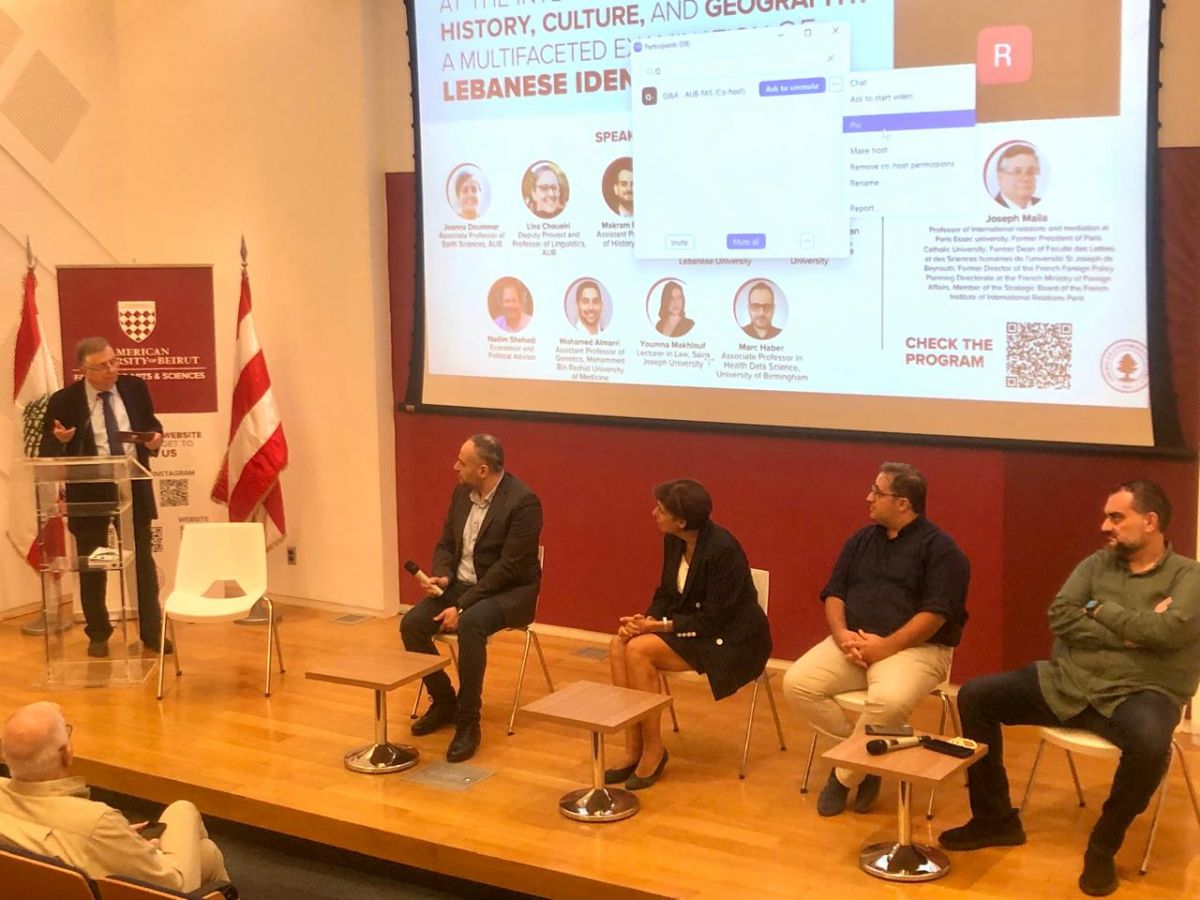
Professor Joseph Maïla, on the left, during a debate with the seminar participants, on Oct. 3, 2025, at AUB. (Credit: Zeina Antonios/L'Orient Today)






BEIRUT — The Michel Chiha Foundation, the American University of Beirut (AUB), and Saint Joseph University (USJ) organized a seminar on Friday exploring Lebanese identity through the lens of academic research.
Titled "At the crossroads of history, culture, and geography: A multidimensional analysis of Lebanese identity," the event was moderated by Joseph Maïla, professor of geopolitics and international relations. Discussions focused on the cultural, geographical, and genetic heritage of modern Lebanon.
"We use mythological elements to begin constructing an identity and lend it legitimacy, then comes the will to live together," begins Amine Elias, a specialist in the history of ideas in the Arab-Mediterranean world. "The national narrative, the founding myth, is a blend of fact and mythology. The will to coexist could be a good thing for the development" of a national identity, he said.
Reflecting on the work of philosopher and politician Michel Chiha and his theories about Lebanon, historian Makram Rabah suggested that "Chiha's vision, which described Lebanon as a message, was never implemented."
"Chiha believed that Lebanon should be both Arab and Western in order to survive, which made it extraordinarily resilient," Rabah explained, considering that today's "digital nationalism" developed on social media "undermines the bridge between East and West that Chiha mentioned."
"The Lebanon of tomorrow must cultivate a civic pact that recognizes difference as a strength," he advocated.
Researcher Nadim Shehadi, believes that "Lebanese identity is disintegrating and the new generation rejects the conception of Lebanon advocated by Chiha."
Chiha, owner and editorialist of "Le Jour" from 1937 until his death in 1954, was the theorist and architect of the Lebanese constitution. He also called for the development of multiculturalism and liberalism in Lebanon, as well as openness to the West and the Arab world.
DNA, personal status, and the Arabic language
On the genetics front, a study led by Marc Haber, a researcher at the University of Birmingham, shows that today's Lebanese "demonstrate genetic continuity with the Canaanites of the Bronze Age."
He revealed that he worked on ancient DNA collected from bones discovered at excavations carried out in the past ten years in Sidon by archaeologist Claude Doumet Serhal. "We reconstructed the DNA of these 4,000-year-old individuals from the Canaanite era. We found a great degree of genetic continuity between that period and present-day Lebanon," despite the many peoples who have passed through Lebanon, including the Crusaders, Haber said.
Lebanese identity is also linked to personal status laws, which differ according to religious communities and "determine who we are," said Youmna Makhlouf, lecturer at Saint Joseph University (USJ).
"Belonging to a religious community determines a person's status, the laws that govern them, and the implications for access to certain civic and political rights," she continued. "We have a civil identity and a religious identity, an individual identity and a collective one. This will create a lot of tension," said Makhlouf, who called on "the Lebanese state to implement civil family law for those who don’t wish to be subject to religious law."
Linguist Lina Choueiri, meanwhile, looked at Lebanese identity through the prism of the Arabic language, noting that "the 2019 thawra [revolution] reshaped linguistics in Lebanon and pushed many people to express themselves in Arabic on social media." According to her, the Arabic language "carries an ideological weight," and its "complex interweaving aligns with the identity claims of the youth."

 7 p.m. recap: 1 person killed near border with Lebanon; 200 kilos of explosives carried by mules; Riyadh shuts its airspace