






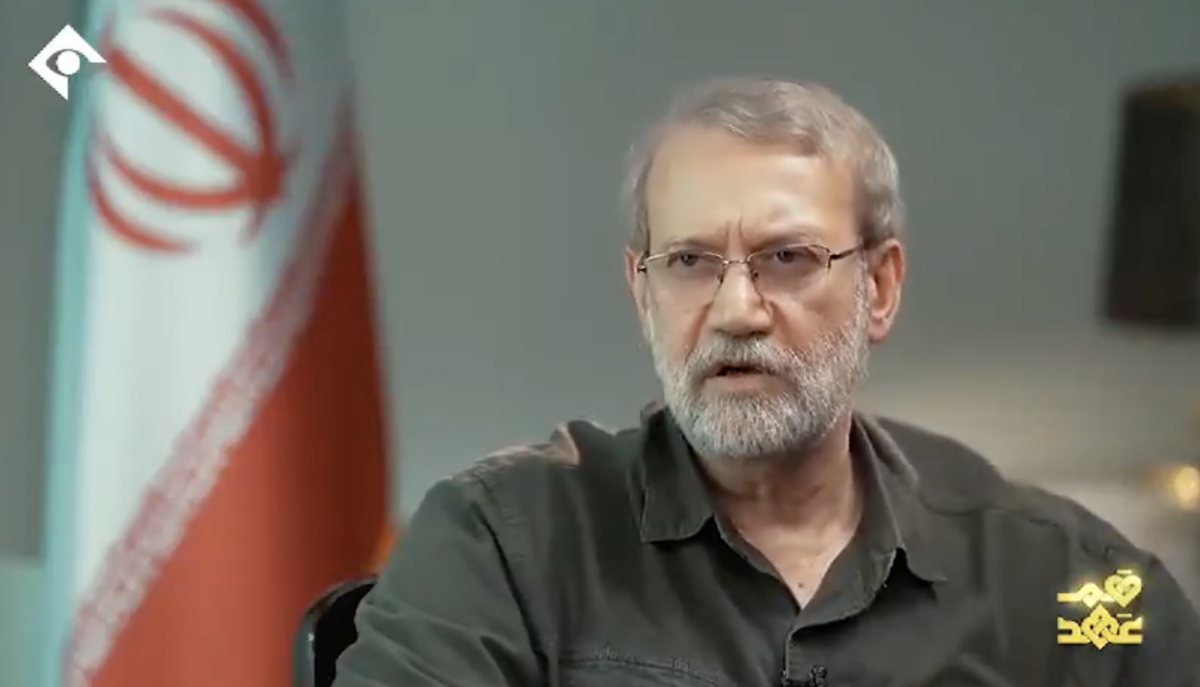
Screenshot of an interview given by Ali Larijani, Secretary of Iran’s Supreme National Security Council, on the Iranian program ‘Ham-e‘ahd’ Wednesday, Oct. 1, 2025.






Ali Larijani, secretary of Iran's Supreme National Security Council, said Wednesday that Hezbollah is not launching military operations "because it does not want to break the cease-fire" between Lebanon and Israel, during an interview on the Iranian television show "Ham-e‘ahd," reported by Iranian news agencies.
"If Hezbollah is not acting right now, it is because it does not want to break the cease-fire between Lebanon and the Zionist regime; otherwise, it has the ability to upset the balance on the ground," he stated. "For now, it is exercising restraint," he added. According to him, "the standing and prestige of this movement explain Israel’s concern." "If Hezbollah were superficial, there would be no fear, but its depth requires a more careful assessment of its regional influence," said Larijani.
Even though Hezbollah came out greatly weakened from its last war with Israel, having lost its historical leadership and thousands of fighters, according to the party itself, Larijani said he observed "a profound renewal within the movement" during his trips to Beirut: "They have largely rebuilt and very quickly," he boasted.
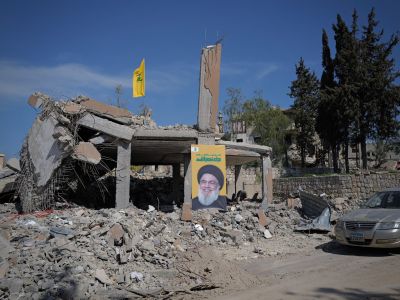
"It is undeniable that Hezbollah has taken hits — assassinations of leaders, losses — and this caused a shock," he also acknowledged, noting that "the charisma of [Hassan] Nasrallah had a moral effect on the entire movement." Serving as the party’s secretary general for 33 years, Nasrallah was assassinated in massive strikes on Beirut's southern suburb on Sept. 27, 2024.
The adviser to Ayatollah Ali Khamenei dwelled at length on this figure, "inclined toward consultation." "Many leaders make good decisions but lack that human charm; Nasrallah, however, had a spiritual dimension, showed humility and possessed a palpable charisma," he said. "He considered himself bound to follow the opinion of the Council [Hezbollah's executive council, the Shura]. Even in meetings we attended with … Qassem Soleimani [the Iranian general considered number two in the 'Axis of Resistance,' assassinated in Baghdad on Jan. 3, 2020, by a U.S. drone strike, Ed.], and other friends, there were times he had a firm opinion; but when new elements emerged in the debates, he demonstrated acceptance and flexibility," he explained.
'The situation in Syria will not remain as it is'
Larijani also said that "foreign" interventions, particularly in Iraq, contributed to the formation of "resistance" there: "At a meeting, I was asked why we wanted to create a current of resistance in Iraq; I answered: 'Weren’t you the ones who created Hezbollah in Lebanon? Now you’re reproducing the same thing in Iraq.'"
According to him, mistakes of "interference and humiliation" of local populations fostered the rise of resistance movements, "which Iran then supported."
"If America wants to attend funerals every day by attacking various countries, the situation in Syria will not remain as it is; Syria has a Muslim people and they will not accept the status quo," he said in this context.
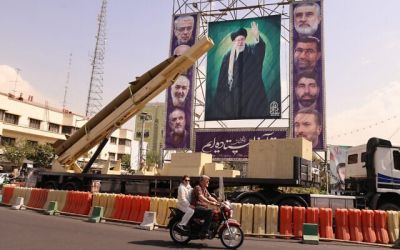
In September 2015, Ali Reza Zakani, a Tehran MP, had said that with the capture of Sanaa, Yemen's capital, by the Houthis, Tehran now controlled four Arab capitals — the other three being Baghdad, Damascus and Beirut. In 2017, Ali Akbar Velayati, then chief adviser to Iran’s Supreme Leader Khamenei, declared from Aleppo, Syria, that "the line of resistance runs from Tehran through Baghdad, Damascus, and Beirut to reach Palestine."
In light of the regional upheaval triggered by the war that began with the Hamas attack on Oct. 7, 2023, and Israel’s subsequent response — whose consequences have extended across the region — Iran has seen its "axis" wither, especially after the fall of the Assad regime in Syria in December 2024, to the benefit of a Sunni Islamist coalition hostile to the "Shiite crescent" in the region.
Regarding the nuclear issue, while the UN officially reinstated its sanctions on the Islamic Republic of Iran Sunday evening, after negotiations failed, Larijani stated that "when the American side explicitly says the range of your missiles must be less than 500 kilometers, it shows that they do not want real negotiations."
