


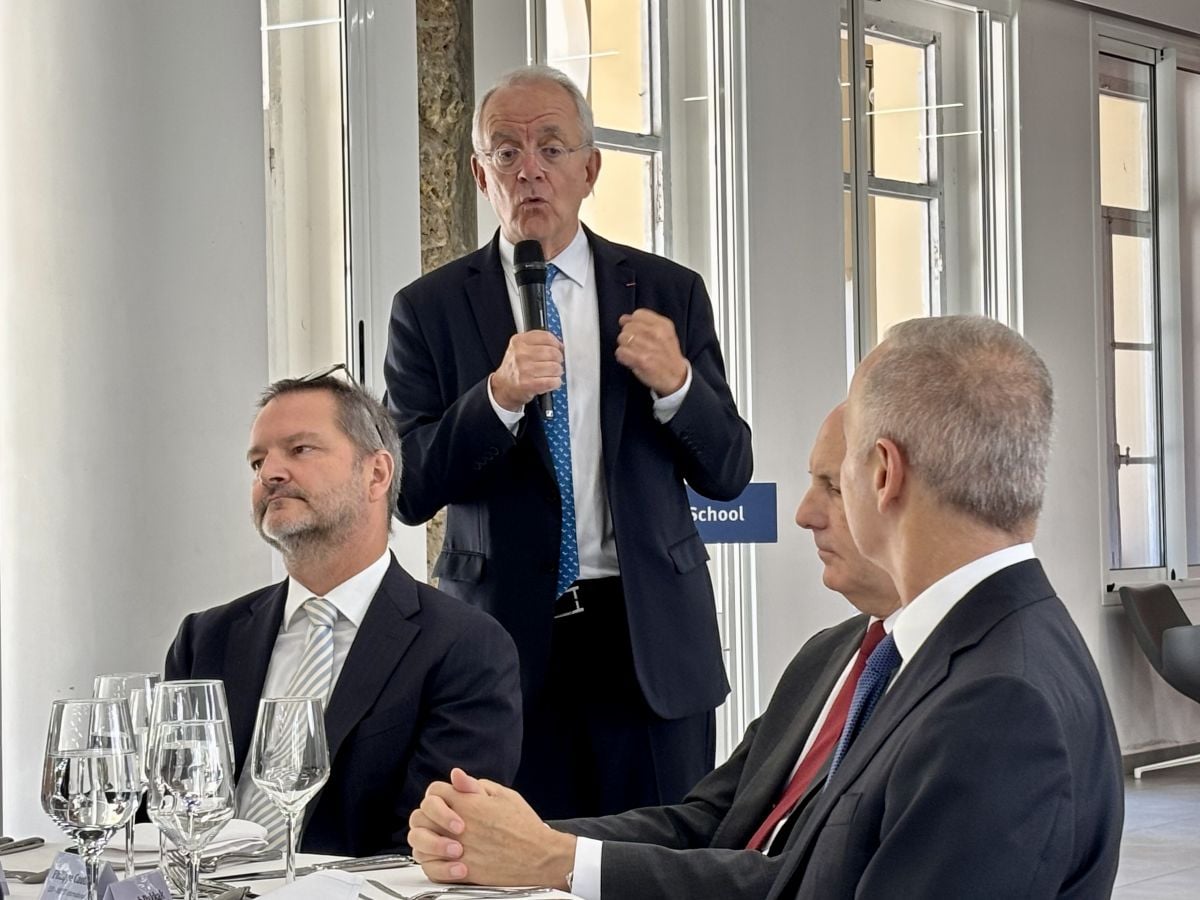
Gerard Wolf, who leads the Medef International delegation, speaking at ESA alongside François Spiorrer, head of the regional economic service for the Near East at the French Embassy, on Sept. 29, 2025. (Credit: Philippe Hage Boutros/L’Orient-Le Jour)






In July 2021, a delegation from Medef International — the foreign affairs arm of France’s largest employers’ union — visited Beirut to present its vision for the capital’s reconstruction after the Aug. 4, 2020 explosion.
After a four-year absence, during which the situation in Lebanon has changed dramatically, a much larger contingent — 33 companies instead of nine — landed in Beirut on Sunday night for a two-day visit, followed by a round trip to Syria on Wednesday.
"This is a much bigger delegation than four years ago. About half of these companies are already present in Lebanon," Gerard Wolf, president of the Sustainable City Task Force at Medef International, told L’Orient-Le Jour.
Wolf is also a permanent special advisor to the French Foreign Minister. "We are only returning now because we couldn't do it before," adds Wolf, who also led the delegation four years ago.

After a stop at the Grand Serail for a meeting with Prime Minister Nawaf Salam and Economy Minister Amer Bisat, the delegation, accompanied by French Ambassador Hervé Magro, made a stop at the École Supérieure des Affaires (ESA) in Beirut for a lunch with Banque du Liban governor Karim Souhaid and the school's director Maxence Duault.
Several private sector representatives were present, including Oumana Saddi Chaya, president of the RDCL (Gathering of Lebanese Business Leaders and Entrepreneurs).
The Medef delegation was initially scheduled to visit Lebanon in June, but had to cancel at the last minute due to the outbreak of war between Israel and Iran.
Contact with Syria
"We have an agenda and priorities for each of the countries we are visiting, even though nothing prevents us from considering synergies afterwards. Our relations with Lebanon are far more developed than those with Syria, where French companies are just starting to return," adds Wolf.
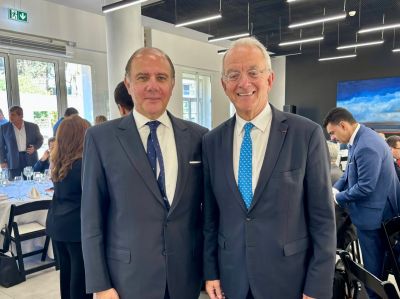
Some entrepreneurs visiting Lebanon will not make the trip to Syria, Wolf notes, saying he himself will be absent to honor other prior commitments.
Syria has changed dramatically since the fall of Bashar al-Assad's regime on Dec. 8, 2024 overthrown by a coalition of Islamist rebels. For the first time in twelve years, a French diplomatic mission visited Damascus a week later, and France has since reopened its embassy in the country.
The European Union and the United States have since lifted some of the sanctions that targeted the Assad regime.
While the goal of the Medef delegation in Syria is to establish contact, the tour of Lebanon is part of an effort to "help revive the entire Lebanese economy," says Wolf. "At the time, we were focusing on the reconstruction of Beirut. Now, the focus is broader, involving infrastructure and essential services — that is, energy, water, and transportation," he explains.
The group includes representatives from hybrid organizations, such as French Healthcare, a public-private initiative aimed at bringing together French healthcare stakeholders (companies, institutes, institutions) and promoting them abroad. If all goes according to plan, Medef is considering sending another delegation as early as next semester, according to Wolf.
In both Lebanon and Syria, the delegation's schedule is busy. In the afternoon, business leaders stopped by the Economic and Social Council, headed by Charles Arbid, where they exchanged with Finance Minister Yassine Jaber, before an appointment in Baabda with President Joseph Aoun. In Syria, all meetings with officials and private sector representatives have already been scheduled.