





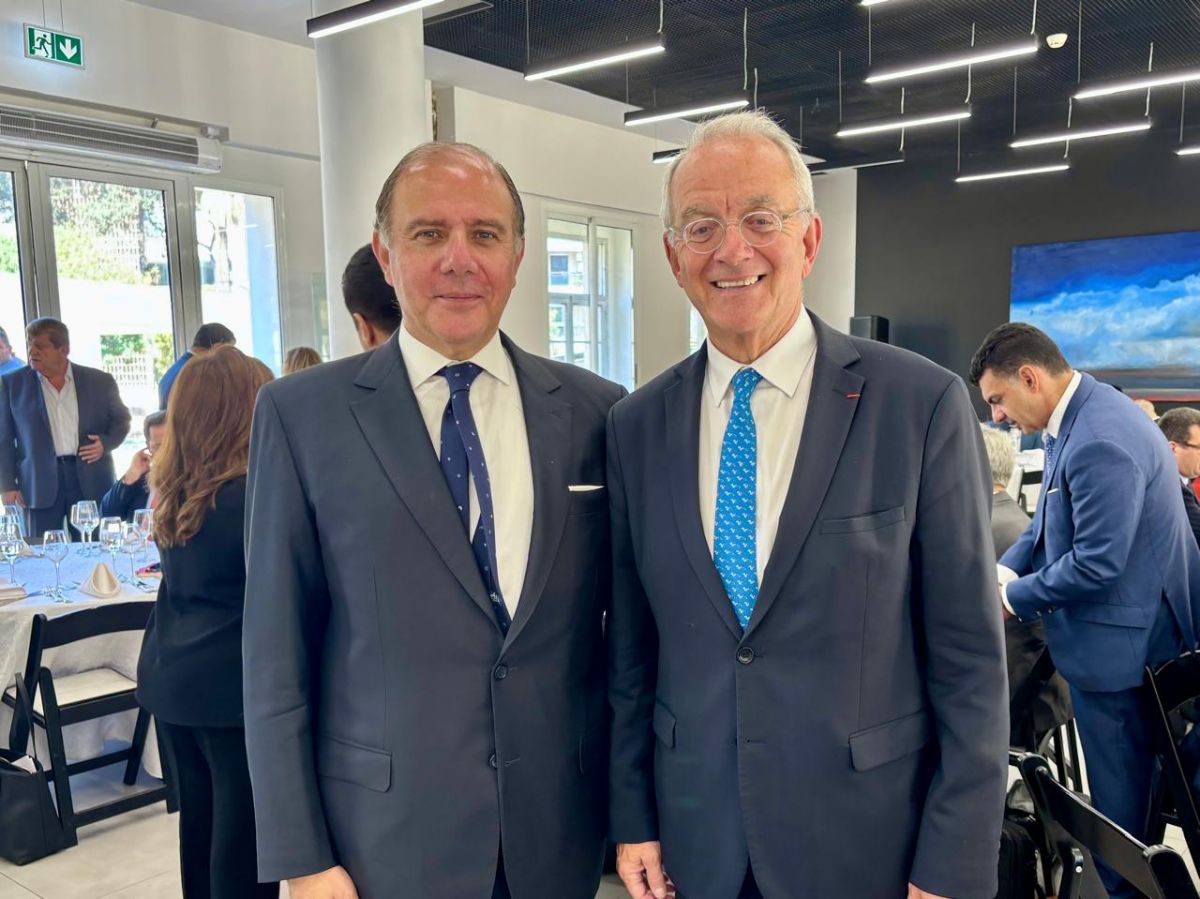
The governor of the Banque du Liban, Karim Souhaid, alongside Gérard Wolf, who is leading the Medef delegation visiting Lebanon on September 29, 2025, at the ESA in Beirut. Photo Philippe HAGE BOUTROS / L’Orient-Le Jour






"The year 2026 could be the one in which bank lending is restored," said Banque du Liban (BDL, central bank) governor Karim Souhaid on Monday.
He was speaking at the ESA Business School campus in Beirut, before a delegation from MEDEF, France's main business association, which is on a two-day visit to explore opportunities related to reconstruction and the rehabilitation of infrastructure after six years of crisis and 13 months of war between Hezbollah and Israel.
Following the crisis that erupted at the end of 2019, Lebanese banks froze tens of billions of dollars in foreign currency deposits and stopped offering credit. Authorities have yet to begin absorbing the country’s financial losses, reimbursing deposits or restructuring the banking sector. The state defaulted in March 2020 on eurobonds — dollar-denominated debt securities — and has still not restructured its public debt.
Responding to a question from the audience, Souhaid said the authorities were genuinely committed to reform. He added that a law to allocate the massive losses of the Lebanese financial system and repay deposits could pass before the end of the year, sending a positive signal to Lebanon’s partners.
"We are fortunate to have a president [Joseph Aoun] who is not a traditional politician and a prime minister [Nawaf Salam] who is not a businessman. They are focused on the country's real structural reforms … But at this stage, even politicians can no longer waste time," he added.
Souhaid also outlined BDL proposals for distributing losses and repaying deposits, as reported last week by L'Orient-Le Jour.
According to the governor's brief presentation, the first point involves "reducing the BDL's deficit by around $30 billion through the elimination of irregular claims." The second consists of segmenting deposits into three categories: small deposits (under $100,000), which account for 84 percent of the total; those between $100,000 and $1 million, another 14 percent; and those over $1 million. The third point would organize cash repayment for small and "certain medium" deposits, with a system of "securities backed by BDL assets" for repayment of the rest. The final point concerns how losses would be shared among the state, banks and BDL, though Souhaid did not provide further details.
Information obtained last week about proposals submitted by BDL to Prime Minister Salam and Finance Minister Yassine Jaber indicates that outstanding deposits could fall from around $84 billion to $49.9 billion. This reduction would involve writing off certain claims, including “suspect” or illicit deposits ($7.54 billion) and excessive additional interest accrued since 2015 ($13.79 billion), among others. The remaining balance would then be divided among BDL ($19.97 billion), the state ($16.5 billion) and the banks ($13.5 billion), under a formula not yet adopted by the executive.
There is no guarantee that the International Monetary Fund (IMF) — which Lebanon approached earlier this year to secure a financial assistance program — would accept this formula. At the end of its visit last week, the IMF said in a statement that “the authorities should continue their efforts to develop a strategy to recognize and distribute losses, and to restore the viability of the banking sector in line with international standards, protection of small depositors, and the sustainability of public debt.”
The IMF has repeatedly stressed that it will not make concessions on the principle that bank shareholders should bear losses before depositors are affected.
This article was originally published in French in L'Orient-Le Jour.

 7 p.m. recap: Iran warns Egypt, Israeli soldiers vote in south Lebanon, Haret Hreik responds to Kataeb