






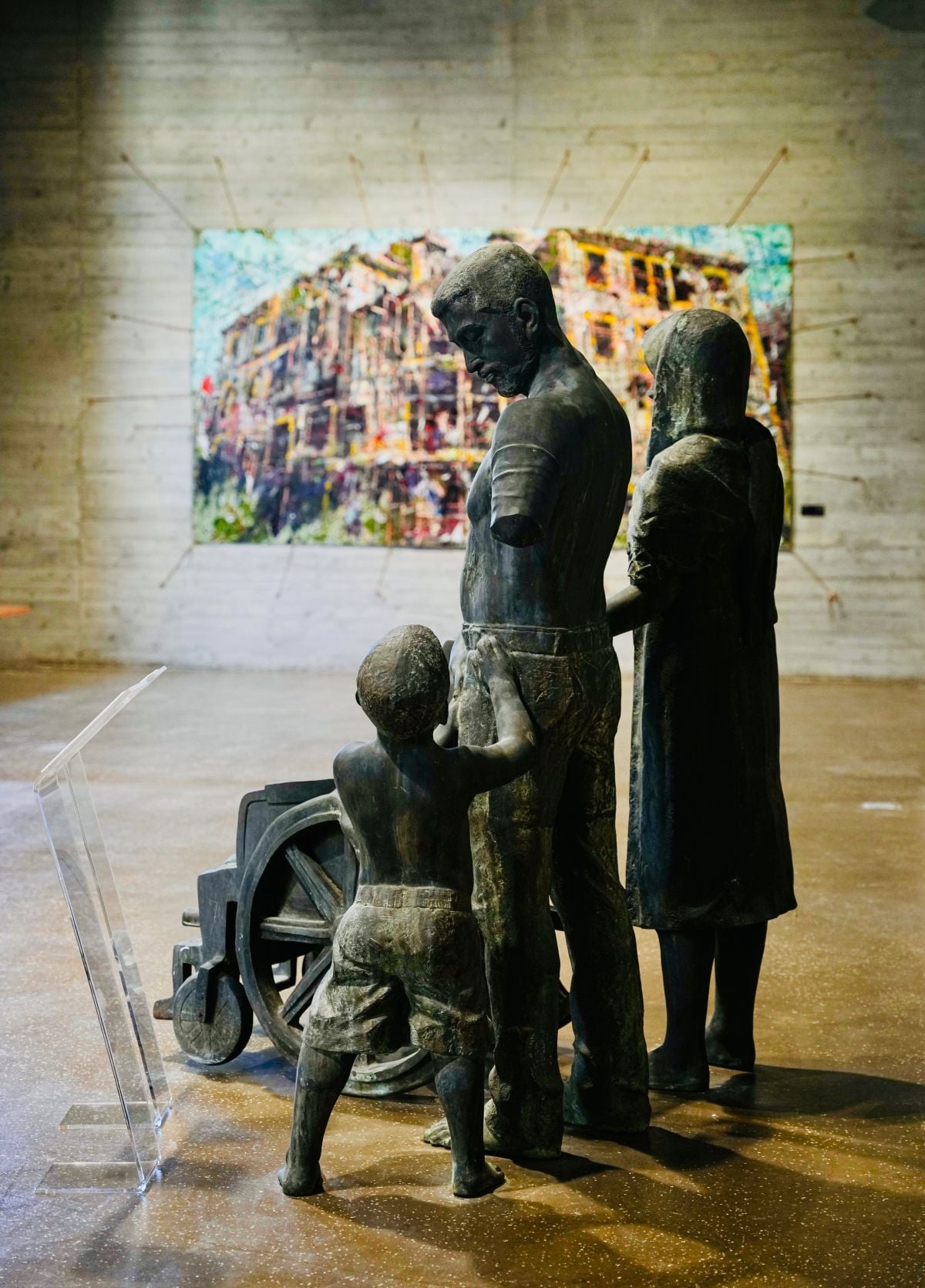
Mahmoud Obaidi, "Operation Iraqi Freedom Family," 2015. Courtesy of the Dalloul Art Collective (DAC)






Adel Abidin, on the necessity of painting 'What Remains'
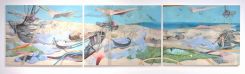
Between gentleness and desolation, critical vision and transcendence, Adel Abidin builds a fascinating pictorial universe on the walls of Beirut's Tanit gallery.
It is hard not to fall under the spell of such large acrylic canvases, with their transparent blue and sandy tones, the result of only recent months' work. The Iraqi-Finnish artist has returned to painting after more than twenty years of primarily conceptual artistic practice — videos, multimedia sculptures, and audiovisual installations that notably led him to represent Finland at the Nordic Pavilion of the 52nd Venice Biennale.
Painting seemed to Abidin, now, the most appropriate medium to express his feeling of the disintegration of the world as we knew it... A world devastated, fragmented, adrift, which he depicts with infinite subtlety in this very aptly titled exhibition, "What Remains."
A world where traces of nature and humanity are nothing but debris and ruins... where catastrophe is suggested through a mix of organic fragments and industrial debris scattered throughout aquatic landscapes and coastal vistas with bright horizons, yet with indeterminate hues, lost somewhere between gray and blue.
The cornerstone of this exhibition: the triptych "Drift," whose fragmented, filamentous forms, evocative of the remains of a shipwreck, powerfully convey this theme of disaster, loss, destruction, remnants, and survival... In the hope, nonetheless, of eventual renewal.
"What Remains" by Adel Abidin at Tanit Gallery, Mar Mikhael, until Oct. 23.
'Testimonies of Fire' from great Arab artists
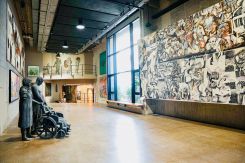
Powerful works by some of the most important contemporary artists from Lebanon and the Arab world are on display at the DAC (the Dalloul Artist Collective) this fall.
Mainly drawn from the collection of the Ramzi and Saeda Dalloul Art Foundation (DAF), and brought together under the title "Testimonies of Fire," these works mark the recent opening of this new Beirut exhibition space (founded by Basel Dalloul and managed, as the name suggests, by a group of artist friends).
This exhibition — almost museum-like, though it does feature certain works outside of the Dalloul collection that are available for sale — explores how Arab artists confront the violence of massacres and the nightmare of wars, transforming devastation into masterpieces of testimony.
Whether it is the paintings of collapsed buildings by Ayman Baalbaki, the re-sculpted shells by Katya Traboulsi, the image box by Alfred Tarazi, the blazing explosion of the "Brighter than a Thousand Suns" series by Tagreed Dargouth, or others on display, the pieces explore the traces left by weapons, fire, ruins, and war memory.
Other works, less familiar to the public, reveal a prophetic art of Arab — especially Palestinian — suffering. For example, the paintings of piles of children's skulls from the 1970s by Chawki Frenn, a Lebanese-American artist from Zahle who lives in the United States.
Among the most moving pieces, a large sculpture made from bronze alloyed with melted shell metal by the Iraqi artist Mahmoud Obaidi represents a family of displaced people, their bodies fractured, victims of war.
Entitled "Operation Freedom Iraqi Family," this piece is less known than the highly publicized "Farewell Kiss" — also included — which is a portrait of George W. Bush framed by shoes. As some may recall, it was directly inspired by the famous shoe-throwing incident by an Iraqi journalist at the former U.S. president during a press conference in Baghdad in 2008.
At the heart of the show, an immense tapestry titled "Massacre of Sabra and Shatila" stands out. This textile piece by Dia al-Azzawi was commissioned for Ramzi Dalloul (with the approval of the artist) and produced between 2014 and 2018 at the Real Fábrica de Tapices in Madrid. The original work — considered the "Arab Guernica" — created in 1982 with charcoal and markers on paper by the Iraqi artist, is now part of the Tate Modern collection in London.
Through these "Testimonies of Fire," visitors are plunged into a reflective exploration of the poignant scars left by violence on human lives in this region. But also into the redemptive beauty of art — one of the strongest forms of resistance against oblivion and erasure!
DAC; Stone Garden building, port district; until Oct. 11, Tuesday to Saturday, 11 a.m. to 6 p.m.
Ghassan Zard builds 'Altars' for a fractured world
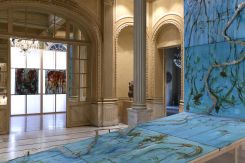
There is also power in the exhibition presented by Ghassan Zard at Villa Audi. It is the force of an instant plunge into the phantasmagoric imagination of this painter and sculptor, who explores, through raw abstraction, the themes of memory, violence, and fear intertwined with childhood reminiscence.
Upon entering the white patrician house, which now houses a Greco-Roman mosaic museum, visitors are immediately confronted with a monumental and intriguing work. An installation of five very large canvases (acrylic and ash) runs from floor to ceiling, marked by a long, winding sculpted brass line.
Titled "Veins of Ascent," the piece leads the viewer's eyes on a contemplative journey from what appears to be aquatic abysses to what could be snow-capped peaks. Inspired by the artist's obsession with the sea and the sky as realms for his tireless quest for silence and calm, the work is meditation in motion.
Beyond this first "altar" — as Ghassan Zard calls the three installations he presents in the aptly titled "Altars" show — the two others, each set in a separate room of Villa Audi, offer a transcendental density that resonates with the site's historical strata.
These pictorial and sculptural "altars" are reinvented as points of convergence of the visible and invisible, as spaces where "a certain mystique, independent of the religious," is inscribed. They lead viewers from the fury of a fragmented present into a place of calm and serenity.
The exhibition is organized, under the direction of Marc Mouarkesh, by the Audi Foundation in collaboration with Tanit Gallery.
*Achrafieh, Sofil Center; until Oct. 11. Open daily from 2 to 7 p.m.
'Between Dust and Dawn' ...
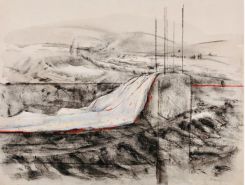
Also recommended is the exhibition by Ghada Zoghbi, titled "Between Dust and Dawn," which takes visitors at Janine Rubeiz Gallery into a meditative interlude induced by silent landscapes that are noticably Lebanese.
The new, mostly monochrome works on paper evoke landscapes shaped by nature's cycles intertwined with human intervention. As always with this talented artist, so attuned to the language of ancient soils and stones, a lyrical reflection on the memory of the land and the transformations left by eras of humanity unfolds beneath her superb mastery of drawing, lines, and perspective
Exhibit runs until Oct. 10.
'A Moment of Union'
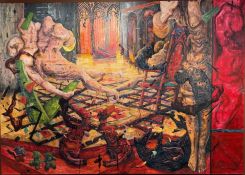
At Cheriff Tabet Gallery, "the human in the chaos of the world" is at the center of Philippe Farhat's new set of paintings.
Presented under the title "A Moment of Union," his oil-on-canvas works (ranging from small to very large) showcase an eruption of anguished flesh, wandering organic forms, and dysmorphic Bacon-esque figures.
Often wrapped in an epic atmosphere reminiscent of old masters’ frescoes, and using vibrant colors for a dark surrealism, his pieces question the nature of human existence as it emerges from cosmic chaos.
Farhat's themes and compositions go against the current minimalist trends, as shown by his immense reinterpretation of "The Last Supper," which boasts unabashed baroque style. Whether loved or not, his work certainly leaves no one indifferent.
*Achrafieh, Abdel Wahab el-Inglizi Street, until Oct. 3.
Under the colorful 'Oversized,' a latent critique
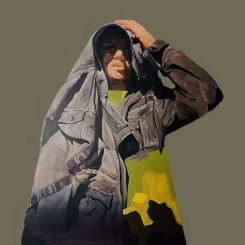
Riyad Ne’mah also takes human nature as the subject of his work, but in a different vein: contemporary portraiture. This Iraqi artist, born in Baghdad in 1968 and recipient of the British Council Prize in Damascus in 2000, is showing his large and medium-size acrylics on canvas at Art Scene Gallery.
United under the title "Oversized," the paintings all feature young male figures, their facial features often blurred or flattened, but always wearing an oversized jacket with military cut. With its bold, decorative touch, this work — seemingly smooth at first — aims to "denounce the recruitment of child soldiers in our region of the world," according to the artist's statement.
He also notes that the paintings can be seen as a veiled critique of the disproportionate power granted to our leaders compared to their ethical and moral stature.
*Gouraud Street, Gemmayze, Pigier building; until Sept. 28.