


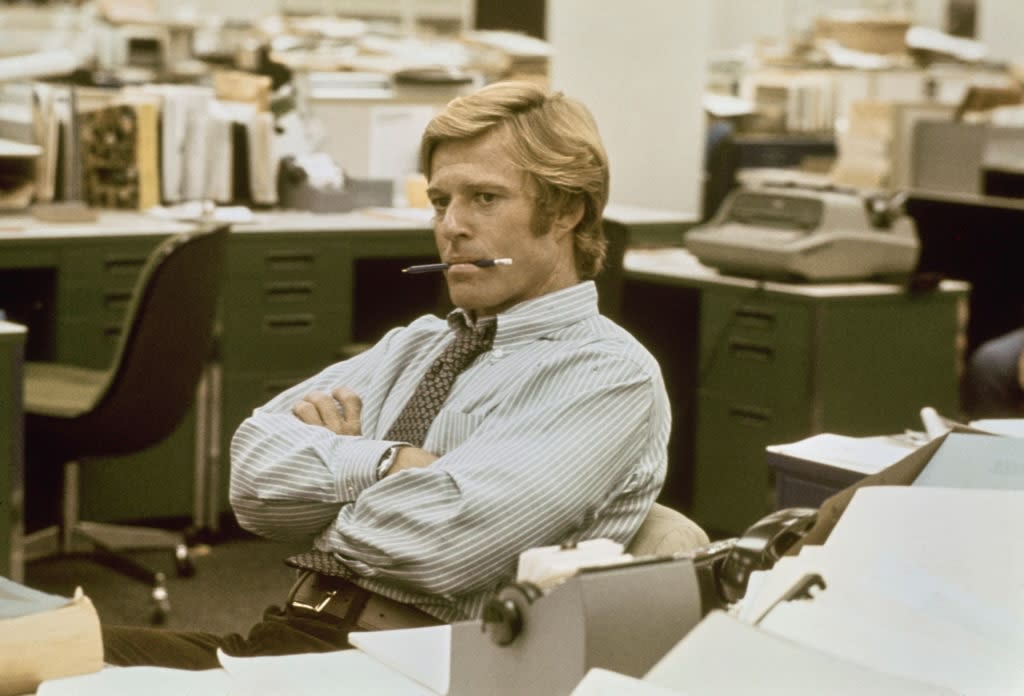
Robert Redford in "All The President’s Men" by Alan J. Pakula. (Credit: Warner Bros)






Robert Redford, who passed away at the age of 89 on Tuesday, entered Hollywood in the 1960s as a tall, square-jawed blond with charisma and charm. But it didn't take long for him to prove himself as more than just a Californian crowd-pleaser.
From the beginning of his career, which quickly took off after his roles in "Barefoot in the Park" by Gene Saks (1967) and Butch Cassidy and "The Sundance Kid" by George Roy Hill (1969), Redford wanted to break free from Hollywood's constraints.
One way for him to do this way through producing. He started off by financing two films, including "The Candidate," in which Redford played a disgraced human rights lawyer. As he became increasingly aware of his influence in Hollywood, Redford took a leap, committing to a film that would end up defining his career: "All the President’s Men."
'Robert Redford’s obsession'
Redford is known for his role as Washington Post reporter Robert Woodward — aka “Bob” — but what's less known is that the film wouldn't have happened without the actor's initiative. The Watergate scandal — revealing a White House wiretapping system — was still unfolding when Redford sensed the cinematic potential of the affair.
In April 1974, just four months before President Richard Nixon’s resignation, which marked the end of the scandal, Redford, an established producer by then, had purchased the adaptation rights from the two journalists who uncovered the scandal for $450,000 (an astronomical sum at the time).

He then commissioned his friend William Goldman, screenwriter of "Butch Cassidy" and "The Sundance Kid," the film that had made him famous a few years earlier, to write the script. “A buddy movie” at first glance, according to the Washington Post, which devoted an article in 2022 to its making.
But, according to the Times, after a first read of Goldman’s script, the Washington Post journalists — the film’s main characters — found it too humorous and feared for their credibility.
Soon, Redford took matters into his own hands by spending time in the newsroom to understand its workings, joined by Alan J. Pakula, the film’s director. The actors, including Dustin Hoffman as journalist Carl Bernstein, ended up rewriting some of their own lines and even improvising scenes during filming.
Upon its release in 1976, "All the President’s Men" was hailed as a masterpiece by critics. Its documentary-style approach, without embellishment or romantic artifice, broke free from Hollywood conventions, accomplishing what Redford had set out to do with his own career.
After a spectacular run — $70 million at the box office — William Goldman alone received the Oscar for best screenplay, stating in his speech: “This movie has been from the very beginning the obsession of Robert Redford."
A glorious or glamorized journalism?
Fame and glory aside, Redford had succeeded in immersing the viewer in the heart of the Watergate story while simultaneously creating a film that was a pioneer in its genre. But the success of "All the President’s Men" didn’t stop at cinematic achievement alone.
"Redford had intended to lend his celebrity to elevate the serious and undervalued work of investigative reporting," Leonard Downie, a Post journalist at the time of Watergate, is quoted as saying in the 2022 article. "Instead, he fueled a trend of journalists becoming stars themselves, a phenomenon that only grew throughout the 1980s and 1990s."
“All the President’s Men changed the very nature of journalism. Investigative reporting exploded ... Investigative teams were created where they didn’t exist before."
The film also popularized the phrase “follow the money,” originally spoken in the movie by “Deep Throat,” the journalists’ mysterious source. The phrase is so often heard in journalistic and political circles to expose political or judicial scandals, that many forget it originates from this film.

By focusing on the two investigators’ perspective, "All the President’s Men" also elevated journalists Carl Bernstein and Robert Woodward to star status. According to some observers, this encouraged the next generation of journalists to pursue the same limelight, leading some to become “rather insufferable,” as noted in a Telegraph editorial published on Sept. 16.
In any case, after the film’s success, Redford never strayed from his path. A staunch Democrat and advocate for truth, he championed these ideals within cinema itself by founding the Sundance Film Festival in 1985, where he notably showcased documentaries, a “better form of truth."
In 2017, he wrote a concerned op-ed in the Washington Post, denouncing the rise of false information and declaring, “Serious and accurate journalism defends our democracy.” Later, he strongly opposed Donald Trump’s administration, calling it “dictatorial.”
“We thought Watergate was a one-off problem of the presidency, and then Donald Trump came along,” Woodward explained to the Washington Post in 2022. Today, Robert Redford is gone, taking with him the memories of a bygone era when the word “truth” meant something.
 Yemen's Houthis say struck Riyadh airport, other Saudi sites