





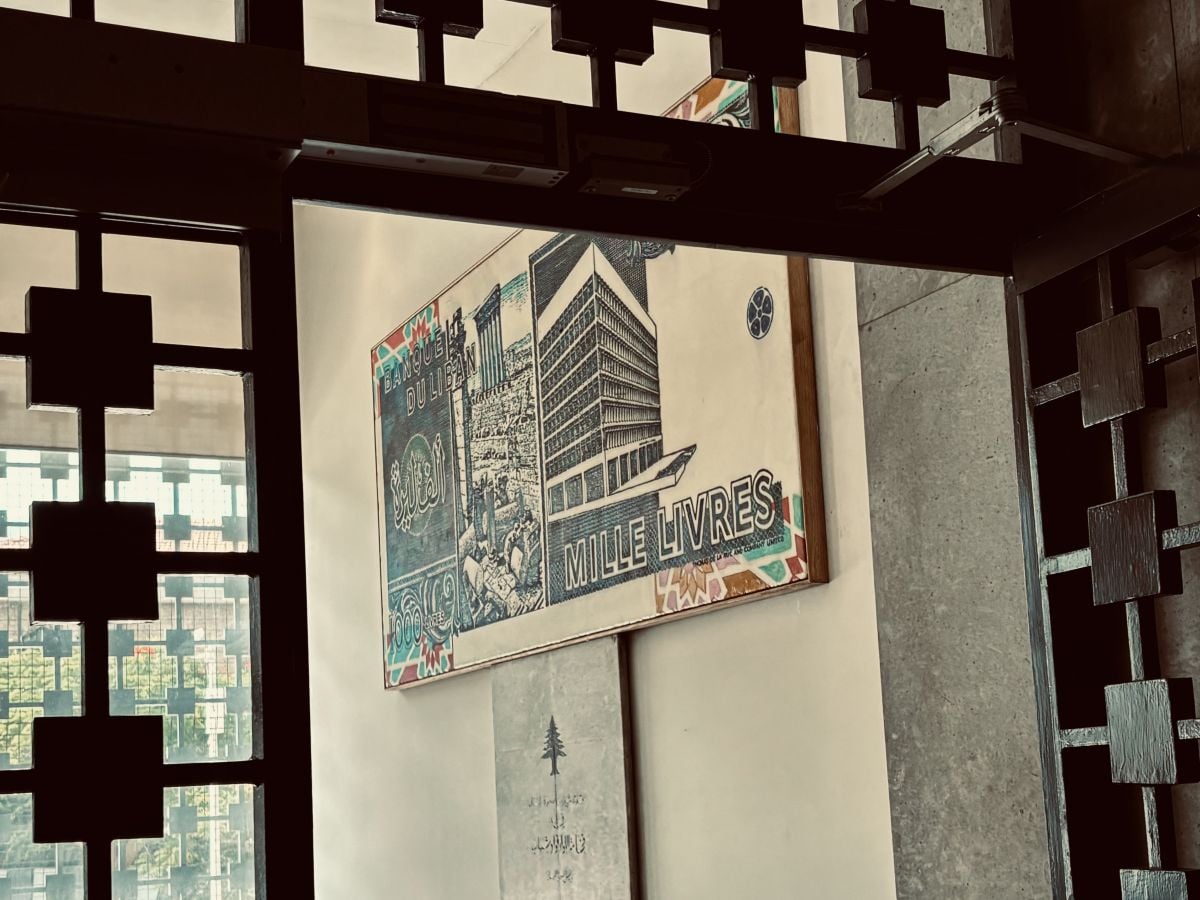
A sign bearing the image of an old version of the 1,000-lira banknote is hung in the entrance hall of the main building of the Central Bank of Lebanon in Hamra. (Credit: Illustrative photo by Philippe Hage Boutros/L'Orient-Le Jour)






The Banque du Liban (BDL, central bank) on Friday unveiled the first issue of its semiannual macroeconomic report, presenting it to the press at the central bank’s Building E, which houses the statistics and economic research directorate.
The more than 40-page report was introduced by Third Vice Governor Salim Chahine, joined by department head Choukri Mouannes and economist Sanaa Souaid Jad, in the presence of BDL Governor Karim Souhaid.
“This is an ambitious report produced by a team with limited means to strengthen the institution’s credibility as a provider of general economic indicators that can be accessed by market players and, we hope, authorities,” BDL said, stressing that the publication is intended to be “objective, neutral and depoliticized.”
The authors, who worked on the report for more than two months, acknowledged that it remains incomplete due to missing data necessary for the work, including national accounts. Furthermore, the Central Administration of Statistics has yet to release GDP figures for 2022 and beyond. Some public finance data is also unavailable.
Still, they said they produced a credible GDP estimate for 2024. “International organizations and research firms following Lebanon are forecasting GDP estimates that range between $26 billion and $33 billion [depending on the methodology used],” Chahine said. “Our estimate, which we have cross-checked multiple times, is $27.8 billion, rounded up to $28 billion in the report.”
The report calculated GDP contracted by 6.4 percent in 2024. For 2025, the bank has not issued a forecast, stating only that it expects “modest growth.”
The central bank said its estimate was based on surveys conducted with local businesses, its new composite indicator — a synthetic indicator of economic activity it had stopped publishing in August 2022 and has updated now— and an econometric model developed in-house, the report's authors explained.
The authors said they withheld their growth forecast due to the high level of uncertainty facing Lebanon’s economy, a decision also recently taken by the International Monetary Fund (IMF).
The World Bank projects growth of 4.7 percent in 2025 but has not issued a forecast for 2026. According to the draft 2026 budget, the Finance Ministry projects GDP at $32.78 billion in 2025 with inflation at 15 percent, and $36.3 billion in the following year with inflation at 3.5 percent.

Electronic money transfers surge
Among the figures highlighted in the report, BDL estimated that the circulars issued since the start of the crisis to ease restrictions on bank deposits — Circulars 154, 158 and 166 — “provided $4.2 billion in fresh money,” a term coined during the 2019 economic and financial crisis to distinguish such funds from those frozen by banks.
BDL added that while these measures offered a “temporary respite” to depositors, they cannot substitute for a “comprehensive restructuring strategy for the sector.” Since the onset of the financial crisis, banks have frozen tens of billions of dollars in deposits. In the absence of a legal capital control, parliament only passed a banking resolution law last July, while a separate bill on how to allocate the country’s large financial losses remains under debate.
At the core of the report, BDL also highlighted that electronic money transfers — made through specialist companies or mobile apps — rose to 133 percent between 2019 and 2024, climbing from $1.2 billion to $2.8 billion during the same period. This, it said, “reflects the growing importance” of the cash economy in Lebanon.
This article was originally published in French in L'Orient-Le Jour.


 7 p.m. recap: Iran warns Egypt, Israeli soldiers vote in south Lebanon, Haret Hreik responds to Kataeb