


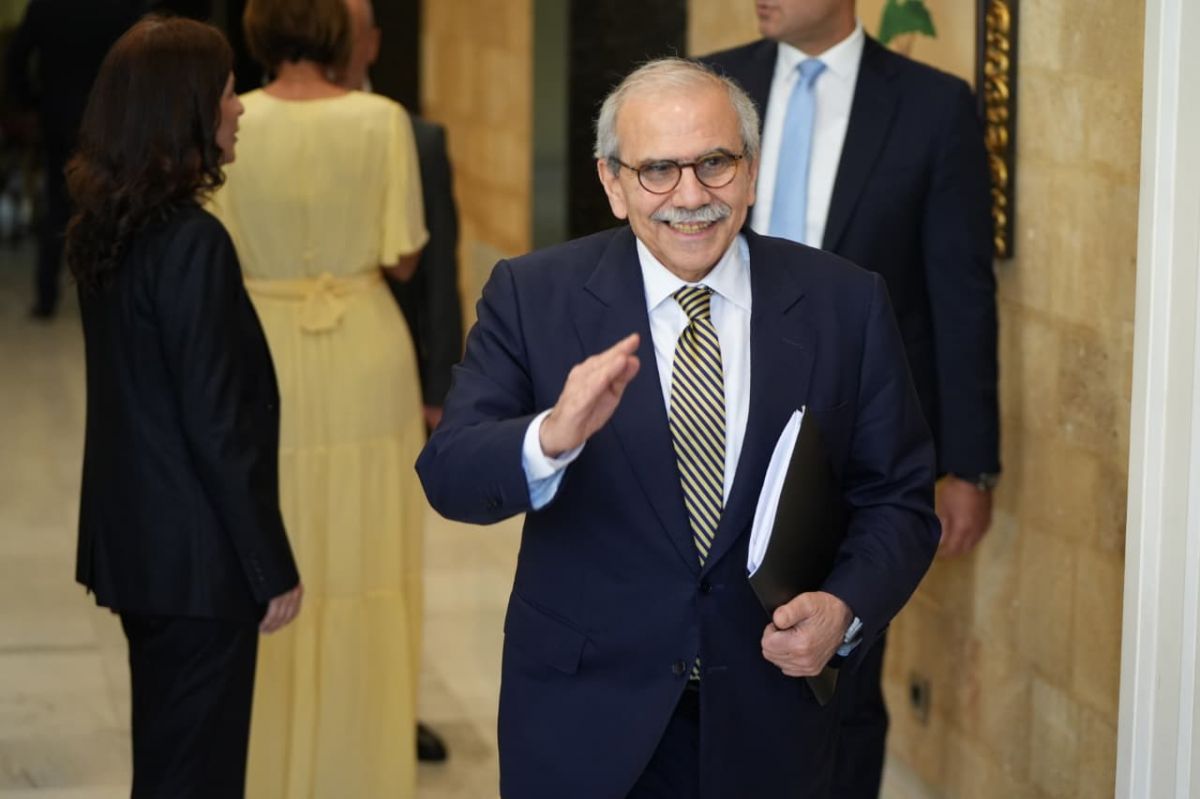
Prime Minister Nawaf Salam in Baabda, shortly before a government session of Aug. 5, 2025. (Credit: Mohammad Yassin/L'Orient Today)






BEIRUT — After meeting with Parliament Speaker Nabih Berri in Ain al-Tineh on Tuesday, Prime Minister Nawaf Salam said that the Lebanese Army’s plan to disarm Hezbollah, presented in the Cabinet session on Sept. 5, is "being dealt with positively" by the Lebanese government, according to local media outlets.
"The army’s plan will be monitored on a monthly basis, has been welcomed by the government, and is being dealt with positively (...) there will be no backtracking on decisions; we will proceed with their implementation," Salam said from Ain al-Tineh.
In the Sept. 5 session, which took place one month after the government tasked the army to prepare a plan to disarm Hezbollah by the end of the year, the government "welcomed" the plan without setting a specific timeline for the process. In his first comment after the session, Salam told Asharq al-Awsat newspaper on Saturday that the government is "continuing the process of extending state authority by its own means," adding that the disarmament plan of U.S. envoy Tom Barrack "requires reciprocal implementation by both parties, which Israel has not yet respected.”
On Monday, Berri, head of the Amal movement and Hezbollah's main ally, met with President Joseph Aoun at the Baabda Presidential Palace and with General Haykal in Ain al-Tineh. Commenting on his relationship with Berri, Salam said that "there has never been any direct or indirect rupture with Berri at any point." The prime minister noted that his "relationship with Berri is ongoing and has two dimensions: As a political leader and head of a major political movement and as parliament speaker." Still, Salam underlined his commitment to the principle of separation of powers.
Since the beginning of last month, Hezbollah and the Amal Movement have been criticizing Salam's government for its Aug. 5 decision to disarm Hezbollah by the end of the year. However, after the Sept. 5 session, the Amal-Hezbollah bloc cautiously welcomed the government’s decision due to the fact that it did not set a timeline, which is a key demand for Hezbollah as the group refuses to hand over its weapons, while Israel continues to violate the cease-fire in Lebanon on a daily basis.
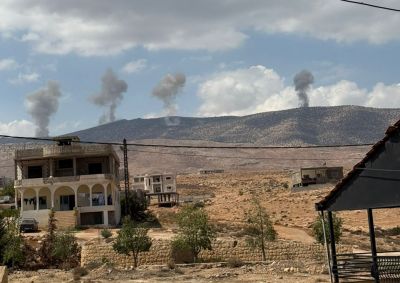
Asked about his reaction to the Israeli strikes that targeted the Bekaa on Monday and the Chouf district on Tuesday, Salam told the Press: "Not every time an Israeli drone flies, someone has to ask me what my comment is," adding that the government's position has always been that these strikes are violations of the cease-fire agreement reached in November 2024.
Regarding the term "defense strategy" which Hezbollah often uses to describe any potential dialogue over its arms, Salam clarified that the "government has never spoken of a defense strategy but rather of a national security strategy encompassing multiple dimensions, which is a commitment included in the ministerial statement and one the government will work on drafting." Moreover, he underscored that "decisions are taken exclusively within constitutional institutions, not through side discussions."
Salam also noted that the "Lebanese Army needs additional assistance given the heavy responsibilities it carries," emphasizing the necessity of "strengthening its equipment and providing greater financial support to raise soldiers’ salaries."
The prime minister finally expressed the "government’s hope for a new international conference to support the army, similar to the previous Rome conference, as French President Emmanuel Macron had promised." Jean-Yves Le Drian, special envoy of President Emmanuel Macron, is expected in Beirut on Wednesday and is expected to prepare the two conferences that President Macron plans to convene: the first on reconstruction in Lebanon, the second on support for the army. No date has been set so far for these two conferences.
Rajji: South Litani disarmament within 3 months
Also on Tuesday, Foreign Minister Joe Rajji told AFP that Lebanon's army is set to fully disarm Hezbollah south of the Litani River within three months as part of the first phase of the Lebanese Army plan. In parallel with this phase, the foreign minister said that "security measures" will be implemented across the country. Rajji said the next four phases of the plan will see disarmament in other regions, including Beirut and the eastern Bekaa, "but without timelines."