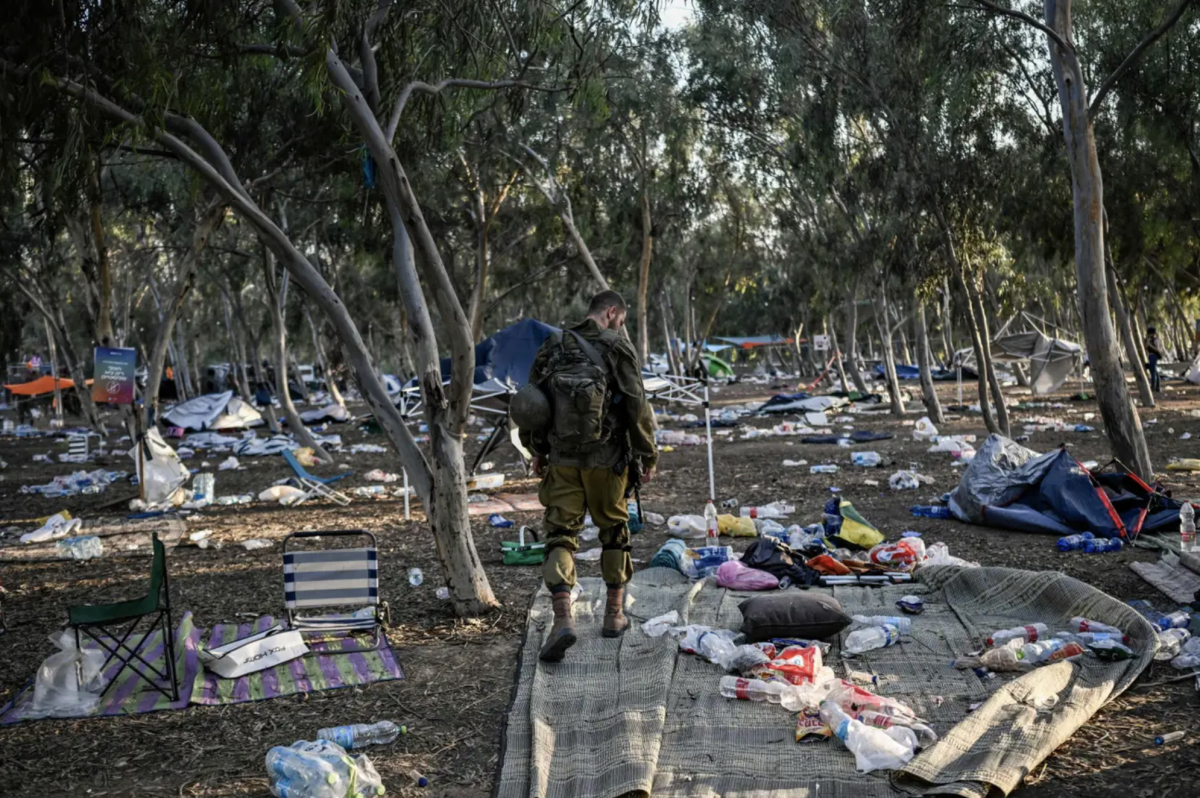
At the site of the Nova festival, near the Israeli settlement Kibbutz Beeri, on Oct. 23, 2023. (Credit: Aris Messinis/AFP)






The commander of the Northern Brigade of the Israeli army’s Gaza Division, Lieutenant Colonel Haim Cohen, who arrived at the Nova Festival on Saturday, Oct. 7, 2023, at 5:30 a.m. — just one hour before Hamas’ Al-Aqsa Flood operation — chose not to reinforce security, despite escalating, alarming signs of an imminent attack by Hamas.
This was reported on Tuesday by Israeli media Haaretz, based on an Israeli army investigation. The senior officer had received prior warnings from Israeli intelligence services, but the exact content of the information “has not yet been clarified,” said the newspaper.
It was Officer Cohen who had approved the festival’s security plans on Oct. 3, when the event was under the authority of his brigade.

‘Alarming signs of unusual Hamas activity’
“Overnight into Saturday, Oct. 7, 2023, throughout the night, the Shin Bet, Military Intelligence and senior IDF command picked up alarming signs of unusual Hamas activity,” wrote Haaretz, which added that “not all the information was passed up the chain of command to Cohen.”
Nevertheless, the officer left his home in Tiberias, northern Israel, at 3:13 a.m. “for unclear reasons” to investigators, to drive “to the division’s distant southern base.”
"While driving from my home to the base, the thought occurred to me that I might be misjudging the situation, (...) I informed the [Israeli] forces that the enemy was acting suspiciously and, in light of this, we needed to make changes in the morning to adjust our troops," he later said in April, Haaretz reported.
The investigation further reveals that Cohen was in contact before his departure with the division commander, Brigadier General Avi Rosenfeld, who reassured him by saying there was “no pressure” to arrive quickly, urging him to “drive safely.”
“It is unclear whether this reflected his complacency or if the full intelligence available at the time had not been shared with the division,” Haaretz wrote.
On his way to the base, the officer stopped at the festival site after a two-hour drive. Although he observed at dawn that only a few police officers — about 50, according to the Israeli army’s investigation — were securing over 4,000 festival-goers, Cohen later told military investigators that “he had no information suggesting that he should act differently or order the festival to be dispersed,” the report continued.
He explained to investigators that the additional police presence he then saw on-site — a counterterrorism unit and another police vehicle positioned on Route 232 at the edge of the Gaza Strip — “reassured him that the event is secure.” The investigation, however, found that most sector forces were unaware that the festival was even taking place.
“The investigation also said that Cohen miscalculated when he did not assign a military force to the festival complex, given the size of the crowd, the timing and the sensitive location,” Haaretz said.
Lieutenant Colonel Cohen was dismissed from his post in December 2024.
Hamas militants, who began their attack at 6:30 a.m., killed at least 370 festival-goers, while 44 others were taken hostage, according to official Israeli data. The Al-Aqsa Flood operation killed a total of 1,219 people, mostly civilians, according to an AFP count based on official figures. The Israeli war on Gaza has killed at least 63,557 people since then, mostly civilians, according to Gaza’s Ministry of Health.
This article was originally published in French in L'Orient-Le Jour and translated by Joelle El-Khoury.