






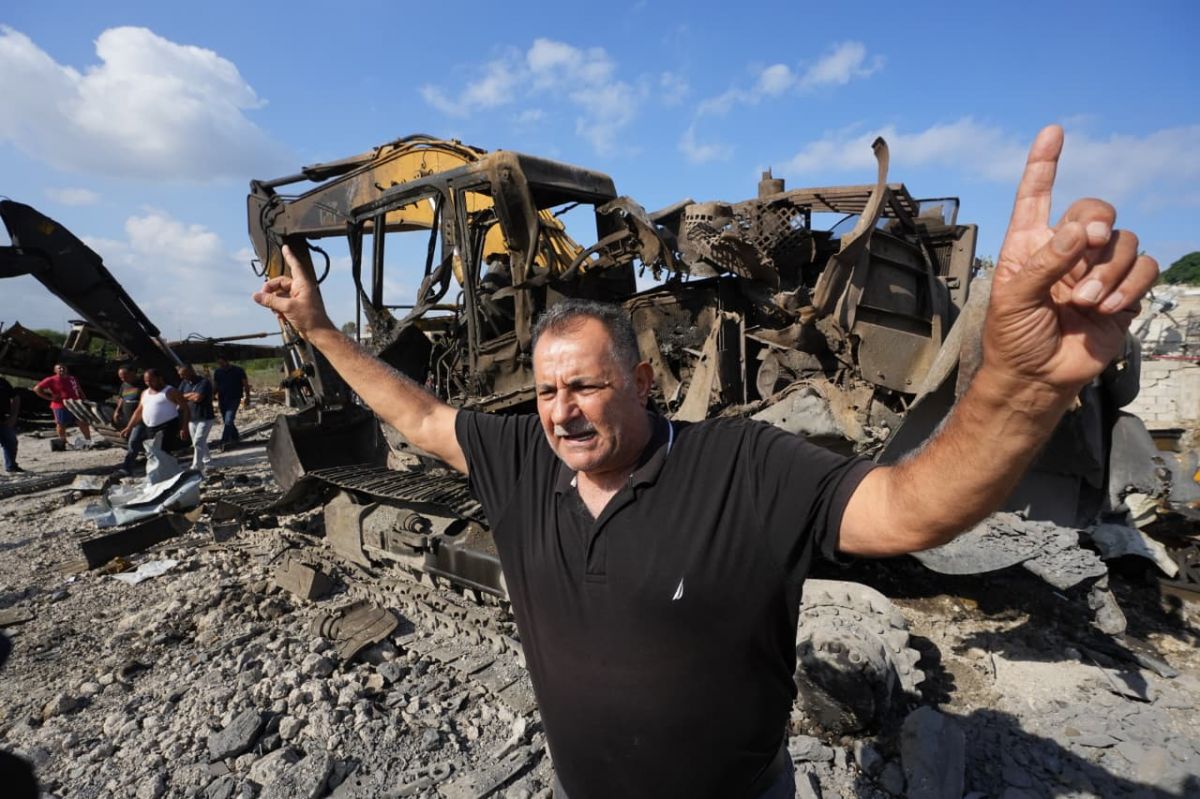
A man observes the extent of the damage after a massive Israeli airstrike on the industrial area of Ansariyeh, near Saida in southern Lebanon, on Sept. 3, 2025. (Credit: Mohammad Yassine/L'Orient Today.)






SOUTH LEBANON —A fragile calm settled in southern Lebanon from Wednesday night to Thursday, following an especially deadly day during which Israel bombarded several areas, even reaching near Saida, located several dozen kilometers from the border.
Around midday, Israeli forces dropped leaflets threatening to target a stone quarry owned by Ahmad Aoudé, known as “Abou Mohammad,” near the former Khiam prison (Marjayoun district). Residents were urged to evacuate the quarry and the adjacent house as a precaution.
At the same time, an Israeli drone crashed a few hours later in Khiam, while another drone targeted a prefabricated container in the Kharza neighborhood of Aita al-Shaab (Bint Jbeil district), close to the border. These structures serve as temporary housing for families whose homes were destroyed by previous Israeli strikes.
In the same district, in Yaroun, an Israeli helicopter dropped a sound bomb near a resident, causing a fire in a field on the village outskirts. No injuries were reported.
'Cries rose with every missile'
The main incident in the past 24 hours occurred Wednesday around 10 p.m. between Adloun and Ansariyeh, about twenty kilometers south of Saida, when Israeli air forces conducted no fewer than eight strikes, firing twelve missiles at the industrial zone between the two towns, destroying several warehouses used as repair shops for construction machinery.
Four Syrian workers present at the site during the attack were injured, and at least one of them died from their wounds, according to an initial report by the Civil Defense, which has not been updated since.
A fire broke out in the warehouse following the strikes, prompting firefighters to intervene and causing the highway between Saida and Sour to be closed for several hours. “I had never heard explosions like that before,” a resident of Ansarieh told our correspondent.
“They were so powerful that cries rose with every missile that exploded. The ground shook beneath our feet. It was immense terror, and the damage to nearby houses is considerable; the targeted area was destroyed,” he added.
“They destroyed all this so we couldn’t work on rebuilding the South,” denounced the mayor of Ansariyeh on Thursday amid the ruins of the warehouse. “This warehouse was hit for the first time. That one, it’s the second time. These machines are worth tens of thousands of dollars each, and the only response from the three presidents is to take up the weapons of the resistance?” he exclaimed.

UNIFIL targeted again by the Israeli army
As usual, the Israeli army claimed responsibility for the series of strikes, stating it had bombed “a Hezbollah site used to store construction machinery intended for the reconstruction” of the Hezbollah’s capabilities. It also commented on the drone strike between Jibbeen and Tayr Harfa, saying it targeted “a Hezbollah rocket launch ramp.”
The rest of the night was less violent but not without incidents. According to our correspondent’s information, shortly after 11 p.m., the outskirts of Shebaa (Hasbaya) were hit by heavy gunfire from the Israeli radar site.
Several Israeli drones also flew over Houch near Sour later in the night, though no strikes were recorded. Earlier, another Israeli drone fired a missile at an area between Jibbeen and Tayr Harfa (Sour,) also in the western part of the border zone.
The day before, Wednesday, the Israeli army had already carried out a major series of attacks that killed at least three people in southern Lebanon, in Kharayeb, Shebaa, and Yater. Additionally, UNIFIL soldiers were targeted by four grenades dropped by the Israeli army a few meters from where Blue Helmets were clearing a road blocking access to one of their positions near the Blue Line, the U.N. force said in a statement, calling the incident “unacceptable” and a “serious violation of resolution 1701.”
This (yet another) escalation comes on the eve of a crucial Cabinet meeting dedicated to reviewing the army’s plan to disarm militias, including Hezbollah.
According to data from the Ministry of Health and the U.N. compiled by L’Orient Today, at least 310 people have been killed in Lebanon since the ceasefire between Hezbollah and Israel came into effect on November 27, 2024, following more than a year of war.
Reporting by our regional correspondent Muntasser Abdallah.