






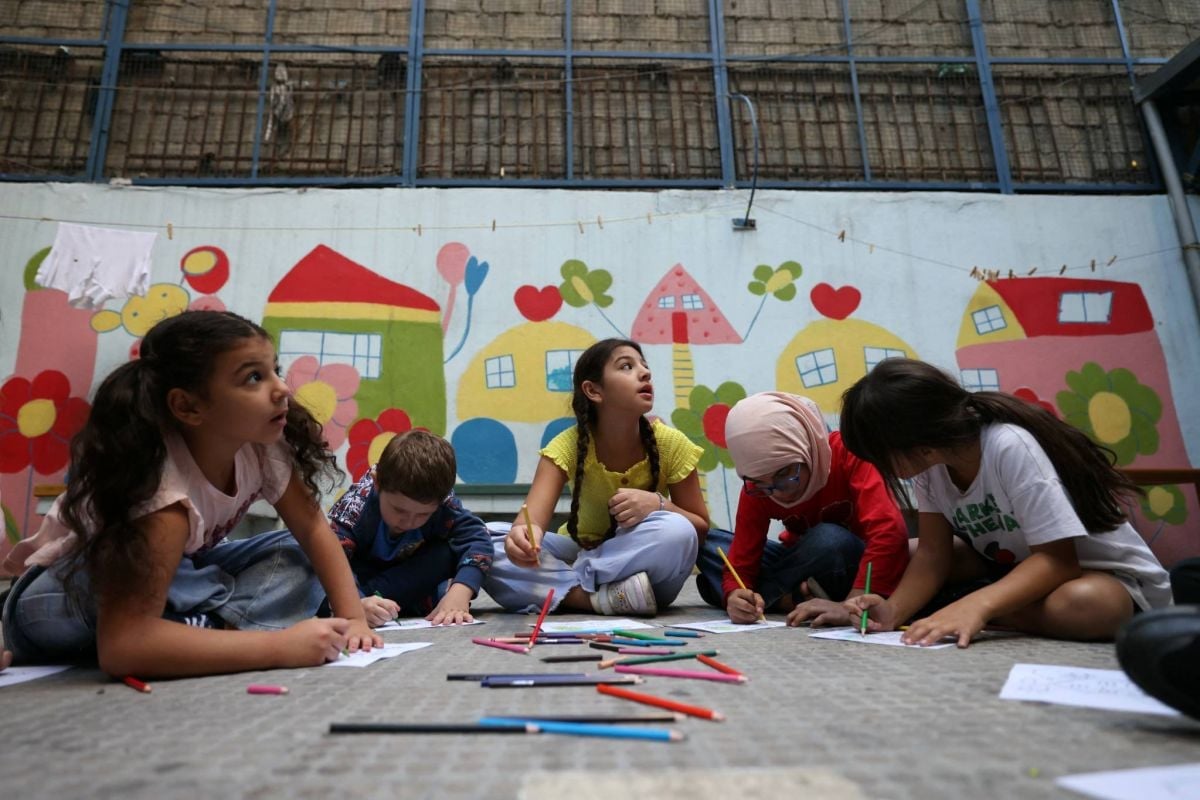
Children who fled Israeli bombings in southern Lebanon take part in a drawing workshop organized by volunteers at a reception center in Beirut, where they have found refuge with their families, on Oct. 20, 2024, as the war between Israel and Hezbollah continues. (Credit: Ibrahim Amro/AFP)






Three public-sector teachers’ unions — representing secondary, technical and basic education — stated on Saturday that the school week will remain four days, but they will not accept extending class periods from 45 to 50 minutes, as had been done last year.
This stance comes a week after Education Minister Rima Karameh confirmed the four-day weekly schedule for the third consecutive year and announced her decision to increase class periods to 50 minutes.
“We confirm that there will be no change to the schedule or the duration of class periods, and that the workweek will remain four days with 45-minute classes,” the statement released by the unions after a virtual meeting of the three organizations emphasized. “Any change would require the adoption of a new pay scale, which would alter the agreement reached with the Minister, and would lead us to take the necessary measures,” the statement added, clearly responding to Minister Karameh and even hinting at the possibility of escalation if the unions’ opinion is not taken into account.
The start of the school year, set for Sep. 15, takes place in a complicated context for public school teachers, whose salaries have still not been adjusted following the collapse of the Lebanese pound since 2019. Despite some cosmetic decisions on salary adjustments and bonus payments, their monthly salaries remain capped at a few hundred dollars, compared with one or several thousand dollars before the financial crisis. As a result, public school teachers have agreed to resume classes only on the condition that they can work at least one day per week in the private sector, where pay is significantly higher.
The unions have also demanded increases in the monthly salaries of permanent teachers and the hourly wages of contract teachers, within the framework of a new pay scale, hoping that these decisions will be discussed during a “highly anticipated” meeting with Finance Minister Yassine Jaber.
Teaching in the public sector is not subject to the Lebanese Labor Code but follows the same pay scale as the civil service, which has remained unchanged since the beginning of the crisis. Despite this, only private school teachers’ salaries have undergone significant revisions and are now indexed to the dollar, which trades at 89,500 Lebanese pounds compared with 1,500 LBP in early 2019.
The public teachers’ unions also announced their intention to hold a press conference on Tuesday, Sep. 2, at 4:00 p.m., at the headquarters of the Basic Education Union to discuss the start of the school year.
In an interview with L’Orient-Le Jour last May, the Minister of Education acknowledged that public school students in Lebanon are at least three years behind, according to the World Bank. She pledged to rehabilitate public schools and raise the level of education.
