






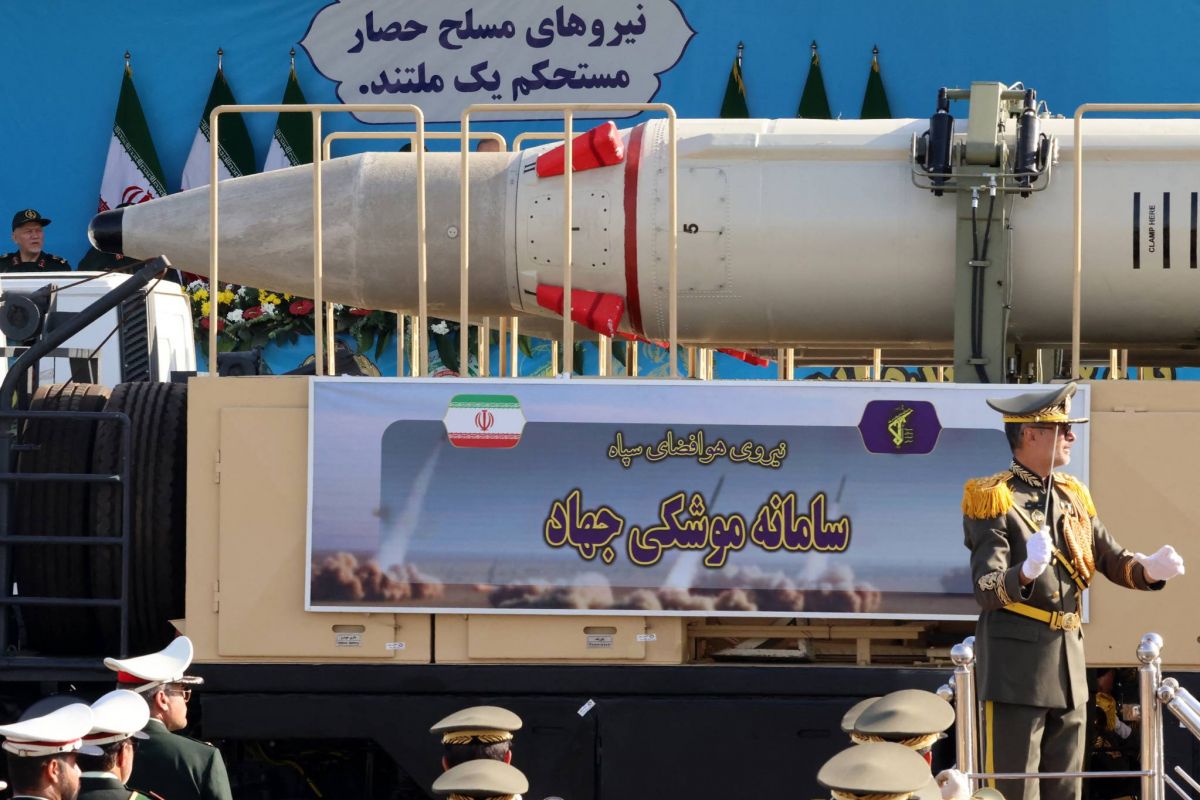
The new Iranian missile "Jihad" presented during an annual military parade marking the anniversary of the outbreak of the 1980–1988 war with Saddam Hussein's Iraq, in Tehran, on Sept. 21, 2024. (Credit: Atta Kenare/AFP)






Iranian Defense Minister General Aziz Nasirzadeh stated that Iran has "built and deployed new missiles with capabilities far superior" to those used during the deadly conflict with Israel that lasted 12 days, following a large-scale attack by the Israeli military on Iranian territory on June 13, which decapitated its security and military command.
"The missiles used during the 12-day war were made by the Defense Ministry years ago. Today, however, we have built and deployed new missiles with far superior capabilities. If the Zionist regime ventures into a new act of aggression, we will certainly use them," he threatened, in remarks reported by the West Asia News Agency (WANA), based in Tehran.
The minister also praised Iran's military capabilities during the war against Israel, despite the "[Israeli] defense systems considered among the most powerful" in the world, "such as THAAD, the Patriot MIM-104, Iron Dome and Arrow," as well as "logistical, intelligence and operational support from the United States" to Israel.

By contrast, Nasirzadeh expressed satisfaction that "everything used during the war came from our own defense industries," with "no dependence on foreign resources."
In accordance with strategic cooperation pacts signed with Beijing in 2021 and Moscow in 2025, Iran received no military assistance from its allies China and Russia during the conflict. According to Iranian sources quoted by Reuters after the war last June, Tehran authorities expressed dissatisfaction with Russian support that they considered insufficient, even while Iran had supplied hundreds of thousands of dollars’ worth of drones to Moscow for its war in Ukraine.
'90 percent of our missiles hit their targets'
"In recent days, however, 90 percent of our missiles hit their targets. This showed not only that our experience was increasing, but also that the enemy's defensive capability was decreasing," he said. "If the war had continued, the advantage would undoubtedly have belonged to the armed forces of the Islamic Republic."
General Nasirzadeh also mentioned a "media blackout imposed by the Zionist regime" to prevent "showing the true extent of the Iranian missile strikes."
"We now have missiles with characteristics much more powerful than those used in this war, and which we have not yet used," he added.
Two days earlier, on Aug. 18, Iranian First Vice President Mohammad Reza Aref warned that a new war with Israel could break out "at any moment."
Iran "is preparing plans for the worst-case scenario," said Yahya Rahim Safavi, military adviser to Iran's Supreme Leader Ali Khamenei, quoted Sunday by the daily Shargh. "There is not currently a real cease-fire, we are in a phase of war, and it can break out at any time. There is no protocol, no regulation, no agreement between us and the Israelis, or between us and the Americans."
