





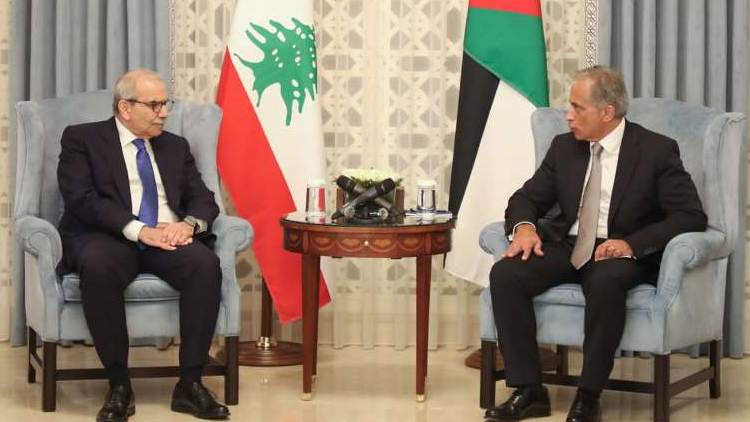
Prime Minister Nawaf Salam alongside his Jordanian counterpart, Jaafar Hassan, during an official visit to Amman on Aug. 19, 2025. (Credit: NNA.)






BEIRUT — Prime Minister Nawaf Salam began his official visit to Jordan on Tuesday, where he met with King Abdullah II. The monarch expressed "his country’s full support for Lebanon to strengthen its security and preserve its sovereignty," according to remarks reported by the Jordanian news agency Petra.
At the meeting, attended by Crown Prince Hussein and Prime Minister Jaafar Hassan, Abdullah II highlighted "the importance of expanding cooperation between Jordan and Lebanon in various fields, especially economic ones." He also called for continued efforts to "maintain coordination with brotherly and friendly countries in order to achieve regional stability.""
Earlier in the day, Salam had held a one-on-one meeting with his Jordanian counterpart Hassan, who told him that "the Israeli occupation of Lebanese territory is condemnable," stressing the need to "fully implement the cease-fire agreement and put an end to ongoing aggressions on Lebanese territory."
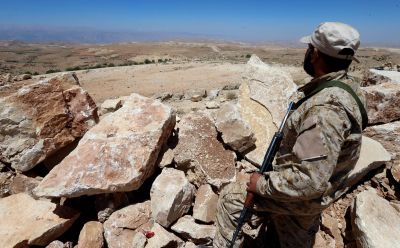
Lebanon is recovering from a devastating war lasting more than 13 months pitting Israel against Hezbollah. Despite the adoption of a fragile cease-fire last November, the Israeli army continues to occupy five positions along the border in southern Lebanon, and conducts almost daily strikes in this region and in the Bekaa.
In its final report on the damages and losses suffered by Lebanon from the outbreak of the war on Oct. 8, 2023, to the truce on Nov. 27, 2024, the World Bank estimates the total bill for damages at $6.8 billion in the areas affected by Israeli bombings, with economic losses reaching $7.2 billion.
"Royal directives always reaffirm Jordan’s position alongside brotherly Lebanon, as well as its support for its sovereignty, security and stability,"Hassan declared.
Salam, praised Amman's role in "supporting Lebanon and showing solidarity at every stage," describing its "positions as historic and strategic." He added that "Jordan’s voice is heard in the world and Lebanon needs this role in this period it is going through."
'The illusion of a Greater Israel'
Salam and the King of Jordan also discussed security instability in the region during their meeting. Abdullah II insisted on "the necessity of an immediate cease-fire in Gaza and the strengthening of humanitarian aid delivery to alleviate the suffering of the population." He also reiterated "Jordan’s categorical rejection of Israeli plans to extend their control in the West Bank and the region.
Regarding Syria, the Jordanian leader said that "the security and stability of this country is a common priority," recalling "Jordan's support for the efforts of Syrian brothers to preserve the stability of their country, its sovereignty and the security of its citizens."
Returning to his discussion with Salam, Hassan said: "We are hearing about visions and proposals aimed at perpetuating endless wars, such as the illusion of a Greater Israel maintained by extremist Israeli politicians. However, the reality is quite different: these policies fuel hatred and resentment, and the peoples of the world and the region will not forgive them for it."
Last week, Prime Minister Benjamin Netanyahu said he was "very attached" to the idea of a "Greater Israel," referring to biblical-era borders that include the West Bank and parts of Jordan, Lebanon, and Syria — territories some ultra-nationalist Israelis hope to control. A Jordanian official dismissed the remarks as "absurd illusions" that would not affect "the legitimate and inalienable rights of the Palestinian people."
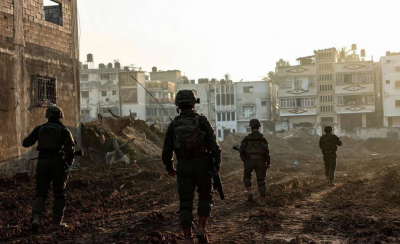
Hassan also said "it is necessary to deploy every effort to end the war in Gaza, the aggressions in the West Bank and the dangerous escalation in the region," while emphasizing that Israel "bears full humanitarian and legal responsibility for the collapse of the humanitarian aid system in Gaza."
He added: "We are facing a tragedy we see every day in Gaza, with famine, killings, and daily massacres. All crossing points must be opened to deliver the necessary aid to save our people and the children of Gaza."
Salam, in turn, stated that "Israel is moving from one isolation to another in the world, in view of what it is doing in Gaza and the West Bank."
The Gaza Strip has been devastated by nearly two years of Israeli attacks, with now 62,000 people killed, according to local health officials who don’t separate civilians from fighters. The conflict has also triggered a hunger crisis, made worse by continued delays in aid deliveries.
'No Going Back on the Disarmament Deadline'
Salam then stated in an interview with Jordan’s al-Mamlaka channel that “it is impossible for his Cabinet to reverse the deadline set for implementing the state’s exclusive control over weapons.”
“The issue of arms exclusivity is not new — we now refer to it as the disarmament of Hezbollah, but it was already part of the 1989 Taif Agreement, which called for extending the Lebanese state’s authority over the entire national territory,” he stressed.
Salam also said he had asked Abdullah II to continue supporting the Lebanese Army as it faces major challenges, particularly in the South, where Israeli forces remain present despite the cease-fire reached in November.

 Evening recap: Netanyahu announces West Bank offensive; 7 killed in Jordan church shooting; tents burned in south Lebanon
 US strike on Iran this weekend? ‘Absolutely,’ says Barrack; ‘I have no idea,’ says Trump