






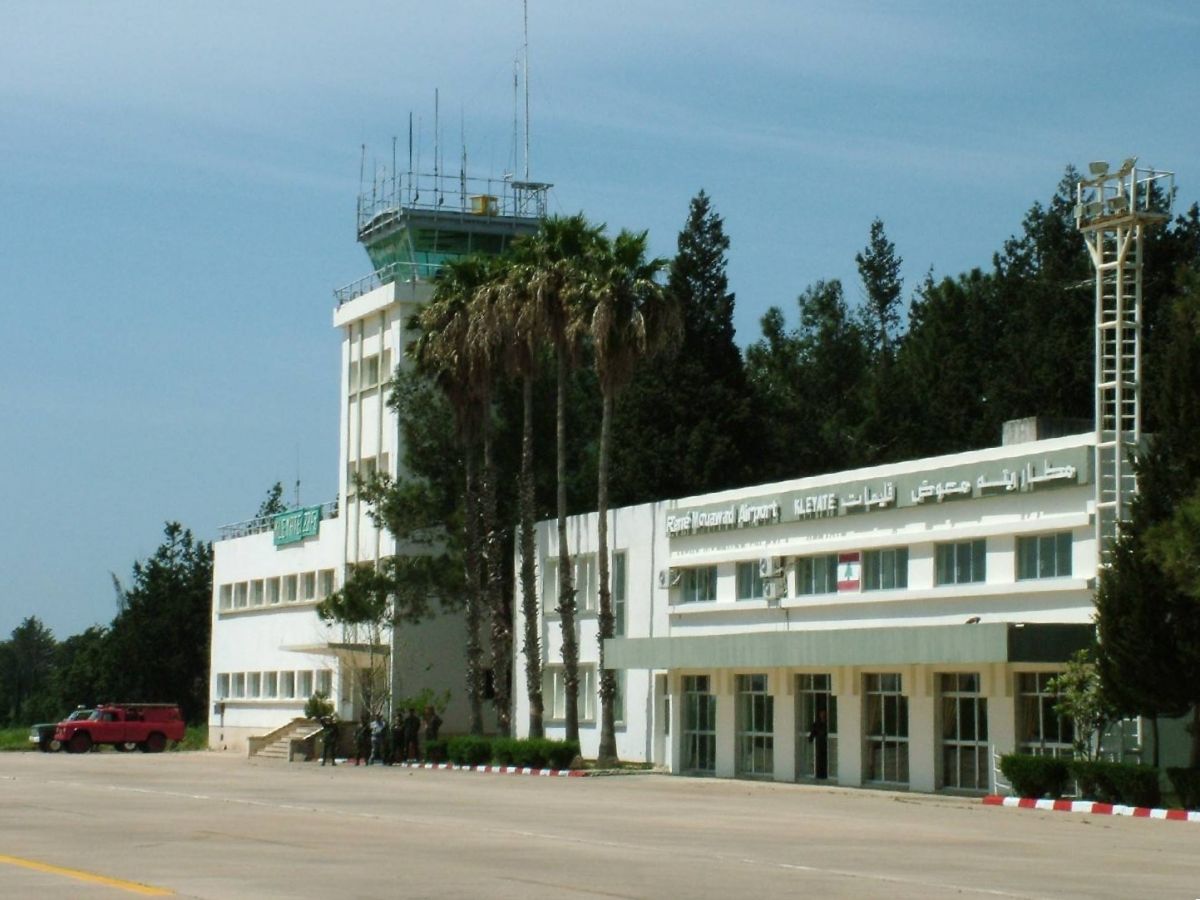
Qleiaat Airport, in North Lebanon. (Credit: Michel Hallak)






NORTH LEBANON — Public Works and Transport Minister, Fayez Rasamny, announced from Tripoli (North Lebanon,) that "the economic feasibility study for Qleiaat airport – in Akkar – has been completed" and that "the project is awaiting executive steps for its reactivation," according to a statement released Tuesday by the state-run National News Agency (NNA.)
The minister made these comments Monday evening on Abdel Wahab Island during a tour with Prime Minister Nawaf Salam and Economy Minister Amer Bisat. The tour included stops at the Rachid Karameh International Fair, the Chamber of Commerce, and the Port of Tripoli.
The minister did not provide details about the study nor specify whether it would be published. He emphasized that "reactivating the Rene Moawad Qleiaat airport is an essential pillar for boosting commercial and tourism activity in the North."

Included in the ministerial declaration, the rehabilitation and reactivation of the Qleiaat airport are considered a priority by Salam’s government. This initiative reflects the executive branch’s intent to equip Lebanon with infrastructure that complements Rafic Hariri International Airport (RHIA) to ease congestion. Designed to accommodate six million passengers, AIB regularly operates over capacity, leading to severe congestion during peak seasons when many Lebanese expatriates return to and leave the country.
The reactivation of this second airport could also help revive economic activity in the north of the country, particularly in Akkar, one of the most rural and poorest regions in Lebanon. Located on the Syrian border and neighboring Tripoli, the country’s second-largest city, this region could thus benefit from a strategic development boost.
Developed by the French army in 1938, the Qleiaat airport was placed under the control of the Lebanese army in 1966, which modernized it into a military base. It was renamed Rene Moawad Airport in 1989, in tribute to the president of the republic who was elected — and then assassinated — on the very site.
In his speech, Rasamny also assured that the government "is committed to accomplishing concrete achievements," revealing that "Tripoli will soon see new projects in preparation that will help propel the city toward a better future." The minister added that Tripoli, which "only needs stability to create job opportunities and restart the wheel of development," possesses "important resources and potential that make it an economic and social model to be exported to other Lebanese regions."
The question of opening a second airport in Lebanon has been debated for many years. Successive wars that led to the bombing of southern Beirut (where the current airport is located) have driven many to call for the opening of a second airport.
Salam chaired a meeting on June 18 at the Grand Serail dedicated to the rehabilitation project for this airport, attended by Rasamny and representatives from the engineering firm Dar al-Handassa, who presented a preliminary master plan that includes a proposal for the passenger terminal, the control tower, as well as a status review of the runways.
Placed on the Cabinet meeting agenda for June 16 and 20, the bill authorizing the development of this airport — according to "BOT" (Build-Operate-Transfer) or "DBOT" (Design-Build-Operate-Transfer) models — had to be suspended.
The Public Works Ministry tried to exempt the project from public-private partnership (PPP) rules, raising concerns among some ministers who saw it as an attempt to bypass the Higher Council for Privatization. The Cabinet then agreed that Law No. 48 of 2017, which regulates PPPs in Lebanon, had to be revised first. This revision was approved on June 27 and sent to Parliament for adoption.
