





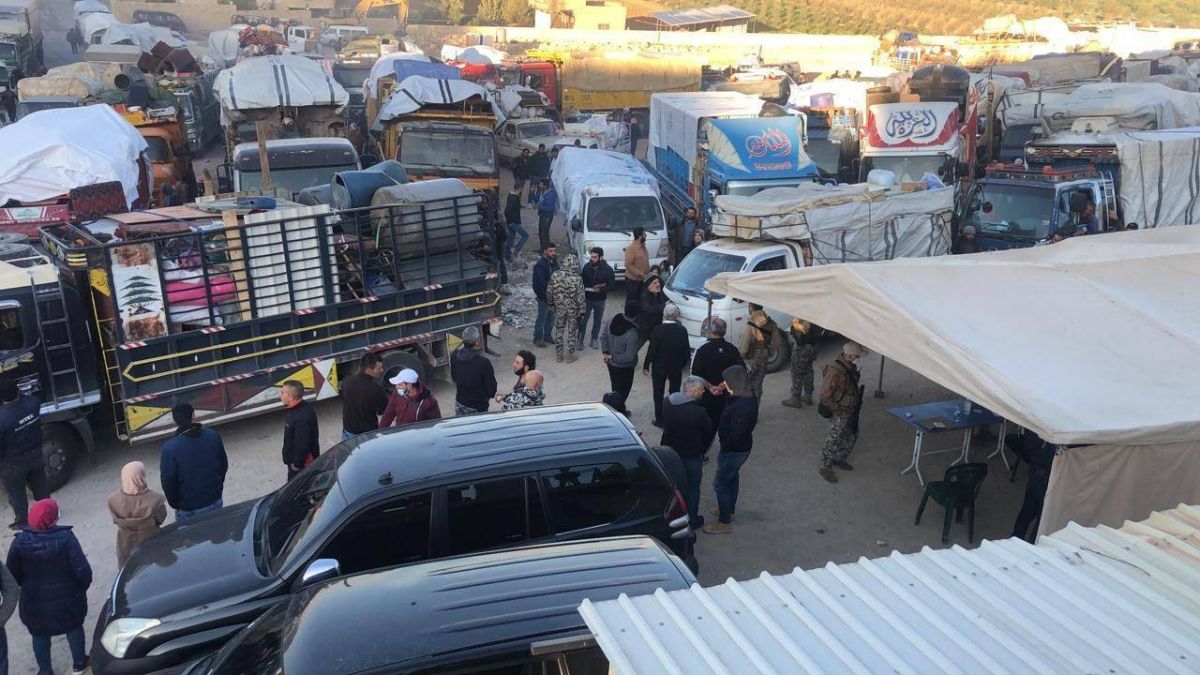
Trucks carrying the luggage of Syrian refugees returning to Syria, Nov. 5, 2022. (Credit: Sarah Abdallah)






BEIRUT — Social Affairs Minister Haneen Sayed said Tuesday that the Lebanese government is currently processing "71,000 additional applications" for the voluntary repatriation of Syrian refugees living in Lebanon, noting that a committee has been formed bringing together representatives from the ministries concerned with this issue.
Pressure on Syrian refugees in Lebanon has greatly increased in recent years, with the country shaken by a war of more than a year with Israel in 2024, and mired since 2019 in a severe economic crisis that has fueled growing hostility toward nationals from the neighboring country. An anti-Syrian wave of violence broke out in the country last year following the murder of a local official of the Lebanese Forces, a Christian party, Pascal Sleiman.
"The government believes that the issue of the presence of Syrians in Lebanon is crucial for the country's future," Sayed said in an interview with the Al-Manar channel. She also stated that 162,000 files of refugees seeking to return have been closed and that Lebanese authorities are currently processing 71,000 additional applications. "The Syrian side is cooperative in this matter," she added.
The first stage of the "voluntary return" program for Syrian migrants and refugees from Lebanon, overseen by the United Nations Refugee Agency (UNHCR) since the fall of Bashar al-Assad's regime, was officially launched on July 29 under the supervision of the Lebanese authorities. In coordination with the International Organization for Migration (IOM), Lebanon's General Security supervised the return of 71 people from 16 different families. The first convoy, made up of three buses, crossed the Lebanese-Syrian border via the Masnaa crossing in eastern Bekaa — currently the only open crossing point for carrying out this "pilot phase" of the program. In total, more than 126,000 Syrian refugees have been removed from the UNHCR's registers since the fall of Assad's regime on Dec. 8, 2024, according to the UNHCR.
Other waves of return, also described as "voluntary" by the Lebanese authorities, have been organized since the start of the year. More than seven months after the regime change in Damascus, Syria still counted at the beginning of June roughly 13.5 million combined refugees and internally displaced people, caused by 14 years of civil war that has left more than 610,000 dead, according to estimates by the Syrian Observatory for Human Rights (SOHR), including 160,000 civilians and 25,000 children. Before the overthrow of Bashar al-Assad by an alliance of predominantly Islamist rebel groups, waves of voluntary returns had already been organized by the Lebanese authorities in dribs and drabs.
Reconstruction in southern lebanon
Regarding reconstruction in the areas affected by the 13-month war between Hezbollah and Israel, Sayed expressed hope that "the government will be able to begin rebuilding." "We are going to launch several reconstruction-related programs," she noted.
Entire villages in southern Lebanon, as well as numerous neighborhoods in Beirut's southern suburbs, were destroyed during the war between the party and Israel. The reconstruction of these areas has still not been officially launched by the Lebanese authorities.

 Evening recap: Netanyahu announces West Bank offensive; 7 killed in Jordan church shooting; tents burned in south Lebanon
 US strike on Iran this weekend? ‘Absolutely,’ says Barrack; ‘I have no idea,’ says Trump