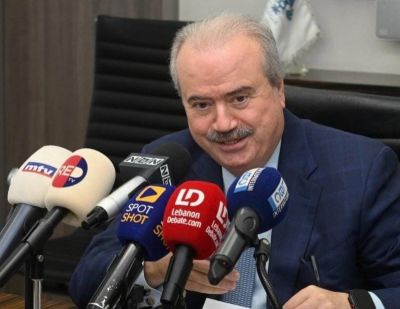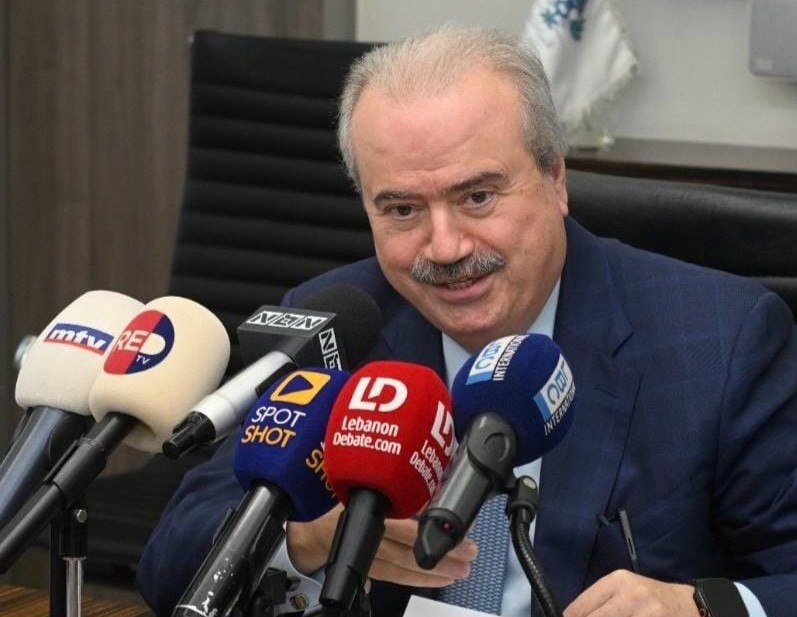
Finance Minister Yassine Jaber at the ministry on July 29, 2025. Photo provided by the ministry.






Finance Minister Yassine Jaber said he has asked several ministries and agencies to provide all “documents and supporting evidence” related to the use of the funds allocated to Lebanon by the International Monetary Fund (IMF) through Special Drawing Rights (SDRs) in recent years.
“The finance minister sent letters to the ministries of Energy, Water, Public Health, Economy and Trade, Public Works and Transport, and Interior and Municipalities — General Directorate of General Security — as well as the Higher Relief Committee, asking them to provide detailed explanations and the necessary supporting documents regarding payments due or transferred to their bank accounts, as well as the settlement of sums funded by SDR proceeds,” according to a statement released Friday evening.
Contacted by L’Orient-Le Jour, the minister explained his approach: “The Audit Court published a report on SDR expenditures, so we need to follow up. As you know, SDRs constitute a loan, not a grant, and all spending must be carried out in accordance with the public accounting law, which was not properly applied, likely due to the circumstances prevailing at the time. We are therefore working to gather all the facts,” he added.
Lack of clarity and transparency
The report the minister referred to was published May 6, 2025, following an initiative launched by opposition MPs Paula Yacoubian, Yassine Yassine, Najat Aoun Saliba and Melhem Khalaf, who questioned how the aid worth $1.139 billion in SDRs allocated to Lebanon in September 2021 had been spent.
In its findings, the court criticized the lack of clarity and transparency in the use of these funds and in the documentation available to track them, highlighting the risk that part of the money had been misused. It recommended the creation of a clear and legal mechanism for the accounting management of SDRs to optimize their use in the future.
SDRs — allocated according to each country’s IMF quota — are a financial instrument distinct from any conditional aid offered through an IMF program. Allocations are typically made every five years by the IMF Board of Governors. SDRs can be converted into currency via another IMF member or a dedicated mechanism, and they generate SDRI interest until they are reconstituted, making them a form of loan rather than a grant. To stop interest payments, a country must repurchase SDRs on the market — using its own currency — to return its holdings to the original level.
Released just as Prime Minister Najib Mikati’s Cabinet took office, Lebanon’s SDR allocation was spent in less than two years amid a deepening economic and financial crisis. In October 2023, caretaker Finance Minister Youssef Khalil and Banque du Liban (BDL) told the Finance Committee that only $76 million remained from the initial amount.
According to figures disclosed at the time, 45 percent of the total was spent on medicine subsidies ($478.3 million); 15.4 percent went to repaying loans, notably to the World Bank ($163.5 million); 15.3 percent funded transfers to Électricité du Liban (EDL) for fuel and maintenance ($162.2 million); 12.6 percent was spent on wheat subsidies ($134.2 million), which were still in effect; and 6.5 percent covered subsidies on gasoline and diesel ($69.4 million), which were fully lifted in September 2022.
While Jaber said his request for clarification is solely based on the Audit Court’s findings, it may also serve to reassure the IMF of the government’s commitment to reform — especially following Parliament’s adoption of the banking resolution law and the law on judicial independence, and just two months ahead of a key IMF meeting during the annual joint sessions with the World Bank in Washington in October.
Insurance expenses for Télé Liban employees
In his statement Friday, Minister Jaber said, “The adoption of the banking resolution law is a clear and explicit message to all observers, both inside and outside the country, and to all those committed to the rebirth of Lebanon and its economy.” He thanked Parliament — and Speaker Nabih Berri, head of the Amal Movement to which Jaber belongs — for passing the legislation.
He added that the government would accelerate efforts to finalize another critical bill, one that will address the distribution of tens of billions of dollars in banking losses and resolve the issue of returning deposits.
Jaber also announced he had approved the release of funds from the 2025 budget reserves to cover insurance expenses for employees of the state-run broadcaster Télé Liban and confirmed he is following preparations for the 2026 budget plan.