






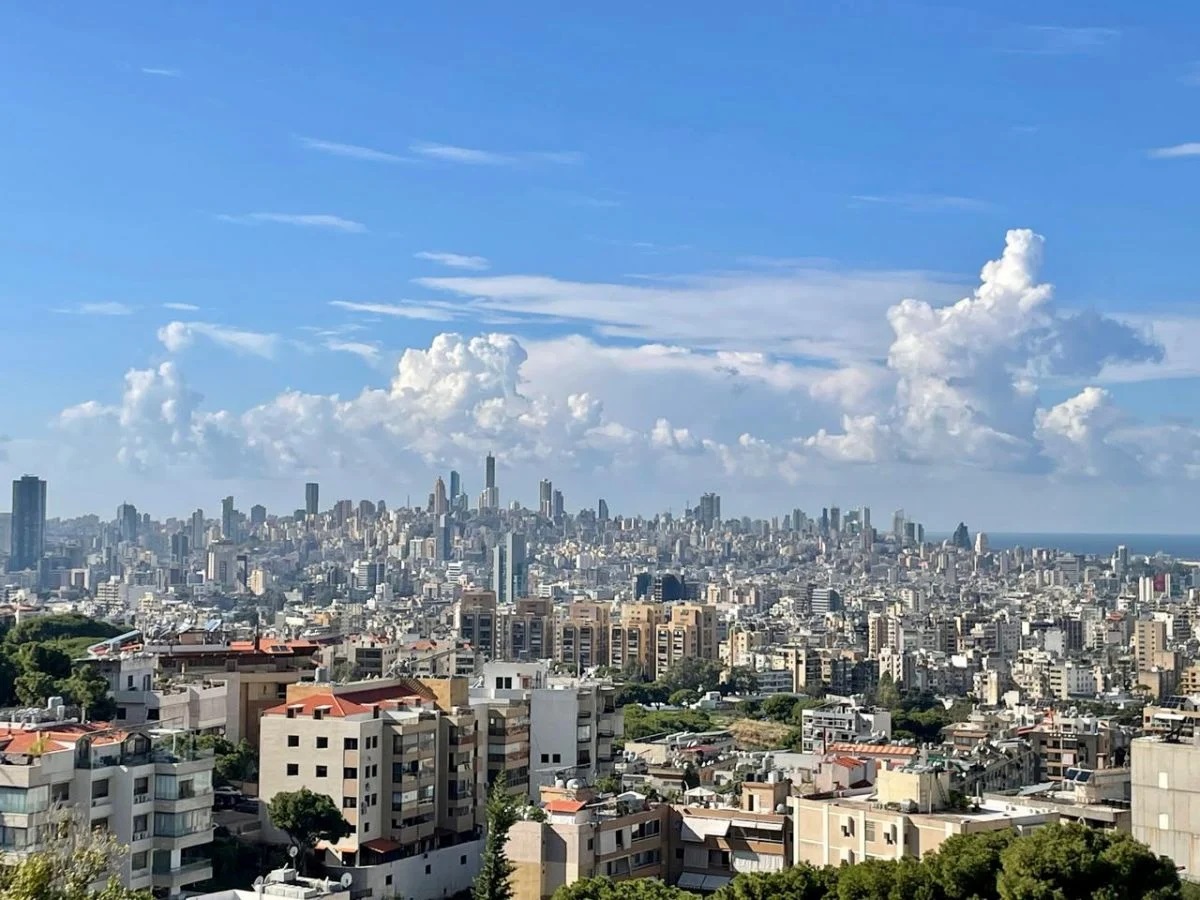
Overview of Beirut. Photo taken on Nov. 20, 2024. (Credit: Philippe Hage Boutros/L’Orient-Le Jour)






"The first half of 2025 marked a clear reversal of the trend" in Lebanon, says Bank Audi in its latest quarterly economic report. This is "driven by a political breakthrough at the national level following a promising presidential election, the formation of a qualified cabinet, key administrative appointments and some reform initiatives," it continues.
According to Bank Audi, this turnaround is evident thanks to several economic indicators, notably the increase in eurobond prices to nearly 18 cents on the dollar, compared to less than 6 cents on the dollar last September.
This shows that "institutional investors are betting that the political breakthrough would lead to the long-awaited economic reforms and a debt restructuring," the authors of the report mention.
Another report form yesterday
Financial inclusion: Lebanon remains among worst countries financially
Balance of payments surplus
Next, Bank Audi highlights a 16 percent year-over-year increase in imports during the first five months of the year, while exports increased by 21 percent over the same period. "Taking into account 6.7 percent imported inflation from the countries of origin, the real increase in imports is estimated at 9.3 percent, reflecting an increase in real demand for consumer and investment goods in Lebanon, which supports our forecast of real GDP growth of 5 percent for 2025," the report adds.
At the same time, the bank notes the $1.9 billion surplus recorded over the first five months of the year in the balance of payments. Although the balance of payments shows "a nominal surplus of $8.1 billion, about $6.3 billion of that is linked to the rise in gold prices," resulting in "a real surplus of $1.9 billion for the period," it details.
As for the domestic level, Bank Audi mentions the stability of the Lebanese pound, mainly supported by "a near-balance in public finances and the balance of payments," while the absence of a public deficit in the past two years equates to no monetary creation in Lebanese pounds.

"That being said, although the pound has recently maintained its stability ... it has, however, not regained its fundamental economic functions [means of exchange, unit of account, store of value, standard of deferred payment], which indicates that it remains an almost inactive currency," the authors of the report qualify. "The monetary challenge of the new era would be for the Lebanese pound to regain its four fundamental functions lost during the crisis gradually," they add.
Optimism, challenges
Still, in terms of levers for monetary stability, the authors note that Banque du Liban's (BDL) foreign currency reserves increased by $1.191 billion in six months, from $10.135 billion at the end of December 2024 to $11.326 billion at the end of June 2025.
At the same time, the bank notes that BDL's gold reserves were valued at $30.277 billion as of the end of June 2025, compared to $24.102 billion at the end of December 2024. This increase is solely due to the global rise in gold prices. In this context, the authors of the report point out "that Lebanon currently has the highest ratio of gold reserves to GDP in the world, close to 100% percent, compared to a global average of about 4 percent."
Regarding the banking sector, the latest figures show that fresh deposits in foreign currency in Lebanese banks, as opposed to those that have been blocked since the start of the crisis, have risen from approximately $3.2 billion at the beginning of the year to more than $4 billion today.
Finally, despite this renewed optimism, Bank Audi maintains that Lebanon still faces numerous challenges, the most pressing of which are centered on three key areas.
First, it is the need to restore confidence that requires upholding the cease-fire, restoring the sovereign role of the state and the army with a total monopoly over arms in the country, and working toward the establishment of a just and lasting peace.
The second would be implementing banking restructuring and the mechanism for distributing financial losses.
Third is concluding a final agreement with the International Monetary Fund (IMF), as "Lebanon is urgently in need of international assistance, which could be provided directly and indirectly by an IMF program," the report concludes.
This article was translated from L'Orient-Le Jour.


 8 p.m. recap: Israel again threatens Beirut’s south suburbs; 2 ships hit near Hormuz; Riyadh football matches canceled