


Surrounded by loved ones, including her daughter Rima, Fairuz leaves the church and gets back into the black car she arrived in.
“I had been by Ziad’s side for several months. I couldn’t convince him to move forward (...) Ziad represents my entire generation. He was always one step ahead,” Culture Minister Ghassan Salameh told L’Orient Today.
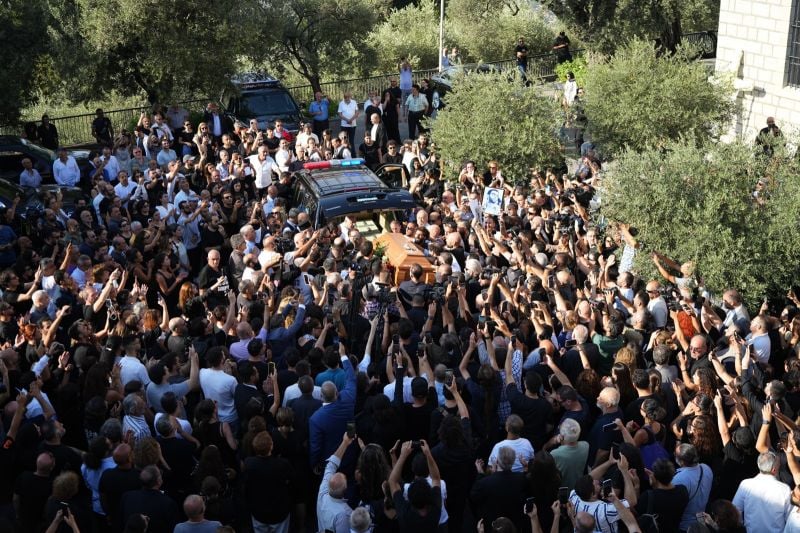
Ziad Rahbani’s coffin as it leaves the church. (Credit: Mohammad Yassine/L’Orient Today.)
Ziad Rahbani’s coffin arrives in Zeghrine, where he is to be buried on family-owned land.
“Ziad is part of our political conscience. He was a genius, and we grew up with his work. We hope his ideas for the country will one day be realized, and that we will finally have a real nation,” says MP Firas Hamdan to L’Orient Today.
Ziad Rahbani’s coffin is carried out of the church on the shoulders of mourners, as the crowd applauds. Church bells ring out in a final farewell.
Prime Minister Nawaf Salam awarded the Order of the Cedar medal, at the rank of Commander, on behalf of President Joseph Aoun. “It is an honor to present it today to his family,” he said.
“Ziad Rahbani, a brilliant creator, you were the honest voice of our generation, committed to human and national causes,” the Prime Minister added. “You dared to say what many of us did not dare to express. You will forever remain the voice of beauty, resistance, justice, and truth.”
Hezbollah MP Ibrahim Moussaoui, speaking to L’Orient-Le Jour in Bickfaya during the memorial mass, paid tribute to Ziad Rahbani, saying he always spoke “on behalf of the poor, the underprivileged, and the weak.”
“We were always on the same wavelength with him on every issue,” Moussaoui said. “We must preserve his message. He was deeply human, close to the Palestinian resistance, and stood against any country in the world that exploits others or tries to impose its will.”
He added that Rahbani’s “resistance roots” even predated the birth of Hezbollah’s own resistance movement.
The mass was officiated by the Greek Orthodox Metropolitan of Mount Lebanon, Selwan Moussi. The church was packed, with dozens of people watching from outside.
Ziad Rahbani's funeral mass began. Fairuz sat in the front row, near her son's coffin, and next to her daughter Rima.
A few minutes before the funeral Mass began, the crowd gathered in the courtyard of the church. Funeral orations were broadcast over the loudspeakers.
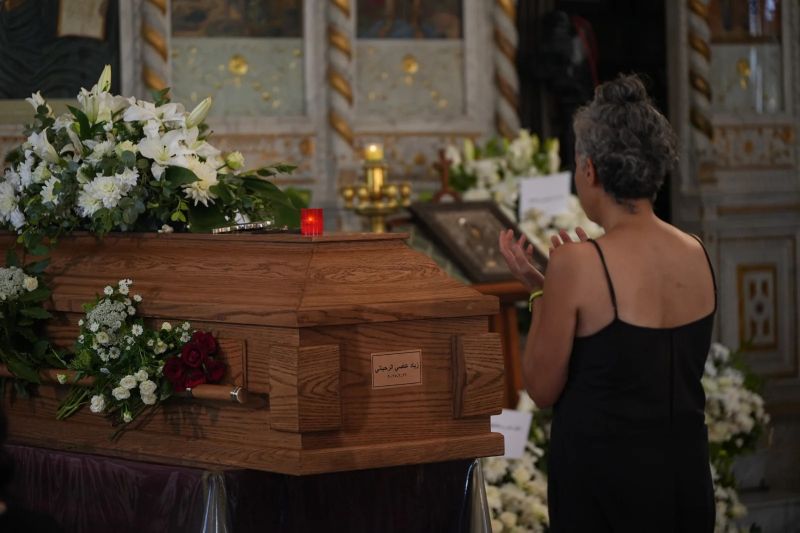
A woman pays her respects before Ziad Rahbani's coffin. (Credit: Mohammad Yassin)
Prime Minister Nawaf Salam and his wife came to offer their condolences to the Rahbani and Fairuz families.
Shortly before their arrival, the singer Majida al-Roumi arrived at the church.
Zahi Wehbeh, journalist, told L'Orient Today, "Ziad Rahbani is the cry from the heart that awakens consciences, the voice of the conscience of the nation, the people, and humanity. And it is a cry of alarm to awaken our collective and individual conscience, so that we can clearly understand our national and Arab reality, and the situation of humanity in general."
While the funeral mass was scheduled to begin at 4 p.m., dozens of people already took their places in the church.
Artist Lady Madonna told L'Orient Today, "I grew up with the Rahbanis. Today I lost Ziad, who was avant-garde. He carried the pain of all of us."
Internationally renowned fashion designer Elie Saab visited Bikfaya and stayed with Fairuz, as did Culture Minister Ghassan Salameh.
Also seen in the crowd were poet Nizar Francis, actress Julia Kassar, her colleague Georges Shalhoub and director Lina Abiad.
Other figures who came to pay their respects to the late artist and stand with his family included the president of the Beiteddine festival, where Ziad Rahbani and Fairuz performed, Nora Joumblatt, Solange Gemayel, the wife of assassinated former president Bashir Gemayel, and former president Michel Sleiman. Other artists, including actors Tarek Tamim, Mohammad Dayekh, and Hussein Qaouq, as well as actress Rita Hayek, were also present.
Elham Rahbani, Ziad's aunt and sister of Elias, Mansour and Assi, joined her relatives in the church.
Many figures from the artistic world are present at Bikfaya to pay their respects to Ziad Rahbani. These include musician Sharbel Rouhana, poet Talal Haidar, weakened by illness, singer Mohammad Iskandar, and renowned composer and oud player Marcel Khalifeh.
Meanwhile, the wife of Parliamentary Speaker Nabih Berri, Randa, was in the church lounge.
Journalist Dima Sadek was also seen there.
In the church hall, Fairuz remained silent as people crowded to offer their condolences and catch a glimpse of the singer beneath her black lace mantilla. From time to time, she discreetly wiped a tear behind her large black glasses.
Alongside Fairuz, in the hall of the Church of the Dormition, where hundreds of people gathered to offer their condolences, were her sister Huda, her daughter Rima, and several of Ziad Rahbani's cousins, including the musicians Oussama, Ghassan and Jad Rahbani.
Find Malek Jadah's insight into the Rahbani family here.
Fairuz entered the church hall to receive condolences. She was still accompanied by MP Elias Bou Saab, whose wife, singer Julia Boutros, was also present at Bikfaya.
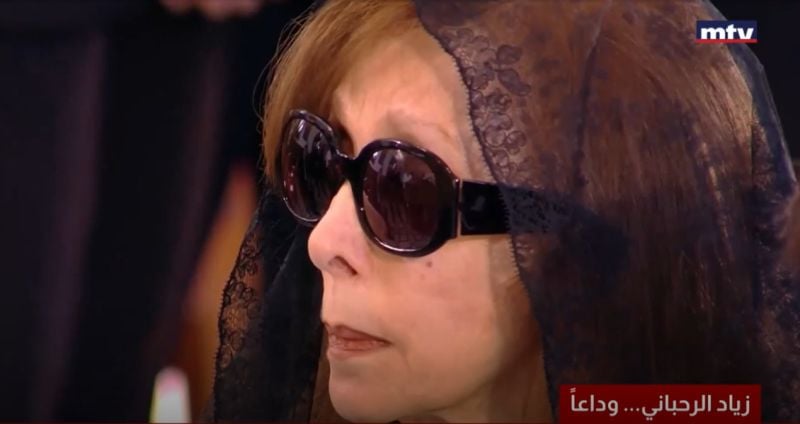
(MTV screenshot)
Sitting in the church with her daughter, Fairuz mourned her son's coffin. As she entered the church, "Ana al-Oum al-Hazina" (I am the grieving mother) was played, a religious hymn usually sung at Easter.
Fairuz got out of the car, her head covered in a black veil, to the applause of the crowd present at the church and wearing dark glasses. She was accompanied by her daughter Rima and MP Elias Bou Saab. She was greeted as she entered the church by the First Lady.
Fairuz arrived at the Church of the Dormition in Bikfaya to bid farewell to her son Ziad Rahbani, according to media reports. According to the reports, the church will be emptied to allow her to pay her respects alone near the coffin.
The crowd began to arrive at the hall of the Church of the Dormition in Mheidetheh-Bikfaya, where the family will receive condolences before and after the funeral mass, scheduled for 4 p.m.
Already present at the scene are his cousins Osama and Jad Rahbani, and his former partner, actress Carmen Lebbos. Also present among those who have come to offer their condolences are First Lady Neemat Aoun, the Greek Orthodox Metropolitan of Beirut, Elias Audi, the CEO of MTV, Interior Minister Ahmad Hajjar, and a dozen members of parliament so far.
As the funeral procession accompanying Ziad Rahbani's remains is on its way to Antelias, then Bickfaya, we invite you to listen to "Bala Wala Shi" (Without anything at all), a piece released in 1985 on the album "Houdou Nisbi " (Relative Calm), which mixes jazz, funk and boogie.
In a message on X, the Internal Security Forces paid tribute to the deceased:
“Ziad … you have left behind a legacy of creative genius and a bright artistic flame that will never be extinguished,” they wrote, alongside a photo of Ziad Rahbani surrounded by his parents.
Good morning. Thank you for joining us for today's live coverage. Be sure to read the Morning Brief so you are caught up with what has been happening.
Ziad Rahbani, the son of Fairouz, the iconic Lebanese singer of international renown, and Assi Rahbani, died Saturday morning at Khoury Hospital in Hamra. While he died of a heart attack, he had suffered from long-term health problems and had recently refused treatment.
At 8 a.m., in front of Khoury Hospital in Hamra, around 200 people were waiting for the body to be released, singing some of his songs, according to L'Orient Today's reporter at the scene.
"He was a communist, but now we're going to give him a religious burial. The Church was the strongest," said one man on the scene.
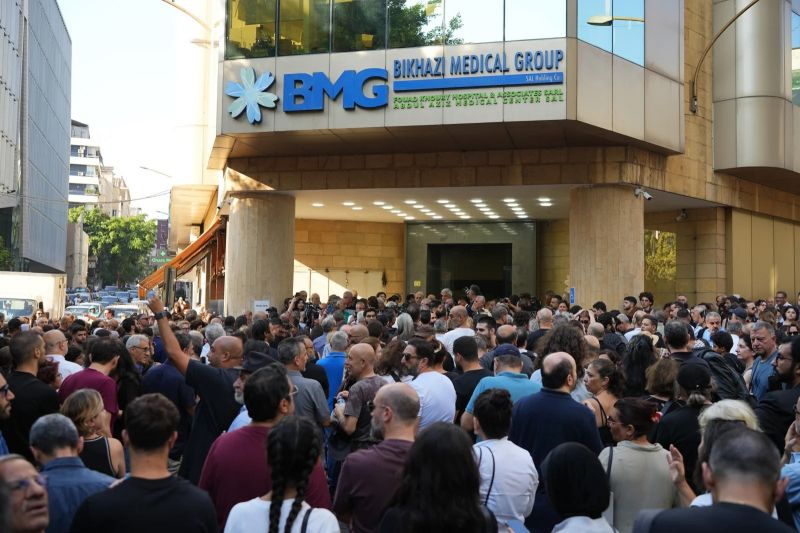
(Credit: Mohammad Yassin/L'Orient Today)
In front of Khoury Hospital, among the crowd, people were in tears and others were holding flowers.
In Hamra, Roukaya, a veiled young woman in her 20s, was in tears: "I grew up in a very different environment from Ziad's. He was a bridge between my environment and others. Thanks to him, I understood the world," she told L'Orient Today.
Still outside the hospital, Ramzi, deeply moved, had tears in his eyes. "We didn't deserve him. He helped me move forward in life," he said. Not far from him, a woman sobbed.
Shawki Fares said that "Ziad taught us how to live and speak. We often use phrases from his plays in everyday life."
Following the death of Zaid Rahbani, L'Orient Today went to Abu Elie, a left-wing Communist bar in Beirut, where people were memorializing the famed singer.
Read what they had to say here.
For Mohammad, who works in the arts community and stated he collaborated twice with Rahbani, "Ziad was a role model for us who grew up in the 1990s. He brought everyone together, despite the war and conflict."
(Credit: Mohammad Yassin/L'Orient Today)
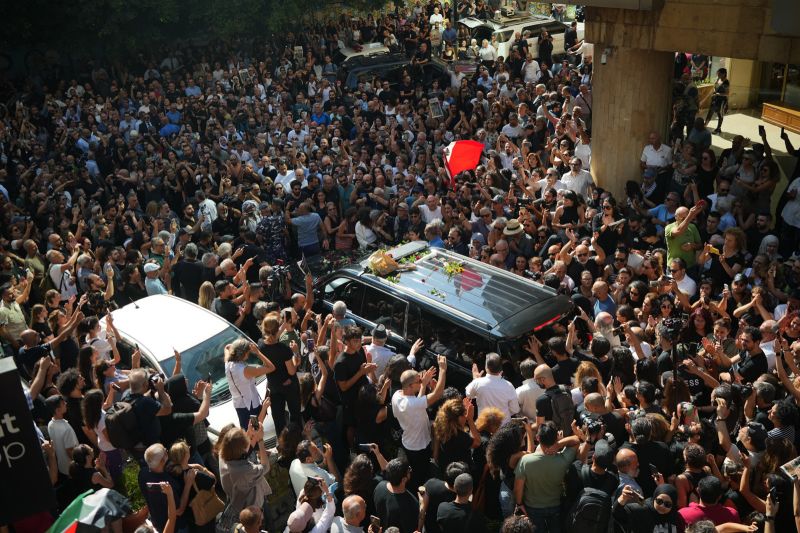
Amid applause and cheers from those present, a hearse left the emergency room of Khoury Hospital, carrying Ziad Rahbani's coffin.
After leaving the hospital, the sedan carrying Ziad Rahbani's coffin drove through Hamra, the neighborhood where the artist lived most of his life, to the sound of his songs.
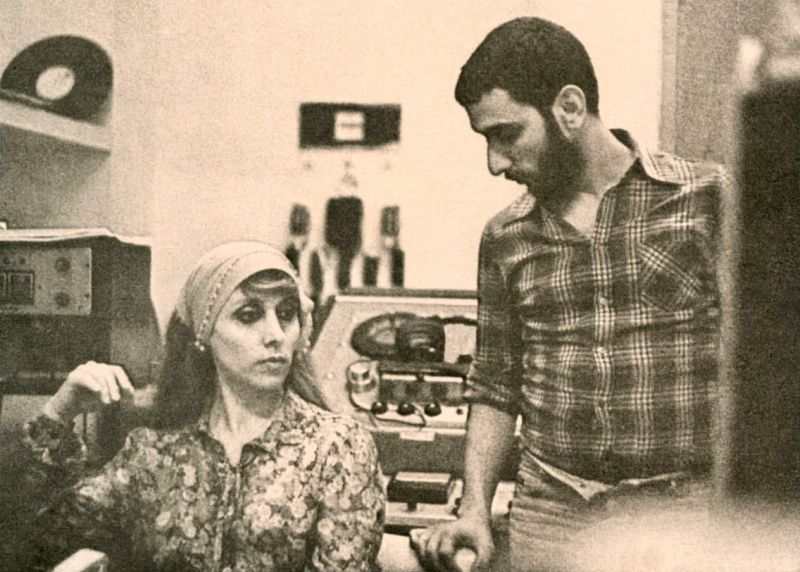
"Their relationship was conflictual against a backdrop of absolute love": relive the relationship between Ziad Rahbani and Fairuz, made of storms and forgiveness here.
Already have an account? Login here
You have reached your article limit
Add L'Orient Today to your syllabus.
Subscribe for $0.5/month for 3 months.
This article is only available to L’Orient Today subscribers.
Already have an account? Login here