





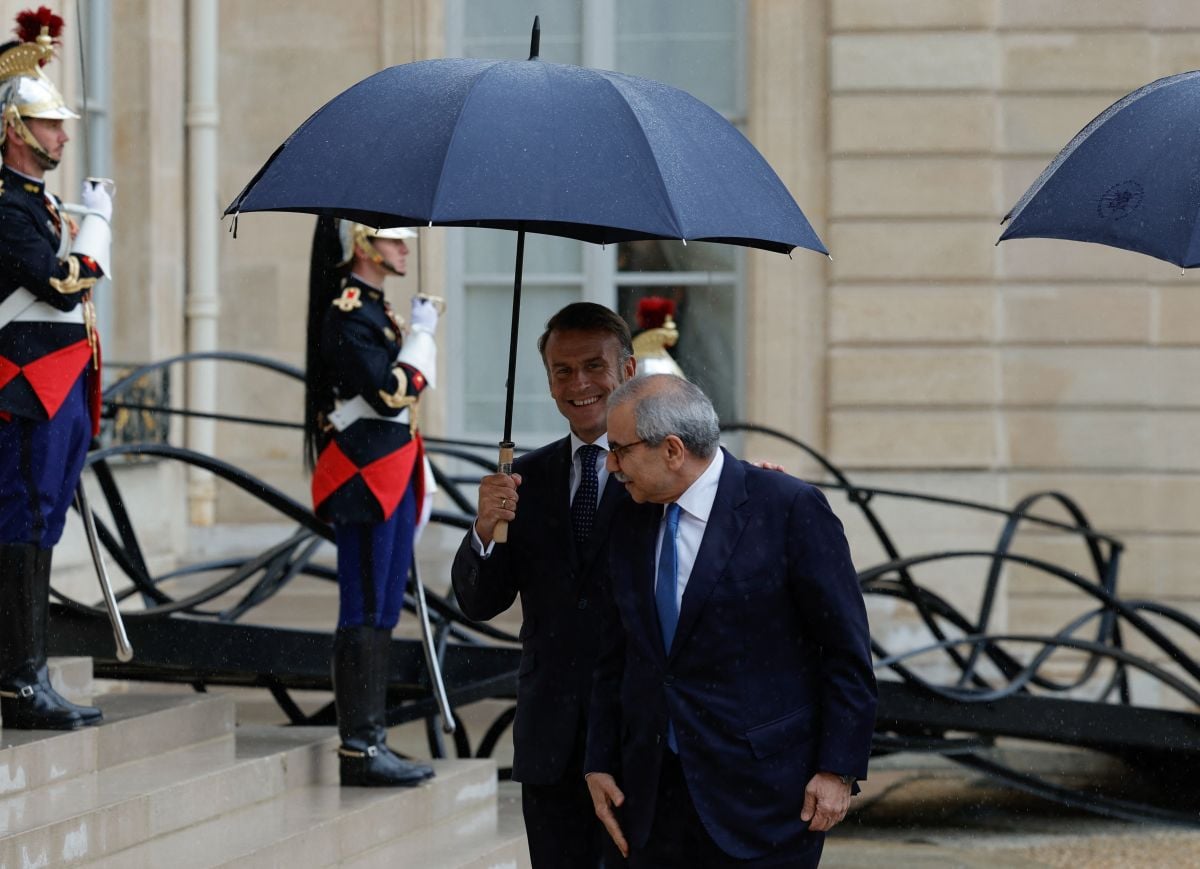
French President Emmanuel Macron (center) welcoming Lebanese Prime Minister Nawaf Salam (right) before their working lunch at the Élysée Palace in Paris, on July 24, 2025. (Credit: Geoffroy Van Der Hasselt/AFP)






French President Emmanuel Macron hosted Lebanese Prime Minister Nawaf Salam on Thursday at the Élysée Palace, marking Salam’s first official visit to France since taking office.
In a post on X, Salam thanked France for its “constant support for Lebanon — its security, sovereignty and prosperity.” He added that he was returning to Beirut “reassured by President Macron’s commitment to help Lebanon, to renew the mandate of the United Nations Interim Force in Lebanon (UNIFIL), and to strengthen bilateral relations, especially in the areas of security, economy, education and culture.”
Before departing Paris, Salam held a meeting with French-based correspondents from Lebanese and Arab media outlets, during which he announced plans for a Franco-Lebanese preparatory conference ahead of broader international aid efforts for Lebanon, according to L’Orient-Le Jour’s Paris correspondent. An international aid conference for Lebanon was organized in Paris in October 2024 during the Hezbollah-Israel war.
According to sources familiar with the visit, Macron reaffirmed France’s support for the Lebanese government and underscored the need to implement reforms to unlock international assistance and support reconstruction efforts. France also reiterated its backing for a cease-fire in southern Lebanon and the renewal of UNIFIL’s mandate, which is up for discussion at the U.N. Security Council.
The French position comes as the United States and Israel increase pressure on Lebanon to bring all weapons under state control. Paris, while maintaining diplomatic channels with all parties, has committed to organizing an international conference to support reconstruction — but only if Lebanon undertakes a series of urgent reforms.
Joint Franco-Saudi position on Lebanon
On the sidelines of the meeting, the foreign ministries of France and Saudi Arabia released a joint statement addressing regional developments. Regarding Lebanon, the statement emphasized “the importance of respecting the cease-fire” brokered in late November between Israel and Hezbollah — a deal that has been increasingly undermined by violations, mostly attributed to Israel.
The statement also reaffirmed support for the Lebanese authorities’ efforts to implement urgent reforms and strengthen state sovereignty, which includes the disarmament of non-state actors such as Hezbollah. The issue remains a focal point of U.S. envoy Tom Barrack’s mission, following his recent visit to Beirut.
According to a statement issued earlier by the Élysée, Macron’s meeting with Salam focused on “security, the country’s stability and the pursuit of essential economic reforms to fully restore Lebanon’s sovereignty and prosperity.” Strengthening the Lebanese Army was also on the agenda, along with broader regional concerns, including the wars in Gaza and Iran and recent clashes in Syria.
In the news
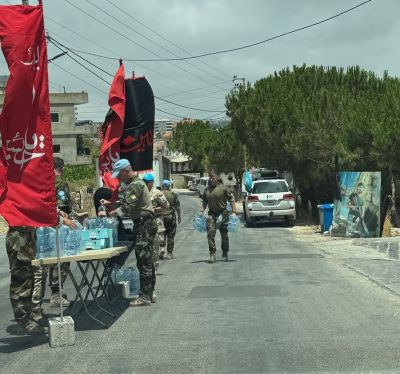
UNIFIL distributes food in 'solidarity with southern Lebanese communities' during Ashura
Salam updates Macron on reforms
In an interview published Wednesday in the Beirut daily an-Nahar, Salam said discussions with U.S. envoy Barrack were ongoing and that he planned to brief Macron on progress made in financial and structural reforms, in coordination with Parliament.
The prime minister also underscored France’s position on the Palestinian cause during his meeting with Macron, commending Franco-Saudi efforts to organize a summit in New York on the issue. “The tragedy in Gaza continues. We cannot go on like this,” Salam said. “It is imperative to mobilize Arab and international efforts to put an end to the massacres committed against the Palestinians.”
The effects of a recent episode of intercommunal violence in the predominantly Druze province of Sweida in southern Syria were also discussed in Macron and Salam's meeting. Relations between Beirut and Damascus, with an emphasis on ongoing efforts to encourage the return of Syrian refugees to their country, were also addressed.
Meanwhile, Israeli Minister for Strategic Affairs Ron Dermer was also in Paris on Thursday to meet French officials and discuss, among other topics, the Iranian issue, according to four sources cited by Reuters.
American envoy Tom Barrack concluded his visit to Beirut on Wednesday by calling on Lebanese authorities to fully assume their responsibilities on the Hezbollah disarmament issue. Since the cease-fire, which went into effect last Nov. 27, the Israeli army has carried out almost daily strikes against Lebanon, mainly in the South and the Bekaa. These attacks have so far killed over 270 people.

 Evening recap: Netanyahu announces West Bank offensive; 7 killed in Jordan church shooting; tents burned in south Lebanon
 US strike on Iran this weekend? ‘Absolutely,’ says Barrack; ‘I have no idea,’ says Trump